
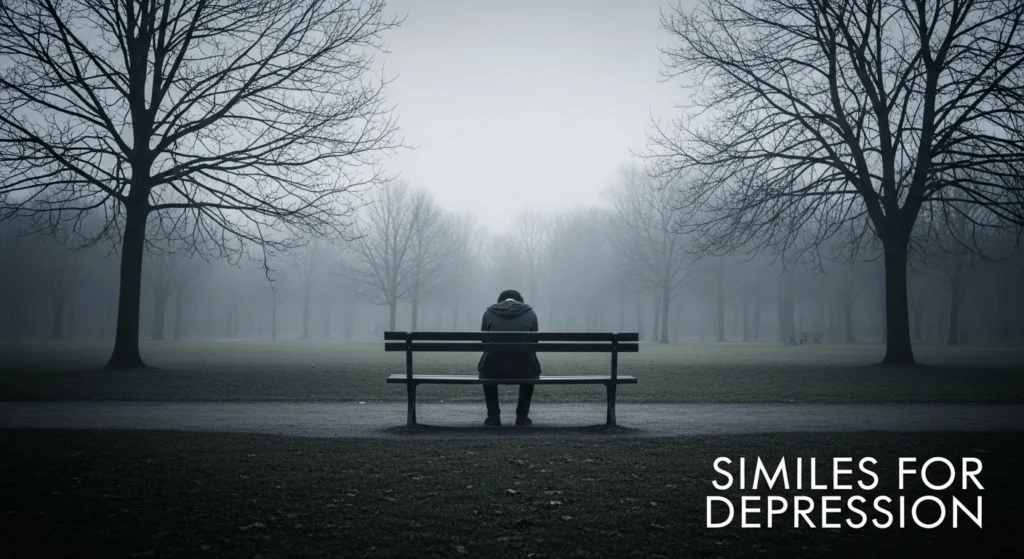
Depression can be hard to explain, even to ourselves. That’s where similes come in—simple comparisons that help us describe complex emotions in clear, vivid ways. In figurative language, similes connect feelings to familiar images from life and nature, making emotions easier to understand and share.
Writers have long used nature similes—especially trees—to express strength, growth, resilience, wisdom, and the full range of human emotion. Like people, trees weather storms, endure long winters, and keep growing despite hardship.
In this article, you’ll find thoughtful similes for depression that offer clarity without exaggeration, empathy without clichés, and imagery that feels real. Whether you’re writing poetry, journaling, essays, or lyrics, these comparisons can help you say what feels unsayable.
What Is a Simile?
A simile is a figure of speech that compares two different things using “like” or “as” to highlight a shared quality.
Example: Depression settled in like a fog that refused to lift.
1. Depression like a fog that never fully lifts
Meaning: A constant heaviness that blurs clarity and motivation.
Usage insight: Works well for reflective prose and personal essays.
Examples:
- All week, my thoughts moved slowly, like a fog that never fully lifts.
- Hope felt distant, hidden like a fog that never fully lifts.
2. Depression like a tree stripped bare in winter
Meaning: Loss of energy and color, yet life remains beneath the surface.
Usage insight: Ideal for gentle, hopeful tones.
Examples:
- I felt like a tree stripped bare in winter, waiting for warmth.
- Even then, roots held on, like a tree stripped bare in winter.
3. Depression like carrying a soaked coat
Meaning: An invisible weight that follows you everywhere.
Usage insight: Great for everyday, relatable writing.
Examples:
- I moved through days like carrying a soaked coat.
- Smiles came, but the weight stayed, like a soaked coat.
4. Depression like a dimmer switch turned down
Meaning: Joy and interest reduced, not gone.
Usage insight: Useful for clinical or academic explanations.
Examples:
- Life felt muted, like a dimmer switch turned down.
- Colors faded like a dimmer switch turned down.
5. Depression like roots tangled underground
Meaning: Deep, hidden causes affecting growth.
Usage insight: Strong for analytical or therapeutic writing.
Examples:
- My sadness spread like roots tangled underground.
- Change came slowly, loosening tangled roots underground.
6. Depression like walking through deep sand
Meaning: Effortful movement and exhaustion.
Usage insight: Effective in narratives showing struggle.
Examples:
- Each task felt like walking through deep sand.
- Progress slowed like deep sand underfoot.
7. Depression like a gray filter over the world
Meaning: Emotional numbness dulling perception.
Usage insight: Works well in descriptive scenes.
Examples:
- The city passed like a gray filter over the world.
- Laughter sounded distant through a gray filter.
8. Depression like a clock ticking too loud
Meaning: Persistent awareness of time and pressure.
Usage insight: Good for anxiety-adjacent depression.
Examples:
- Nights echoed like a clock ticking too loud.
- Silence pressed in with a loud ticking clock.
9. Depression like branches weighed down by snow
Meaning: Burden without breaking.
Usage insight: Gentle, resilient imagery.
Examples:
- I bent, like branches weighed down by snow.
- Still standing, branches heavy with snow.
10. Depression like a closed window on a warm day
Meaning: Separation from comfort and connection.
Usage insight: Clear and emotionally accessible.
Examples:
- Relief felt close, like a closed window on a warm day.
- Air waited outside that closed window.
11. Depression like an echo in an empty room
Meaning: Loneliness and self-reinforcing thoughts.
Usage insight: Effective in poetry.
Examples:
- Thoughts returned like an echo in an empty room.
- Words bounced back in an empty room.
12. Depression like a stalled season
Meaning: Feeling stuck while time moves on.
Usage insight: Great for long-form essays.
Examples:
- Life paused like a stalled season.
- Change waited for a season to turn.
13. Depression like a low tide that won’t rise
Meaning: Emotional depletion.
Usage insight: Strong coastal imagery.
Examples:
- Energy stayed out like a low tide that won’t rise.
- Hope watched the shore waiting for tide.
14. Depression like a whisper that grows louder
Meaning: Subtle onset that intensifies.
Usage insight: Useful for progression narratives.
Examples:
- It began like a whisper that grew louder.
- By nightfall, the whisper filled the room.
15. Depression like reading with the lights off
Meaning: Difficulty understanding or engaging.
Usage insight: Clear metaphor for students/readers.
Examples:
- Days felt like reading with the lights off.
- Meaning blurred without the lights.
16. Depression like rain that soaks slowly
Meaning: Gradual, pervasive sadness.
Usage insight: Natural and lyrical.
Examples:
- It came like rain that soaks slowly.
- By morning, everything was wet.
17. Depression like a locked gate on a familiar path
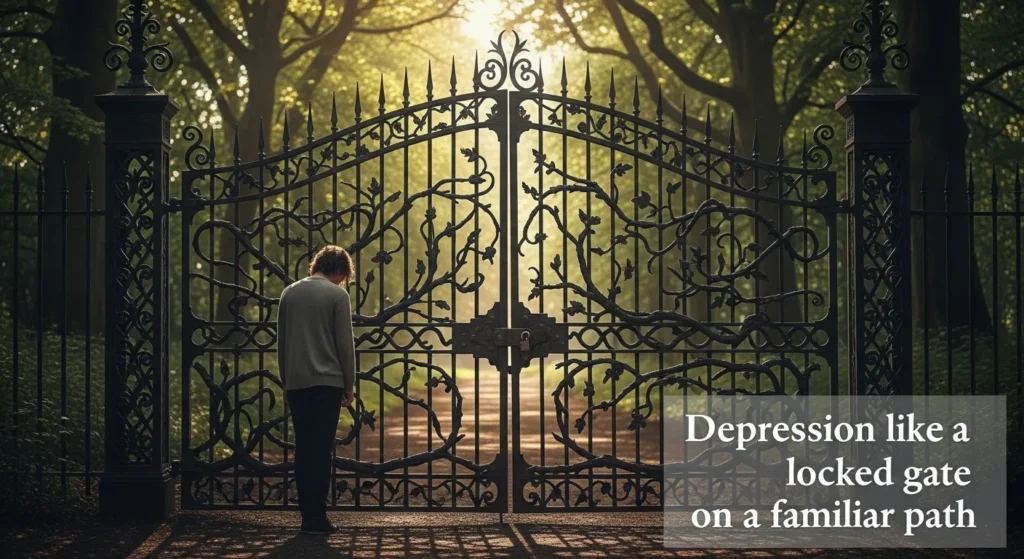
Meaning: Blocked access to former joys.
Usage insight: Narrative-friendly.
Examples:
- Old hobbies sat behind a locked gate.
- I knew the path, not the key.
18. Depression like leaves losing color
Meaning: Fading vitality.
Usage insight: Subtle and visual.
Examples:
- Motivation thinned like leaves losing color.
- Autumn arrived early inside me.
19. Depression like a song stuck on one note
Meaning: Emotional monotony.
Usage insight: Musical writing and lyrics.
Examples:
- Days played like a song stuck on one note.
- No chorus came.
20. Depression like a heavy sky before rain
Meaning: Anticipatory heaviness.
Usage insight: Builds tension.
Examples:
- The air pressed like a heavy sky before rain.
- Release felt close, not here.
21. Depression like walking past mirrors
Meaning: Self-scrutiny and discomfort.
Usage insight: Psychological depth.
Examples:
- I avoided myself like walking past mirrors.
- Every glance felt sharp.
22. Depression like a seed waiting underground
Meaning: Hidden potential despite darkness.
Usage insight: Hopeful reframing.
Examples:
- I rested like a seed waiting underground.
- Growth doesn’t rush.
23. Depression like a long shadow at noon
Meaning: Darkness where it shouldn’t be.
Usage insight: Striking contrast.
Examples:
- Joy stood bright, yet a long shadow at noon followed.
- It surprised me every time.
24. Depression like pages stuck together
Meaning: Difficulty moving forward.
Usage insight: Academic and creative fit.
Examples:
- Progress stalled like pages stuck together.
- I knew the story continued.
25. Depression like a quiet room after guests leave
Meaning: Emptiness after connection.
Usage insight: Gentle melancholy.
Examples:
- The house felt like a quiet room after guests leave.
- Silence lingered.
26. Depression like a slow leak
Meaning: Energy draining over time.
Usage insight: Practical and precise.
Examples:
- Motivation slipped like a slow leak.
- I noticed only when empty.
27. Depression like a frozen lake
Meaning: Feelings present but inaccessible.
Usage insight: Calm, restrained tone.
Examples:
- Emotions lay like a frozen lake.
- Depth remained beneath ice.
28. Depression like carrying unspoken words
Meaning: Suppressed expression.
Usage insight: Personal narratives.
Examples:
- I moved carefully, carrying unspoken words.
- Silence weighed more.
29. Depression like dusk that lasts too long
Meaning: Prolonged in-between state.
Usage insight: Transitional imagery.
Examples:
- Life dimmed like dusk that lasts too long.
- Night wouldn’t arrive.
30. Depression like a map without landmarks
Meaning: Disorientation.
Usage insight: Essays and memoirs.
Examples:
- I searched like a map without landmarks.
- Direction felt theoretical.
31. Depression like a muted drumbeat
Meaning: Constant, low-level presence.
Usage insight: Rhythmic writing.
Examples:
- Days pulsed like a muted drumbeat.
- Always there, never loud.
32. Depression like branches reaching for light
Meaning: Effort amid struggle.
Usage insight: Resilient tone.
Examples:
- I kept trying, like branches reaching for light.
- Growth leaned forward.
33. Depression like a book written in pencil
Meaning: Fragile certainty and self-doubt.
Usage insight: Reflective prose.
Examples:
- Plans felt tentative, like a book written in pencil.
- Erasures came easily.
34. Depression like a closed fist
Meaning: Tension and guardedness.
Usage insight: Strong emotional impact.
Examples:
- My chest tightened like a closed fist.
- Relaxing took time.
35. Depression like waiting for spring
Meaning: Patience, endurance, hope.
Usage insight: Uplifting endings.
Examples:
- I stayed like waiting for spring.
- Trusting warmth would return.
How to Use Similes Effectively in Writing
- Be specific: Choose images that match the exact shade of feeling.
- Match tone to purpose: Gentle nature similes suit reflection; sharper ones fit analysis.
- Avoid clichés: Fresh comparisons feel truer and more respectful.
- Layer lightly: One strong simile often says more than many.
- Adapt by genre: Poems favor imagery; essays favor clarity; songs favor rhythm.
FAQs
What are similes for depression? They are comparisons using like or as to describe depressive feelings clearly and compassionately.
How are similes different from metaphors? Similes compare explicitly (like/as), while metaphors imply the comparison directly.
Can similes be used in academic writing? Yes—sparingly. Clear similes can improve understanding without sacrificing rigor.
Why use nature similes for depression? Nature offers universal images—seasons, trees, weather—that mirror emotional cycles.
Do similes appear in literature? Absolutely. Many classic and modern works rely on similes to express inner life.
Conclusion
Thoughtful similes for depression give language to heavy feelings without overwhelming the reader. By pairing emotion with clear imagery—especially from nature and trees—writers add clarity, depth, and empathy to their words. Used well, similes don’t just decorate language; they connect us. Whether you’re crafting a poem, an essay, or a quiet journal entry, the right comparison can open understanding, invite compassion, and remind us that even in long winters, growth is still possible.