Language becomes more vivid when we compare one thing to another. That is exactly what similes do—they bring emotion, color, and depth into writing. When describing someone who is unkind or cruel, simply saying “mean” often feels flat. Strong comparisons make the feeling sharper and more memorable. In figurative language, similes help readers see and feel the behavior rather than just read about it.
Writers have long used similes in literature to capture complex human emotions. Nature, especially trees, storms, thorns, and harsh landscapes, provides powerful symbols of strength, growth, resilience, wisdom, and even emotional coldness. Trees can represent shelter and life—but they can also symbolize rigidity or harshness when stripped bare. By drawing on nature similes and creative comparisons, we can describe meanness in a way that feels alive and meaningful.
In this guide, you’ll discover 35 original similes for mean, along with explanations, usage tips, and examples to help you apply them naturally in poems, stories, essays, and everyday writing.
What Is a Simile?
A simile is a figure of speech that compares two different things using the words like or as to create vivid imagery.
Example: Her words were as sharp as shattered glass.
This comparison helps readers feel the emotional sting instead of just being told that her words hurt.
1. As mean as a thorn in a rosebush
Meaning: Someone who hurts others despite appearing pleasant.
Usage Insight: Works well when describing hidden cruelty beneath charm.
Examples:
- He smiled sweetly, but his comments were as mean as a thorn in a rosebush.
- Her polite tone couldn’t hide words as mean as a thorn in a rosebush.
2. As mean as a winter wind
Meaning: Cold and emotionally harsh.
Usage Insight: Ideal for describing emotional coldness.
Examples:
- Her reply was as mean as a winter wind cutting through layers of hope.
- He laughed, as mean as a winter wind across an empty field.
3. As mean as a snake in tall grass
Meaning: Sneaky and cruel.
Usage Insight: Best for secretive or backstabbing behavior.
Examples:
- His betrayal was as mean as a snake in tall grass.
- She whispered rumors, as mean as a snake in tall grass.
4. As mean as a storm without warning
Meaning: Suddenly cruel and explosive.
Usage Insight: Effective in dramatic storytelling.
Examples:
- His temper flared, as mean as a storm without warning.
- The argument began as mean as a storm crashing out of clear skies.
5. As mean as a cracked whip
Meaning: Sharp, harsh, and aggressive.
Usage Insight: Great for describing strict or cutting speech.
Examples:
- Her orders snapped, as mean as a cracked whip.
- His criticism landed as mean as a cracked whip.
6. As mean as a wolf denied its prey
Meaning: Bitter and hostile out of frustration.
Usage Insight: Useful when cruelty comes from jealousy.
Examples:
- He glared, as mean as a wolf denied its prey.
- Her voice turned as mean as a wolf denied its prey.
7. As mean as a frostbitten branch
Meaning: Emotionally frozen and brittle.
Usage Insight: Symbolic nature simile for cold personalities.
Examples:
- His heart felt as mean as a frostbitten branch.
- She responded with a tone as mean as a frostbitten branch.
8. As mean as a stray dog cornered
Meaning: Defensive and aggressive.
Usage Insight: Good for reactive cruelty.
Examples:
- He snapped back, as mean as a stray dog cornered.
- Her insults came as mean as a stray dog cornered.
9. As mean as a blade without a handle
Meaning: Hurts others and self.
Usage Insight: Shows destructive behavior.
Examples:
- His anger was as mean as a blade without a handle.
- She lashed out, as mean as a blade without a handle.
10. As mean as a drought-stricken field
Meaning: Lacking kindness or warmth.
Usage Insight: Effective for emotional emptiness.
Examples:
- His apology sounded as mean as a drought-stricken field.
- Her silence felt as mean as a drought-stricken field.
11. As mean as a crow over carrion
Meaning: Feeding on others’ misfortune.
Usage Insight: Use for mocking or gossiping.
Examples:
- They laughed, as mean as crows over carrion.
- Her gossip was as mean as a crow over carrion.
12. As mean as shattered ice
Meaning: Cold and cutting.
Usage Insight: Perfect for harsh dialogue.
Examples:
- His tone was as mean as shattered ice.
- She replied, as mean as shattered ice underfoot.
13. As mean as a locked gate in a storm
Meaning: Refusing help in hardship.
Usage Insight: Works in emotional conflict scenes.
Examples:
- He stood firm, as mean as a locked gate in a storm.
- Her refusal felt as mean as a locked gate in a storm.
14. As mean as a scorpion’s sting
Meaning: Small but intensely hurtful.
Usage Insight: Ideal for short insults.
Examples:
- His joke was as mean as a scorpion’s sting.
- She smiled, but her words were as mean as a scorpion’s sting.
15. As mean as a fire without warmth
Meaning: Angry but loveless.
Usage Insight: Describes rage lacking compassion.
Examples:
- His anger burned, as mean as a fire without warmth.
- Her glare was as mean as a fire without warmth.
16. As mean as a rusted nail
Meaning: Infectious negativity.
Usage: Subtle cruelty that lingers.
- His comment stuck, as mean as a rusted nail.
- Her sarcasm felt as mean as a rusted nail.
17. As mean as a shadow at midnight
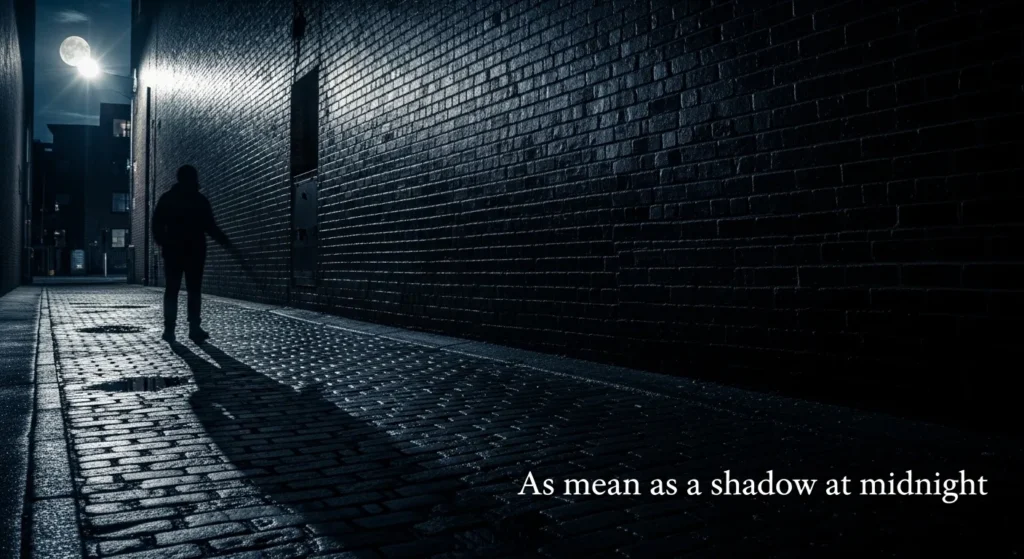
Meaning: Dark and unsettling.
Usage: Psychological tension.
- His presence felt as mean as a shadow at midnight.
- Her silence grew as mean as a shadow at midnight.
18. As mean as a hawk circling prey
Meaning: Calculated cruelty.
Usage: Predatory behavior.
- He watched her struggle, as mean as a hawk circling prey.
- Her strategy was as mean as a hawk circling prey.
19. As mean as a desert sun
Meaning: Relentless harshness.
Usage: Sustained cruelty.
- His criticism was as mean as a desert sun.
- She endured words as mean as a desert sun.
20. As mean as a splinter under skin
Meaning: Small but persistent hurt.
Usage: Lingering insults.
- His remark stayed, as mean as a splinter under skin.
- Her tone was as mean as a splinter under skin.
21. As mean as a broken compass
Meaning: Misleading and harmful.
Usage: Deceptive guidance.
- His advice proved as mean as a broken compass.
- She led them astray, as mean as a broken compass.
22. As mean as a cage without light
Meaning: Oppressive cruelty.
Usage: Emotional control.
- His love felt as mean as a cage without light.
- Her rules were as mean as a cage without light.
23. As mean as a stone in a shoe
Meaning: Irritating and hurtful.
Usage: Everyday cruelty.
- His teasing was as mean as a stone in a shoe.
- She complained, as mean as a stone in a shoe.
24. As mean as a thorny vine
Meaning: Clinging and harmful.
Usage: Toxic relationships.
- His jealousy grew as mean as a thorny vine.
- Her words wrapped around him, as mean as a thorny vine.
25. As mean as a frozen lake
Meaning: Beautiful but dangerous.
Usage: Hidden cruelty.
- Her smile was as mean as a frozen lake.
- His calmness felt as mean as a frozen lake.
26. As mean as a cracked mirror
Meaning: Reflecting pain unfairly.
Usage: Emotional projection.
- He blamed others, as mean as a cracked mirror.
- Her anger shattered outward, as mean as a cracked mirror.
27. As mean as dry lightning
Meaning: Sudden and destructive.
Usage: Unexpected insults.
- His comment struck as mean as dry lightning.
- She snapped, as mean as dry lightning.
28. As mean as a hollow tree
Meaning: Empty of kindness.
Usage: Emotional vacancy.
- His heart felt as mean as a hollow tree.
- She stared, as mean as a hollow tree.
29. As mean as gravel in the mouth
Meaning: Rough and unpleasant speech.
Usage: Dialogue-heavy scenes.
- His apology sounded as mean as gravel in the mouth.
- Her laughter grated, as mean as gravel in the mouth.
30. As mean as a locked diary
Meaning: Withholding and secretive.
Usage: Emotional isolation.
- He shut down, as mean as a locked diary.
- Her silence was as mean as a locked diary.
31. As mean as a broken branch in the path
Meaning: Causing harm unexpectedly.
Usage: Betrayal moments.
- His betrayal lay as mean as a broken branch in the path.
- She tripped over words as mean as a broken branch.
32. As mean as a thunderclap at dawn
Meaning: Jarring cruelty.
Usage: Shock value writing.
- His shout was as mean as a thunderclap at dawn.
- Her refusal struck as mean as a thunderclap at dawn.
33. As mean as poison ivy
Meaning: Harmful upon contact.
Usage: Toxic personalities.
- His friendship proved as mean as poison ivy.
- Her influence spread as mean as poison ivy.
34. As mean as an empty well
Meaning: Devoid of compassion.
Usage: Emotional depth contrast.
- His eyes looked as mean as an empty well.
- She spoke, as mean as an empty well.
35. As mean as a storm-torn forest
Meaning: Chaotic and destructive cruelty.
Usage: Dramatic narratives.
- His rage was as mean as a storm-torn forest.
- Their argument left the room as mean as a storm-torn forest.
How to Use Similes Effectively in Writing
- Match the tone. A harsh simile fits drama but may overwhelm lighthearted writing.
- Avoid clichés. Fresh comparisons create stronger imagery.
- Use sparingly. Too many similes can clutter your prose.
- Connect to theme. Nature similes work beautifully in poems and reflective essays.
- Show emotion. Let the simile deepen emotional impact instead of simply decorating a sentence.
Similes enhance poems, short stories, novels, academic essays (when used carefully), and even song lyrics by adding texture and clarity.
FAQs
1. What are similes for mean? Similes for mean are comparisons that describe cruelty or unkindness using “like” or “as,” such as “as mean as a winter wind.”
2. What is the difference between a simile and a metaphor? A simile uses like or as to compare, while a metaphor directly states one thing is another.
3. Are similes appropriate in academic writing? Yes, when used moderately to clarify complex ideas or illustrate emotional tone.
4. Why are nature similes effective? Nature provides universal imagery—storms, thorns, frost—that readers instantly recognize.
5. How can I create original similes? Think about the emotion you want to describe, then compare it to something vivid, sensory, and relatable.
Conclusion
Strong similes for mean transform flat descriptions into powerful, memorable comparisons. Instead of merely labeling someone as cruel, you can show readers the sting of shattered ice or the chill of a winter wind. These figurative language examples enrich storytelling, sharpen emotional clarity, and bring depth to characters and scenes.
When used thoughtfully, similes in literature—and in your own writing—add imagery, rhythm, and resonance. Whether you’re crafting poetry, essays, songs, or fiction, meaningful comparisons make your language stronger and more expressive. Mastering similes allows you to capture human emotion with precision and artistry, turning simple words into unforgettable images.