
Introduction
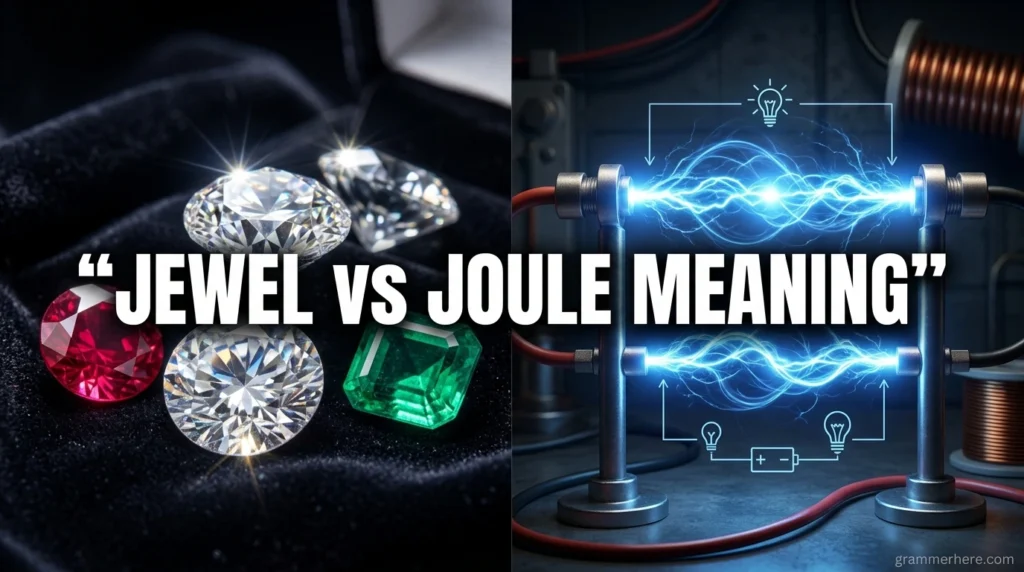
Imagine opening a small velvet box and finding a sparkling diamond inside. It catches the light, reflects beauty, and instantly feels valuable. Now imagine holding your phone, watching the battery slowly drain as you scroll, stream, and message. You may not see it, but energy is being used every second to power your world. One represents beauty and worth; the other represents power and motion.
This contrast captures the essence of two words that sound almost identical but belong to entirely different worlds: jewel and joule. While one speaks to aesthetics, emotion, and material value, the other is rooted in science, measurement, and the invisible forces that drive everyday life.
Understanding the difference between “jewel” and “joule” is more than just a vocabulary lesson. It sharpens your communication, prevents confusion, and deepens your awareness of how language connects seemingly unrelated ideas—from luxury to physics. Let’s explore their meanings, uses, and the deeper insights they reveal.
Jewel vs Joule: The Core Difference
At first glance, “jewel” and “joule” might seem interchangeable due to their similar pronunciation. However, their meanings are entirely distinct.
A jewel is a precious object—often a gemstone or decorative piece—that holds beauty and monetary value. It is something you can see, touch, and admire.
A joule, on the other hand, is a scientific unit of energy. It measures work, heat, or power. It is invisible but essential, describing how energy moves and transforms in the world.
This difference highlights a fascinating contrast: one is tangible and emotional, while the other is abstract and measurable.
In everyday life, confusing these words can lead to misunderstandings. For example, saying “this machine uses many jewels” instead of “joules” changes the meaning entirely. One suggests decoration; the other refers to energy consumption.
Understanding this distinction allows you to communicate more clearly, especially in academic, technical, or professional settings.
What Is a Jewel? A Symbol of Beauty and Value
A jewel is more than just a decorative item—it carries emotional, cultural, and symbolic meaning.
Jewels are often associated with luxury, celebration, and milestones. Think of engagement rings, heirloom necklaces, or crowns. They are used to mark important moments and express deep feelings.
Emotional Significance
Jewels often represent love, commitment, and memory. A ring passed down through generations is not just valuable—it tells a story.
Cultural Importance
Across cultures, jewels symbolize status, power, and identity. From royal crowns to wedding jewelry, they carry meaning beyond their physical form.
Personal Connection
People treasure jewels not only for their price but for what they represent—moments, relationships, and achievements.
In this sense, a jewel is both material and emotional. It shines not just because of its surface, but because of the meaning we attach to it.
What Is a Joule? The Invisible Unit of Energy
A joule belongs to the world of physics. It is the standard unit used to measure energy, work, or heat.
Simply put, one joule is the amount of energy needed to perform a small task—like lifting an object or generating heat.
Everyday Examples
- Charging your phone consumes thousands of joules
- Eating food gives your body energy measured in joules (or kilojoules)
- A light bulb converts electrical energy into light using joules
Why It Matters
Energy is everywhere. Every movement, every machine, and every natural process involves energy transfer. The joule helps us measure and understand this invisible force.
Practical Understanding
Even though you cannot see a joule, its effects are all around you—heat, motion, electricity, and sound all depend on it.
Unlike a jewel, which you can admire, a joule is something you experience indirectly through action and change.
Why These Words Sound Similar
The confusion between “jewel” and “joule” often comes from their pronunciation.
Both words are pronounced similarly, especially in fast speech. This makes them easy to mix up, particularly for learners or in casual conversation.
However, their spelling provides a clue:
- Jewel contains “we,” hinting at something we can possess
- Joule ends in “le,” often seen in scientific terms
This small difference in spelling reflects a much larger difference in meaning.
Understanding this helps avoid mistakes and builds confidence in both writing and speaking.
The Tangible vs The Abstract
One of the most interesting ways to understand jewel vs joule is through the idea of tangible vs abstract.
A jewel is tangible. You can hold it, wear it, and see its sparkle. It exists physically and occupies space.
A joule is abstract. You cannot touch it, but you can measure its effects. It exists as a concept used to describe energy.
This distinction mirrors many aspects of life:
- Emotions vs logic
- Beauty vs function
- Appearance vs process
Both are important, but they serve different purposes. Recognizing this difference helps you think more clearly and communicate more precisely.
Real-Life Scenarios Where Confusion Happens
Misusing “jewel” and “joule” can lead to amusing or confusing situations.
In Education
A student might write, “The experiment required 500 jewels of energy.” This changes the meaning entirely and may confuse the reader.
In Conversation
Someone might say, “This battery stores many jewels,” unintentionally turning a scientific statement into something decorative.
In Writing
Writers sometimes mix them up, especially when discussing technology or luxury in the same context.
These examples show why understanding the difference matters—not just academically, but in everyday communication.
Jewel in Language and Metaphor
The word “jewel” often appears in metaphors and expressions.
Common Expressions
- “A jewel of a person” – someone kind and valuable
- “Hidden jewel” – something rare and overlooked
- “Crown jewel” – the most important or valuable part
Deeper Meaning
In language, jewel represents something precious, rare, and admired. It goes beyond physical objects to describe qualities and experiences.
This metaphorical use makes the word rich and expressive, adding emotional depth to communication.
Joule in Science and Daily Life
While less poetic, “joule” plays a critical role in understanding the world.
Energy in Action
Every action you take—walking, typing, breathing—requires energy measured in joules.
Technology and Innovation
From smartphones to electric cars, joules help engineers design efficient systems.
Environmental Awareness
Understanding energy usage in joules can help you make better decisions about conservation and sustainability.
Though it may seem technical, the concept of joules is deeply connected to everyday life.
The Emotional vs The Functional Perspective
Jewel and joule also represent two different ways of seeing the world.
A jewel appeals to emotion. It is about beauty, meaning, and human connection.
A joule appeals to function. It is about efficiency, measurement, and understanding processes.
Balancing Both
Life often requires both perspectives:
- Appreciating beauty while understanding practicality
- Valuing meaning while recognizing function
This balance helps create a more complete view of the world.
How Context Changes Meaning
Context plays a crucial role in determining which word to use.
In Art and Fashion
“Jewel” is the correct term when discussing accessories, design, or aesthetics.
In Science and Engineering
“Joule” is used when talking about energy, physics, or measurements.
In Everyday Speech
Understanding the context ensures clarity and avoids confusion.
Learning to recognize these contexts strengthens both your language skills and your confidence.
Practical Tips to Remember the Difference
Here are some simple ways to avoid confusion:
Visual Association
- Jewel = something you can see
- Joule = something you measure
Memory Trick
Think of “jewel” as related to jewelry and beauty, while “joule” belongs to science and energy.
Practice
Use each word in sentences:
- “She wore a beautiful jewel.”
- “The device uses 100 joules of energy.”
Repetition helps reinforce the distinction.
Lessons from Jewel vs Joule
Beyond vocabulary, this comparison offers deeper insights.
Value vs Function
A jewel teaches us about value, beauty, and emotional connection.
A joule teaches us about efficiency, energy, and movement.
Seeing the Unseen
While jewels are visible, joules remind us that not everything important can be seen.
Appreciation and Awareness
Understanding both encourages appreciation for both the visible and invisible aspects of life.
How This Difference Applies to Everyday Life
The distinction between jewel and joule can shape how you think and communicate.
In Communication
Using the correct word improves clarity and credibility.
In Learning
It strengthens your understanding of both language and science.
In Perspective
It reminds you to value both beauty and function in your surroundings.
These small insights can have a meaningful impact on daily life.
Common Misunderstandings to Avoid
Some common mistakes include:
- Using “jewel” in scientific contexts
- Using “joule” when referring to jewelry
- Assuming they are interchangeable
Avoiding these errors ensures accurate and effective communication.
FAQs
1. What is the main difference between jewel and joule?
A jewel is a valuable decorative object, while a joule is a unit of energy in physics.
2. Are jewel and joule pronounced the same?
They sound very similar, which is why they are often confused.
3. Can “jewel” be used in science?
No, “jewel” is not a scientific term. “Joule” is used in scientific contexts.
4. What is an example of a joule in daily life?
Charging your phone or turning on a light involves energy measured in joules.
5. Why do people confuse these words?
Their similar pronunciation leads to confusion, especially in spoken language.
6. Is a jewel always expensive?
Not necessarily. Some jewels are valuable, but others may hold more emotional than monetary worth.
7. How can I remember the difference?
Associate jewel with jewelry and beauty, and joule with energy and science.
8. Is joule used outside physics?
Yes, it is used in engineering, nutrition (kilojoules), and energy-related discussions.
Conclusion
The difference between jewel and joule may seem small at first, but it reveals a deeper contrast between two worlds—one of beauty and one of energy. A jewel shines visibly, capturing attention and emotion, while a joule works quietly behind the scenes, powering movement and change.