Imagine reading a message from a friend that says, “I prefer the ladder option,” when they actually meant “the latter option.” At first glance, the mistake may seem small, almost harmless. Yet a single misplaced letter completely changes the meaning. One word brings to mind a physical object used for climbing roofs or reaching high shelves, while the other points to the second item in a comparison. This tiny spelling difference often confuses students, writers, professionals, and even native English speakers.
The confusion between “ladder” and “latter” is common because the words look and sound somewhat alike. However, their meanings belong to entirely different worlds. One is concrete and physical; the other is abstract and grammatical. Understanding the distinction is important not only for grammar accuracy but also for clear communication in everyday conversations, emails, essays, and professional writing.
In this article, we will explore the meanings, uses, emotional associations, common mistakes, practical examples, and memorable tricks behind ladder vs latter. By the end, you will confidently understand when to use each word and why this small difference matters more than many people realize.
What Does “Ladder” Mean?
The word “ladder” refers to a structure used for climbing up or down. It usually consists of two vertical sides connected by horizontal steps called rungs. People use ladders to paint walls, fix roofs, pick fruit from trees, or reach high places safely.
At its core, the word carries a physical and visual meaning. When someone says “ladder,” most people instantly picture a tall object leaning against a wall or tree.
But the meaning goes beyond physical use. In many situations, ladder is also used metaphorically. People talk about:
- The corporate ladder
- The social ladder
- The career ladder
These expressions describe progress, growth, or movement upward in life.
Everyday Example
A young employee might say:
“I’m trying to climb the corporate ladder.”
Here, no actual ladder exists. Instead, the speaker is describing career advancement step by step.
Emotional Connection
Ladders often symbolize:
- Ambition
- Progress
- Opportunity
- Risk
- Growth
Think about how climbing a ladder requires balance and courage. In the same way, personal growth often involves careful steps and persistence.
This symbolic meaning makes “ladder” a powerful word in both practical and emotional contexts.
What Does “Latter” Mean?
Unlike ladder, the word “latter” has nothing to do with climbing or physical objects. “Latter” refers to the second of two things mentioned earlier.
For example:
“I had to choose between tea and coffee, and I picked the latter.”
In this sentence, “the latter” means coffee because coffee was mentioned second.
The word helps avoid repetition in writing and speech. Instead of repeating the second item, we simply say “the latter.”
A Simple Way to Understand It
Consider this sentence:
“Summer and winter both have beauty, but I prefer the latter.”
The latter = winter.
This makes communication smoother and more elegant.
Why It Matters
Using “latter” correctly shows clarity and precision in language. It is especially useful in:
- Academic writing
- Professional communication
- Essays
- Formal discussions
While ladder is physical and visual, latter is grammatical and relational. One helps people climb; the other helps people compare ideas.
Why People Commonly Confuse Ladder and Latter
At first glance, the confusion seems understandable. The words differ by only one letter:
- Ladder
- Latter
Both contain six letters and share similar pronunciation patterns. When spoken quickly, they may sound alike to learners or casual listeners.
The Role of Pronunciation
In many accents, the middle sounds become softer, making the distinction harder to hear. A student listening to spoken English may easily misinterpret one for the other.
Typing and Autocorrect Errors
Modern communication also contributes to confusion. People type quickly on phones, rely on autocorrect, and often miss subtle spelling differences.
Imagine sending this message:
“Out of the two suggestions, I liked the ladder.”
The reader may pause in confusion because the sentence accidentally creates an image of someone liking a climbing tool instead of the second option.
Similar Appearance, Different Meaning
This confusion teaches an important lesson about English: Small spelling differences can completely change meaning.
The emotional impact of misunderstanding can range from humorous to embarrassing, especially in professional writing.
That is why mastering the distinction matters more than people initially think.
The Deeper Symbolism Behind “Ladder”
Although ladder is a simple object, it carries deep symbolic meaning in literature, motivation, and everyday speech.
People naturally associate ladders with movement upward. Climbing represents improvement, dreams, and ambition.
Climbing Toward Goals
Imagine a teenager working hard in school, hoping to build a successful future. Parents may say:
“Education is your ladder to success.”
Here, the ladder symbolizes opportunity and gradual progress.
The Risk of Falling
A ladder also represents vulnerability. Every climb involves balance and caution. In life, growth often comes with uncertainty.
Someone pursuing a difficult career may feel emotionally “on a ladder,” trying not to fall while aiming higher.
Spiritual and Emotional Meaning
In stories and religious symbolism, ladders sometimes connect earth and heaven, reality and hope, struggle and achievement.
This deeper symbolism gives the word emotional richness far beyond its everyday function.
The next time you hear “ladder,” you may notice how often people use it to describe human ambition and personal journeys.
The Deeper Meaning Behind “Latter”
While “latter” seems like a purely grammatical word, it also reflects decision-making and comparison.
Every time people use “the latter,” they are choosing focus between two ideas.
A Word About Preference
Consider this sentence:
“I could stay comfortable or chase my dreams. I chose the latter.”
The word quietly carries emotional weight because it reveals a choice.
Clarity in Communication
Latter also represents precision. Instead of repeating long phrases, it helps organize thoughts clearly and efficiently.
Good writers often use it to guide readers smoothly through comparisons.
Mental Organization
The word teaches people how language structures thinking. When we compare two ideas, we mentally separate:
- The former
- The latter
This creates order in communication.
In a deeper sense, “latter” reflects how humans naturally evaluate options, prioritize choices, and organize experiences.
Ladder in Everyday Conversations
The word ladder appears constantly in daily life, often without people noticing its broader significance.
Home and Practical Use
Many households keep ladders for:
- Changing light bulbs
- Cleaning roofs
- Painting walls
- Reaching storage spaces
In these situations, the meaning is simple and direct.
Workplace Conversations
In offices, the metaphorical use becomes common:
“She’s climbing the corporate ladder quickly.”
This phrase communicates ambition and professional growth.
Educational Settings
Teachers may encourage students by saying:
“Each skill you learn is another step on the ladder.”
The image of step-by-step improvement feels motivating because ladders naturally represent progress.
Emotional Impact
A ladder suggests effort. Nobody instantly appears at the top. Every rung requires movement and balance.
This is why the word resonates emotionally in motivational speech and storytelling.
Latter in Everyday Communication
Although latter sounds formal, people use it more often than they realize.
Casual Examples
- “Pizza and burgers both sound good, but I’d choose the latter.”
- “We could leave today or tomorrow. The latter might be easier.”
These sentences avoid unnecessary repetition and sound smoother.
Academic and Professional Use
Latter frequently appears in:
- Essays
- Research papers
- Business discussions
- Presentations
For example:
“The company considered expansion and restructuring, ultimately choosing the latter.”
This style creates concise and polished communication.
Why It Sounds Intelligent
Because “latter” is common in formal writing, correct usage often makes speech sound more educated and organized.
However, misuse has the opposite effect. Confusing ladder with latter may distract readers and reduce clarity.
That is why mastering this word improves communication confidence.
Common Mistakes People Make
Many people understand the meanings individually but still mix them up while writing quickly.
Mistake 1: Using Ladder Instead of Latter
Incorrect:
“Of the two movies, I enjoyed the ladder.”
Correct:
“Of the two movies, I enjoyed the latter.”
The incorrect sentence accidentally sounds as if someone enjoyed a climbing tool.
Mistake 2: Confusing Metaphorical Ladder
People sometimes assume “ladder” can mean “later” or “latter” because of pronunciation confusion.
Incorrect:
“I prefer the career latter.”
Correct:
“I prefer the career ladder.”
Mistake 3: Forgetting Latter Requires Two Items
“Latter” only works when comparing two things.
Incorrect:
“Among the three choices, I picked the latter.”
When there are more than two items, “latter” becomes unclear.
Why These Errors Happen
Most mistakes come from:
- Fast typing
- Pronunciation confusion
- Weak vocabulary memory
- Lack of proofreading
Fortunately, simple memory tricks can solve the problem quickly.
Easy Memory Tricks to Remember the Difference
Learning vocabulary becomes easier when linked to visual or emotional associations.
Trick for “Ladder”
Notice the double “d” in ladder.
Think:
“Double d = climbing device.”
You can imagine the two vertical sides of a ladder as the double d shape.
Trick for “Latter”
Notice the word contains:
“tt”
Think of:
“Two things compared.”
The two t letters can remind you that latter refers to the second of two items.
Visual Association
- Ladder = object you climb
- Latter = second choice in a pair
Story Method
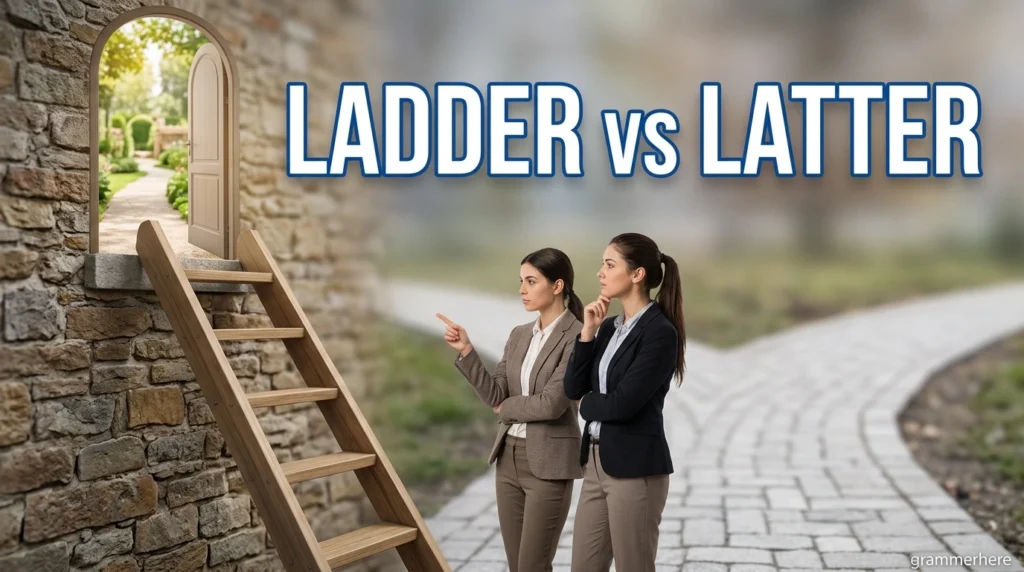
Imagine choosing between two doors. You pick the second door. That is the latter choice.
Now imagine needing a tool to reach the roof above those doors. That tool is a ladder.
Simple visual stories help the brain remember naturally.
Ladder vs Latter in Writing and Grammar
Strong writing depends on precise word choice. Using ladder and latter correctly improves readability and professionalism.
In Creative Writing
A novelist may write:
“He climbed the ladder slowly, afraid of falling.”
The word creates physical tension and imagery.
In Analytical Writing
An essay might say:
“Between freedom and security, the latter often feels safer.”
Here, the word organizes abstract ideas.
Why Context Matters
Readers understand words through surrounding context. Even a tiny spelling mistake can interrupt comprehension.
For example:
- “career ladder” makes sense
- “career latter” sounds confusing
Building Reader Trust
Correct grammar builds credibility. Readers unconsciously trust writing that feels clear and polished.
That is why understanding small distinctions like ladder vs latter can improve communication quality dramatically.
Real-Life Situations Where the Difference Matters
Some vocabulary mistakes are harmless. Others create confusion in important moments.
Professional Emails
Imagine writing:
“Between the two proposals, management preferred the ladder.”
The sentence may confuse colleagues or clients.
Academic Essays
In school assignments, incorrect word usage can affect grades because teachers expect precision.
Job Interviews
Clear communication matters during interviews and presentations. Using the wrong word may create awkward misunderstandings.
Everyday Humor
Sometimes mistakes become unintentionally funny.
A friend texting:
“I chose the ladder option.”
may accidentally create an image of someone choosing a staircase tool instead of a second suggestion.
The Bigger Lesson
Small language details shape how people perceive intelligence, professionalism, and clarity.
Mastering these differences strengthens confidence in both speaking and writing.
How Context Helps Identify the Correct Word
One of the easiest ways to avoid confusion is to examine context carefully.
Ask Yourself a Simple Question
Does the sentence involve:
- Climbing or progress? OR
- Comparing two things?
If it involves climbing, the correct word is ladder.
If it involves comparison, the correct word is latter.
Example Analysis
Sentence:
“She reached the top of the corporate ladder.”
The phrase discusses advancement, so ladder fits.
Sentence:
“Between honesty and silence, he chose the latter.”
This sentence compares two ideas, so latter fits.
Context Creates Clarity
Words rarely exist alone. Their surroundings reveal meaning.
Strong readers naturally use context clues to interpret vocabulary accurately. Developing this habit improves overall language understanding, not just these two words.
The Psychological Side of Language Confusion
Confusing similar words is part of how the human brain processes language.
Why the Brain Mixes Similar Words
The brain often groups:
- Similar sounds
- Similar spellings
- Familiar patterns
This is why people mix up:
- affect/effect
- accept/except
- ladder/latter
Learning Through Repetition
Repeated exposure helps create stronger mental distinctions.
The more people read and use these words correctly, the easier accurate recall becomes.
Confidence and Communication
Language mistakes sometimes make people feel embarrassed or insecure. But confusion is a normal part of learning.
Even experienced writers occasionally mistype similar words.
Growth Through Awareness
The important step is recognizing the difference and practicing intentionally. Small improvements in vocabulary gradually lead to stronger communication skills overall.
FAQs
1. What is the main difference between ladder and latter?
Ladder is a climbing tool or symbol of progress, while latter refers to the second of two mentioned items.
2. Can ladder be used metaphorically?
Yes. People often use ladder metaphorically in phrases like “career ladder” or “social ladder.”
3. When should I use latter?
Use latter when referring to the second item in a comparison between two things.
4. Is it wrong to use latter for more than two items?
Yes. Latter is traditionally used only when comparing two things.
5. Why do people confuse ladder and latter?
The words look and sound similar, especially in fast speech or typing.
6. What is the opposite of latter?
The opposite is former, which refers to the first of two mentioned items.
7. Can ladder refer to success?
Yes. Metaphorically, ladder often symbolizes growth, ambition, and advancement.
8. What is the easiest way to remember the difference?
Think:
- Ladder = climbing device
- Latter = second choice in comparison
Conclusion
The difference between ladder and latter may seem small, but understanding it can greatly improve communication clarity and confidence. Ladder represents something physical or symbolic that helps people climb higher, whether literally or metaphorically through career growth and personal achievement. Latter, on the other hand, belongs to the world of comparison and refers to the second of two mentioned ideas or choices.