
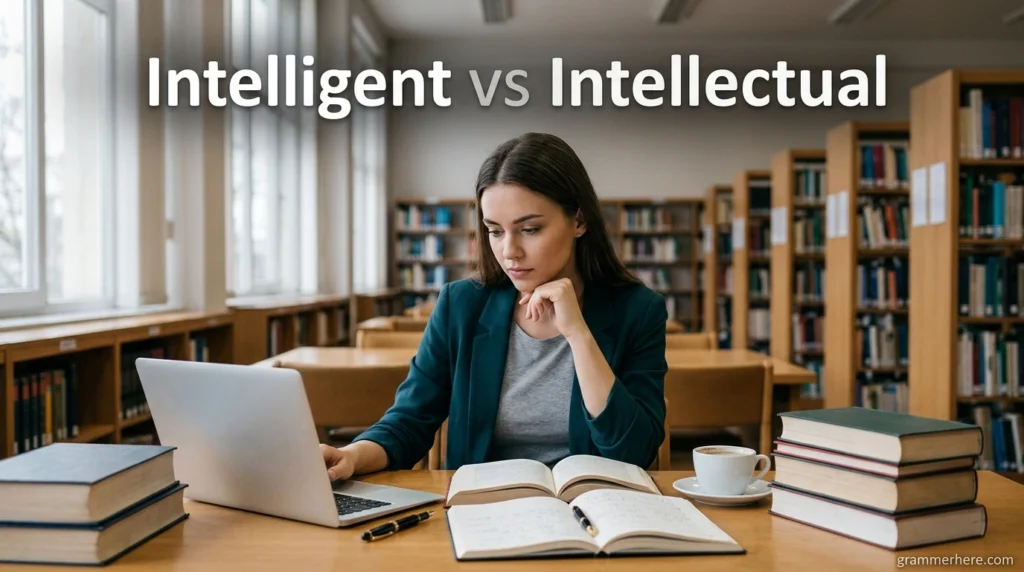
Imagine sitting in a coffee shop watching two people solve very different problems. One quickly figures out why the café’s Wi-Fi keeps disconnecting, tests a few possibilities, and fixes it within minutes. The other engages in a fascinating discussion about philosophy, history, and scientific theories, connecting ideas from different fields with remarkable depth. Both seem impressive, yet in different ways.
Many people use the words intelligent and intellectual interchangeably. After all, both are associated with thinking, learning, and mental ability. However, they describe distinct qualities that influence how people approach knowledge, solve problems, and interact with the world.
Understanding the difference matters because it affects education, careers, relationships, and personal growth. Someone may be highly intelligent without being particularly intellectual, while another person may be deeply intellectual without possessing extraordinary problem-solving abilities. Recognizing this distinction helps us appreciate different forms of human capability and avoid unfair assumptions about ourselves and others.
This article explores the meaning of intelligent versus intellectual, examines how these traits appear in everyday life, and offers practical insights into developing both qualities for a richer and more effective life.
What Does “Intelligent” Mean?
Intelligence generally refers to the ability to learn, reason, understand, adapt, and solve problems effectively. It is often associated with mental agility and the capacity to process information efficiently.
Think about a teenager who has never used a particular software program before. Within an hour, they understand the interface, discover shortcuts, and teach others how to use it. Their success may not come from prior knowledge but from their ability to learn and adapt quickly.
Intelligence often shows itself through:
- Problem-solving skills
- Quick learning
- Logical reasoning
- Pattern recognition
- Adaptability
- Decision-making ability
An intelligent person may not know every answer, but they can often figure things out. They tend to navigate unfamiliar situations effectively and find practical solutions when challenges arise.
Intelligence is not limited to academics. A mechanic diagnosing a complex engine issue, a business owner spotting market opportunities, or a parent creatively resolving family conflicts may all demonstrate intelligence.
At its core, intelligence is less about what you already know and more about how effectively your mind works when facing new information or problems.
What Does “Intellectual” Mean?
An intellectual is someone deeply engaged with ideas, knowledge, learning, and critical thinking. While intelligence focuses on mental capability, intellectualism focuses on the pursuit and exploration of knowledge.
Picture someone who spends evenings reading history, analyzing literature, discussing political theories, and exploring philosophical questions. Their interest is not merely finding solutions but understanding concepts at a deeper level.
Intellectual people often:
- Enjoy studying complex subjects
- Reflect deeply on ideas
- Engage in thoughtful discussions
- Value learning for its own sake
- Explore abstract concepts
- Seek deeper meaning and understanding
Being intellectual does not necessarily mean having an exceptionally high IQ. Instead, it reflects a habit of engaging seriously with ideas.
For example, a professor who spends decades studying ancient civilizations may be highly intellectual because of their dedication to understanding and interpreting knowledge.
The intellectual mindset is driven by curiosity about ideas rather than merely practical outcomes.
The Core Difference Between Intelligent and Intellectual
The simplest distinction is this:
Intelligence is a capability; intellectualism is an orientation toward knowledge.
An intelligent person can quickly solve problems. An intellectual person is often drawn to exploring and analyzing ideas in depth.
Consider two friends discussing climate change.
One focuses on practical solutions, quickly evaluating options and identifying effective actions. This demonstrates intelligence.
The other explores historical, economic, ethical, and philosophical dimensions of the issue. This demonstrates intellectual engagement.
Neither approach is superior. They simply represent different strengths.
Intelligence Focuses on Function
Intelligence often answers questions such as:
- How can this problem be solved?
- What is the most efficient approach?
- What pattern explains this situation?
The emphasis is practical and outcome-oriented.
Intellectualism Focuses on Understanding
Intellectual thinking often asks:
- Why does this idea exist?
- What are the broader implications?
- How does this connect with other concepts?
The emphasis is exploration and understanding.
Many people possess both qualities, but one often appears more prominently than the other.
Can Someone Be Intelligent but Not Intellectual?
Absolutely.
Many highly intelligent individuals have little interest in academic discussions, philosophy, literature, or theoretical debates. They may excel at solving practical problems without spending much time exploring abstract ideas.
Imagine a successful entrepreneur who quickly identifies opportunities, negotiates effectively, and adapts to changing markets. Their intelligence is obvious. Yet they may have little interest in reading philosophy or discussing political theory.
Real-Life Example
A skilled technician might diagnose equipment failures within minutes and develop innovative fixes. However, they may not enjoy intellectual pursuits such as analyzing historical events or debating ethical theories.
Their intelligence manifests through practical effectiveness rather than intellectual exploration.
This example highlights an important lesson: intelligence does not require intellectual interests.
Can Someone Be Intellectual but Not Exceptionally Intelligent?
This possibility surprises many people, but the answer is yes.
An intellectual person may be deeply committed to learning and reflection without possessing extraordinary cognitive speed or problem-solving ability.
Imagine a lifelong reader who studies literature, history, and philosophy with great dedication. They may spend years developing thoughtful perspectives and engaging in meaningful discussions.
Their strength lies in commitment to knowledge rather than exceptional mental processing power.
Intellectual Effort Matters
Intellectual engagement often depends on:
- Curiosity
- Discipline
- Reflection
- Reading habits
- Openness to ideas
A person does not need genius-level intelligence to become intellectual.
Many respected scholars achieved influence through persistence, study, and thoughtful analysis rather than extraordinary natural talent.
This distinction reminds us that intellectual growth is accessible to nearly everyone.
How Intelligence Appears in Everyday Life
People often imagine intelligence only in classrooms or laboratories, but it appears everywhere.
Solving Unexpected Problems
A traveler loses their wallet in a foreign city and quickly creates a recovery plan. This demonstrates practical intelligence.
Reading Social Situations
A manager notices tension within a team and adjusts communication before conflict escalates. This reflects social intelligence.
Learning New Skills
Someone masters a new technology within days while others struggle for weeks. This reflects adaptive intelligence.
Intelligence frequently operates behind the scenes. It helps people navigate uncertainty, identify opportunities, and respond effectively to challenges.
In many cases, intelligent behavior is recognized through results rather than lengthy discussions about ideas.
How Intellectualism Appears in Everyday Life
Intellectualism often reveals itself through a person’s relationship with knowledge and ideas.
Deep Conversations
An intellectual individual may enjoy exploring questions that have no simple answers.
For example:
- What creates a meaningful life?
- How does culture shape identity?
- What responsibilities come with technological progress?
Continuous Learning
Intellectual people often maintain a lifelong commitment to learning. They read widely, attend lectures, listen to educational content, and explore unfamiliar perspectives.
Reflective Thinking
Rather than accepting information at face value, they examine assumptions and seek deeper understanding.
Intellectualism transforms ordinary experiences into opportunities for reflection and discovery.
Common Misunderstandings About Intelligence and Intellectualism
Many misconceptions surround these terms.
Misconception 1: Intellectuals Are Always More Intelligent
Someone can possess extensive knowledge yet struggle with practical problem-solving.
Knowledge and intelligence are related but not identical.
Misconception 2: Intelligent People Know Everything
Intelligence is not the same as possessing vast information.
An intelligent person may know very little about a specific subject yet learn it rapidly when needed.
Misconception 3: Intellectuals Are Elitist
Some people associate intellectualism with arrogance. While certain individuals may behave this way, genuine intellectual curiosity often involves humility and openness.
Misconception 4: Intelligence Is Only Academic
Many forms of intelligence exist, including social, emotional, creative, and practical intelligence.
Recognizing these misunderstandings helps us appreciate human abilities more accurately.
The Role of Curiosity in Both Traits
Curiosity serves as a bridge between intelligence and intellectualism.
Imagine a child who constantly asks questions about how things work. That curiosity may strengthen intelligence through exploration and intellectualism through learning.
Curiosity Fuels Intelligence
Curious people experiment, test ideas, and learn from experience. This process improves problem-solving abilities.
Curiosity Fuels Intellectual Growth
Curious individuals also seek explanations, theories, and broader understanding. This deepens intellectual engagement.
Without curiosity, both intelligence and intellectualism can remain underdeveloped.
The most effective learners often combine intellectual curiosity with intelligent application.
Emotional Intelligence and Intellectual Thinking
A fascinating aspect of this comparison involves emotions.
Traditional discussions about intelligence often emphasize logic. However, emotional intelligence plays a critical role in success.
Emotional intelligence includes:
- Self-awareness
- Empathy
- Relationship management
- Emotional regulation
An intellectual person may possess deep theoretical knowledge yet struggle emotionally in relationships.
Conversely, someone with strong emotional intelligence may build excellent relationships despite lacking intellectual interests.
A Workplace Example
One employee delivers brilliant analyses but struggles to communicate effectively.
Another understands colleagues’ concerns, resolves conflicts, and creates cooperation.
Both contribute valuable strengths.
This example demonstrates that intelligence and intellectualism represent only part of human capability.
Which Trait Matters More for Success?
This question arises frequently, but the answer depends on the situation.
In Practical Environments
Intelligence often provides an advantage because effective problem-solving leads to results.
Engineers, entrepreneurs, emergency responders, and business leaders frequently rely on intelligent decision-making.
In Academic and Cultural Fields
Intellectual engagement often becomes more valuable. Scholars, researchers, writers, and philosophers benefit from deep exploration of ideas.
In Modern Life
The most successful individuals often combine both qualities.
They learn continuously while also applying knowledge effectively.
Success rarely depends on a single trait. It emerges from balancing understanding with action.
How to Become More Intelligent
Although some aspects of intelligence may have natural foundations, many cognitive abilities can be strengthened.
Challenge Your Brain
Solve puzzles, learn languages, and explore unfamiliar subjects.
Embrace New Experiences
New situations force your brain to adapt and develop flexible thinking.
Practice Problem-Solving
Instead of immediately seeking answers, try developing your own solutions first.
Learn From Mistakes
Reflecting on failures improves judgment and decision-making.
Consistent mental challenges strengthen cognitive skills over time.
Like physical fitness, intelligence grows through regular exercise.
How to Become More Intellectual
Developing intellectual habits requires intentional engagement with knowledge.
Read Broadly
Explore literature, history, science, philosophy, psychology, and culture.
Ask Better Questions
Instead of simply asking what happened, ask why it happened and what it means.
Engage in Thoughtful Discussion
Conversations expose you to different perspectives and encourage deeper thinking.
Reflect Regularly
Journaling and contemplation help transform information into understanding.
Becoming more intellectual is not about appearing knowledgeable. It is about developing a genuine relationship with learning and ideas.
The Power of Combining Intelligence and Intellectualism
The strongest thinkers often integrate both qualities.
Imagine a doctor who not only understands complex medical research but also applies it effectively to patient care.
Or consider a business leader who studies economics, psychology, and history while making practical decisions that produce results.
These individuals demonstrate the synergy between intelligence and intellectualism.
Intelligence provides the ability to process and solve.
Intellectualism provides depth, context, and perspective.
Together, they create balanced thinkers capable of understanding the world and acting effectively within it.
Rather than choosing one over the other, personal growth often comes from cultivating both.
Conclusion
The distinction between intelligent and intellectual is subtle but important. Intelligence refers to the ability to learn, reason, adapt, and solve problems effectively, while intellectualism reflects a deep engagement with knowledge, ideas, and thoughtful exploration. One focuses primarily on mental capability; the other emphasizes a commitment to understanding.
Throughout everyday life, we encounter people who embody one trait more strongly than the other, and many who combine both. A practical problem-solver may demonstrate remarkable intelligence without being deeply intellectual, while a lifelong scholar may pursue ideas passionately without possessing extraordinary cognitive speed. Neither approach is inherently better.
The most rewarding path often involves developing both qualities. By strengthening problem-solving abilities while nurturing curiosity, reflection, and lifelong learning, individuals gain not only the capacity to navigate challenges but also the wisdom to understand their deeper meaning. In that balance lies a richer, more effective way of thinking and living.
FAQs
1. What is the main difference between intelligent and intellectual?
Intelligent refers to the ability to learn, reason, and solve problems, while intellectual refers to a person who actively engages with knowledge, ideas, and deep thinking.
2. Can a person be intelligent without being intellectual?
Yes. Many people are excellent problem-solvers and quick learners but have little interest in studying abstract ideas or engaging in intellectual discussions.
3. Can someone be intellectual but not highly intelligent?
Yes. Intellectualism often depends on curiosity, study, and reflection rather than exceptional natural cognitive ability.
4. Is intelligence more important than intellectualism?
Neither is universally more important. Different situations value different strengths, and many successful people benefit from having both qualities.
5. Are intellectual people always highly educated?
No. Formal education can support intellectual development, but intellectual curiosity and deep thinking can exist regardless of academic background.
6. Does reading a lot make someone intellectual?
Frequent reading can contribute to intellectual growth, especially when it involves reflection and critical thinking, but reading alone does not automatically make someone intellectual.
7. Can intelligence be improved?
Yes. Problem-solving practice, learning new skills, mental challenges, and diverse experiences can strengthen many aspects of intelligence.
8. How can I become both intelligent and intellectual?
Challenge your mind regularly, solve real-world problems, read widely, explore new ideas, engage in thoughtful discussions, and maintain a lifelong commitment to learning.