
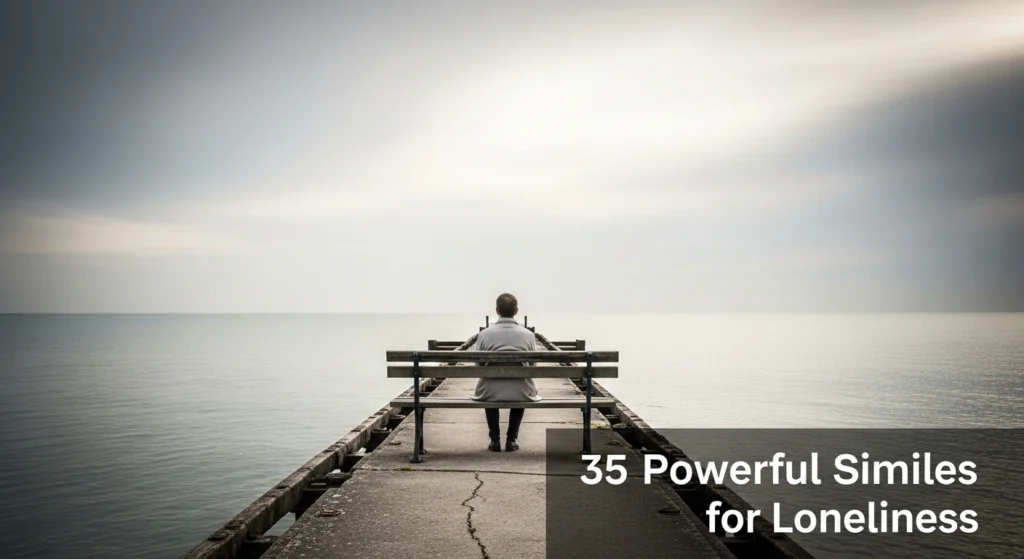
Loneliness is a feeling almost everyone experiences, yet it can be difficult to describe. This is where similes become powerful tools in writing. Similes are comparisons that use the words like or as to connect one idea with another, helping readers clearly imagine emotions and experiences. In figurative language, similes add color, depth, and vivid imagery to ordinary sentences.
They allow writers to turn abstract emotions—like isolation, sadness, or longing—into something readers can see and feel. Nature similes are especially powerful because natural elements often mirror human emotions. Trees, for example, symbolize strength, growth, resilience, wisdom, and human emotion; a lone tree in an open field can represent both endurance and isolation at the same time. In this guide, you’ll discover carefully crafted similes for loneliness that will enrich your creative writing, poetry, essays, and storytelling.
What Is a Simile?
A simile is a figure of speech that compares two different things using the words like or as to create a vivid image.
Example: She felt as lonely as a single star in a cloudy sky.
This comparison helps readers picture isolation more clearly than simply saying “she felt lonely.” Similes are widely used in literature, songs, speeches, and everyday conversation because they make language more expressive and memorable.
1. As lonely as a single tree in an empty field
Meaning
This simile expresses deep isolation while hinting at quiet strength and endurance.
Usage
It works beautifully in reflective writing, poetry, and emotional storytelling where solitude feels both heavy and dignified.
Examples
- He stood at the station, as lonely as a single tree in an empty field.
- After the crowd left, she felt as lonely as a single tree beneath the wide sky.
2. Like a star lost in the daylight sky
Meaning
It suggests invisibility and being unnoticed despite existing.
Usage
Best used in emotional narratives about feeling overlooked or forgotten.
Examples
- In the busy classroom, he felt like a star lost in the daylight sky.
- Her voice faded like a star lost in the morning light.
3. As lonely as a lighthouse in a storm
Meaning
This comparison shows isolation mixed with responsibility and resilience.
Usage
Effective in dramatic storytelling or symbolic writing.
Examples
- He guarded his secret as lonely as a lighthouse in a storm.
- She stood firm, as lonely as a lighthouse battered by waves.
4. Like a book left unread on a dusty shelf
Meaning
It reflects neglect and the desire to be noticed or valued.
Usage
Ideal for essays or creative prose about emotional neglect.
Examples
- He felt like a book left unread on a dusty shelf.
- Her dreams gathered dust like a forgotten novel.
5. As lonely as the last leaf on a winter tree
Meaning
This simile conveys fragility and isolation during difficult times.
Usage
Perfect for poetic or seasonal descriptions.
Examples
- She clung to hope as lonely as the last leaf on a winter tree.
- He stood alone, trembling like the final leaf in the cold wind.
6. Like an echo in an empty valley
Meaning
It suggests speaking without being heard or answered.
Usage
Works well in emotional monologues or reflective pieces.
Examples
- His laughter faded like an echo in an empty valley.
- Her words returned to her like unanswered echoes.
7. As lonely as a deserted island
Meaning
It emphasizes extreme isolation.
Usage
Common in both creative and academic figurative language examples.
Examples
- Without her friends, she felt as lonely as a deserted island.
- He wandered through the city, isolated like an island in the sea.
8. Like a cloud drifting alone in a vast sky
Meaning
This simile expresses gentle, quiet loneliness.
Usage
Great for calm, reflective tones in poems.
Examples
- She moved through life like a cloud drifting alone.
- His thoughts floated like a solitary cloud.
9. As lonely as a train station at midnight
Meaning
It conveys emptiness and stillness.
Usage
Perfect for atmospheric storytelling.
Examples
- The house felt as lonely as a train station at midnight.
- He waited there, alone like a silent platform after the last train.
10. Like a candle flickering in the dark
Meaning
Loneliness mixed with vulnerability.
Usage
Effective in emotional or dramatic contexts.
Examples
- She felt like a candle flickering in the dark hallway.
- His courage burned like a lonely flame.
11. As lonely as a wolf howling at the moon
Meaning
This expresses longing and emotional pain.
Usage
Ideal for passionate or dramatic writing.
Examples
- He felt as lonely as a wolf howling at the moon.
- Her heart cried out like a wolf in the night.
12. Like footprints fading in the sand
Meaning
It suggests being forgotten over time.
Usage
Useful in reflective essays.
Examples
- His memory faded like footprints in the sand.
- She feared her efforts would disappear like waves washing away prints.
13. As lonely as an empty playground
Meaning
This conveys silence after joy has passed.
Usage
Works well in nostalgic writing.
Examples
- The park looked as lonely as an empty playground.
- After summer ended, the yard felt deserted and still.
14. Like a bird separated from its flock
Meaning
It expresses social isolation.
Usage
Ideal for describing exclusion.
Examples
- He felt like a bird separated from its flock.
- She drifted away from her friends like a lost sparrow.
15. As lonely as a shadow at dusk
Meaning
This simile reflects quiet fading presence.
Usage
Best for poetic imagery.
Examples
- She lingered as lonely as a shadow at dusk.
- His hopes stretched thin like a fading shadow.
16. Like rain falling on an empty street
Meaning
Gentle sadness without comfort.
Usage
Good for soft emotional tones.
Examples
- Her tears fell like rain on an empty street.
- The silence spread like rainfall with no one to hear it.
17. As lonely as a broken clock on the wall

Meaning
Feeling useless or disconnected from time and progress.
Usage
Works in symbolic writing.
Examples
- He felt as lonely as a broken clock on the wall.
- Her days passed, ticking in silence like a stopped clock.
18. Like a window without light
Meaning
Emotional emptiness.
Usage
Effective in serious, reflective writing.
Examples
- She seemed like a window without light.
- His eyes looked dark like an unlit room.
19. As lonely as a ship lost at sea
Meaning
Being directionless and isolated.
Usage
Great for dramatic narratives.
Examples
- He wandered as lonely as a ship lost at sea.
- Her heart drifted without anchor.
20. Like a chair at an empty table
Meaning
Excluded or missing from belonging.
Usage
Ideal for family or friendship themes.
Examples
- He felt like a chair at an empty table.
- The holiday dinner felt incomplete and quiet.
21. As lonely as a fading star at dawn
Meaning
Quiet disappearance or unnoticed presence.
Usage
Poetic and symbolic contexts.
Examples
- She felt as lonely as a fading star at dawn.
- His hopes dimmed like the last star in the morning sky.
22. Like a message never sent
Meaning
Unexpressed emotions.
Usage
Modern, relatable writing.
Examples
- He felt like a message never sent.
- Her confession stayed unsaid like a draft left in her phone.
23. As lonely as an abandoned house
Meaning
Deep neglect and silence.
Usage
Dramatic storytelling.
Examples
- The building stood as lonely as an abandoned house.
- His heart felt deserted and cold.
24. Like snow falling without footprints
Meaning
Isolation without connection.
Usage
Nature similes in poetry.
Examples
- She walked like snow falling without footprints.
- His presence left no trace.
25. As lonely as a silent church at night
Meaning
Sacred but empty solitude.
Usage
Reflective spiritual writing.
Examples
- He sat as lonely as a silent church at night.
- The hall echoed softly around her.
26. Like a puzzle piece that doesn’t fit
Meaning
Not belonging.
Usage
Personal growth essays.
Examples
- She felt like a puzzle piece that didn’t fit.
- He searched for a place where he belonged.
27. As lonely as a candle after the party ends
Meaning
Left behind after joy fades.
Usage
Nostalgic tone.
Examples
- The room felt as lonely as a candle after the party ends.
- She stayed behind in the quiet aftermath.
28. Like a diary no one reads
Meaning
Private emotions unseen.
Usage
Intimate storytelling.
Examples
- He felt like a diary no one reads.
- Her secrets stayed locked away.
29. As lonely as a road stretching into the fog
Meaning
Uncertain and isolated future.
Usage
Symbolic narratives.
Examples
- She felt as lonely as a road stretching into the fog.
- His future seemed unclear and distant.
30. Like a photograph with no one in it
Meaning
Absence and emptiness.
Usage
Visual descriptive writing.
Examples
- The house looked like a photograph with no one in it.
- His memories felt empty and silent.
31. As lonely as the moon in a cloudless sky
Meaning
Visible yet distant.
Usage
Romantic or poetic tone.
Examples
- She felt as lonely as the moon in a cloudless sky.
- He watched from afar, distant and quiet.
32. Like a forgotten song
Meaning
Overlooked beauty.
Usage
Creative essays or lyrics.
Examples
- He felt like a forgotten song.
- Her laughter once bright was now rarely heard.
33. As lonely as a stone at the bottom of a river
Meaning
Silent and unseen isolation.
Usage
Deep reflective writing.
Examples
- She felt as lonely as a stone at the bottom of a river.
- His sadness sank quietly beneath the surface.
34. Like a garden without flowers
Meaning
Lack of joy or connection.
Usage
Symbolic descriptions.
Examples
- The home felt like a garden without flowers.
- His life seemed colorless and bare.
35. As lonely as a door that never opens
Meaning
Emotional closure and separation.
Usage
Strong for dramatic or metaphorical storytelling.
Examples
- She felt as lonely as a door that never opens.
- His heart remained closed and silent.
How to Use Similes Effectively in Writing
To use similes effectively:
- Be specific. Choose comparisons that clearly match the emotion.
- Use nature similes for emotional depth and universal imagery.
- Avoid clichés by creating fresh, original comparisons.
- Match the tone. Gentle similes suit reflective writing, while dramatic ones fit intense scenes.
- Balance usage. Too many comparisons can overwhelm readers.
In poems and songs, similes create rhythm and imagery. In stories, they reveal character emotions. In essays, they clarify complex ideas. In creative descriptions, they transform simple language into powerful storytelling.
FAQs
1. What are similes for loneliness?
They are comparisons using like or as to describe feelings of isolation in vivid and imaginative ways.
2. What is the difference between a simile and a metaphor?
A simile uses like or as for comparison, while a metaphor directly states that one thing is another.
3. Why are nature similes effective for loneliness?
Nature reflects human emotions—storms, empty fields, and fading stars naturally symbolize isolation.
4. Can similes be used in academic writing?
Yes, but they should be used carefully to clarify ideas rather than make writing overly dramatic.
5. Are similes common in literature?
Yes. Many classic and modern works use similes in literature to deepen emotional meaning and imagery.
Conclusion
Powerful similes for loneliness help writers turn silent emotions into vivid, unforgettable images. Through thoughtful comparisons—especially nature similes—you can express isolation with clarity, beauty, and emotional depth. Whether you’re writing poetry, fiction, essays, or songs, similes enrich your language and connect readers to universal human experiences. By choosing original comparisons and matching them to the right tone and context, you transform simple sentences into meaningful expressions that resonate long after they are read.