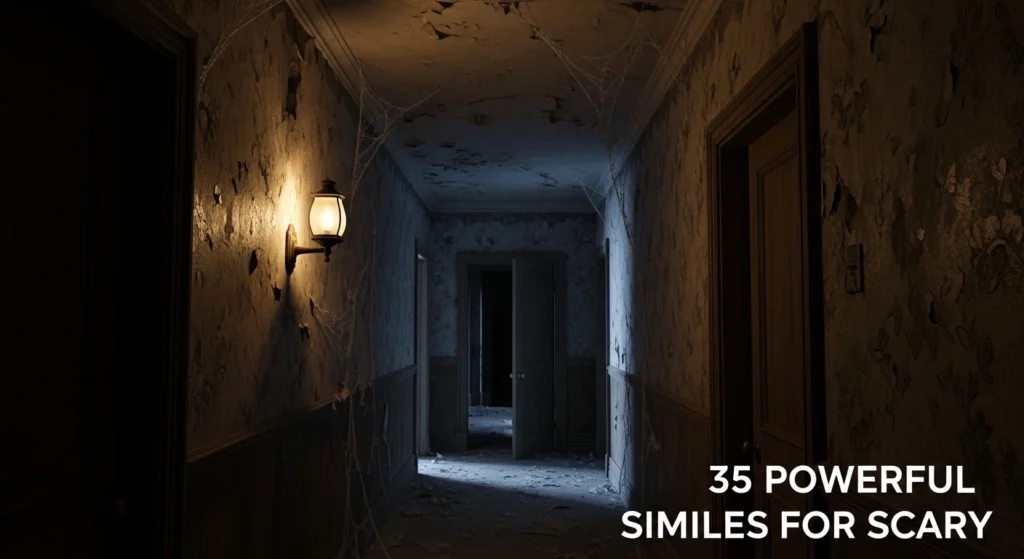
Fear is one of the strongest emotions we experience, and writers often struggle to describe it in a vivid and memorable way. That’s where similes become incredibly powerful. Similes help us compare one thing to another using words like “as” or “like,” turning ordinary descriptions into striking images. In figurative language, similes allow readers to feel the emotion instead of just reading about it.
When describing something frightening, comparisons drawn from nature—like trees creaking in the wind or shadows stretching at dusk—can make writing more dramatic and realistic. Trees, in particular, are powerful symbols of strength, growth, resilience, wisdom, and even human emotion. A twisted tree under a stormy sky can feel just as terrifying as any ghostly figure. In this guide, you’ll discover creative and original similes for scary that will strengthen your storytelling and deepen emotional impact.
What Is a Simile?
A simile is a figure of speech that compares two different things using the words “like” or “as.” It helps readers visualize emotions, actions, and experiences more clearly.
Example: The abandoned house was as silent as a grave.
This comparison makes the silence feel heavier and more unsettling than simply saying “very quiet.”
1. As scary as a shadow moving without a source
Meaning: Something deeply unsettling and mysterious.
Usage Insight: Works well in horror stories where uncertainty builds tension.
Examples:
- The hallway felt as scary as a shadow moving without a source.
- His whisper in the dark was as scary as a shadow moving without a source.
2. As scary as a tree creaking in a storm
Meaning: Fear caused by natural, eerie sounds.
Usage Insight: Ideal for nature similes in suspenseful outdoor scenes.
Examples:
- The forest was as scary as a tree creaking in a storm.
- That sudden crack outside sounded as scary as a tree creaking in a storm.
3. As scary as footsteps behind you at night
Meaning: Sudden fear of being followed.
Usage Insight: Perfect for building suspense in thrillers.
Examples:
- The echo in the alley was as scary as footsteps behind you at night.
- The quiet campus felt as scary as footsteps behind you at night.
4. As scary as eyes glowing in the dark
Meaning: A frightening and unknown presence.
Usage Insight: Strong visual simile for horror descriptions.
Examples:
- The attic window looked as scary as eyes glowing in the dark.
- His glare was as scary as eyes glowing in the dark.
5. As scary as thunder cracking above your head
Meaning: Sudden and overwhelming fear.
Usage Insight: Great for dramatic, high-impact moments.
Examples:
- The explosion was as scary as thunder cracking above your head.
- Her scream was as scary as thunder cracking above your head.
6. As scary as a forest at midnight
Meaning: Deep, quiet, isolating fear.
Usage Insight: Works beautifully in atmospheric storytelling.
Examples:
- The empty road was as scary as a forest at midnight.
- That silence felt as scary as a forest at midnight.
7. As scary as a door slowly opening by itself
Meaning: Suspenseful and supernatural fear.
Usage Insight: Best used in horror fiction.
Examples:
- The creaking sound was as scary as a door slowly opening by itself.
- The draft felt as scary as a door slowly opening by itself.
8. As scary as a scream in total silence
Meaning: Sudden shock breaking calmness.
Usage Insight: Excellent contrast-based comparison.
Examples:
- The alarm was as scary as a scream in total silence.
- His shout was as scary as a scream in total silence.
9. As scary as lightning splitting the sky
Meaning: Quick and intense fear.
Usage Insight: Ideal for dramatic action scenes.
Examples:
- The crash was as scary as lightning splitting the sky.
- Her anger struck as scary as lightning splitting the sky.
10. As scary as a mirror cracking at midnight
Meaning: A sense of bad luck or doom.
Usage Insight: Works well in symbolic horror writing.
Examples:
- The sudden bang felt as scary as a mirror cracking at midnight.
- That moment was as scary as a mirror cracking at midnight.
11. As scary as whispers in an empty room
Meaning: Fear of the unseen.
Usage Insight: Effective for psychological tension.
Examples:
- The wind was as scary as whispers in an empty room.
- The old building sounded as scary as whispers in an empty room.
12. As scary as a storm swallowing the sky
Meaning: Overwhelming and unstoppable fear.
Usage Insight: Great for describing emotional turmoil.
Examples:
- His rage felt as scary as a storm swallowing the sky.
- The news was as scary as a storm swallowing the sky.
13. As scary as a heartbeat in the dark
Meaning: Heightened awareness and fear.
Usage Insight: Best in suspenseful, intimate scenes.
Examples:
- The ticking clock was as scary as a heartbeat in the dark.
- That silence felt as scary as a heartbeat in the dark.
14. As scary as a branch snapping behind you
Meaning: Sudden, unexpected fear.
Usage Insight: Effective in wilderness settings.
Examples:
- The noise outside was as scary as a branch snapping behind you.
- That sound felt as scary as a branch snapping behind you.
15. As scary as fog swallowing the road
Meaning: Fear of the unknown future.
Usage Insight: Strong metaphorical comparison for uncertainty.
Examples:
- The decision ahead was as scary as fog swallowing the road.
- That moment felt as scary as fog swallowing the road.
16. As scary as a howl under a full moon
Meaning: Wild, haunting fear.
Usage Insight: Perfect for gothic or eerie settings.
Examples:
- The distant cry was as scary as a howl under a full moon.
- The night felt as scary as a howl under a full moon.
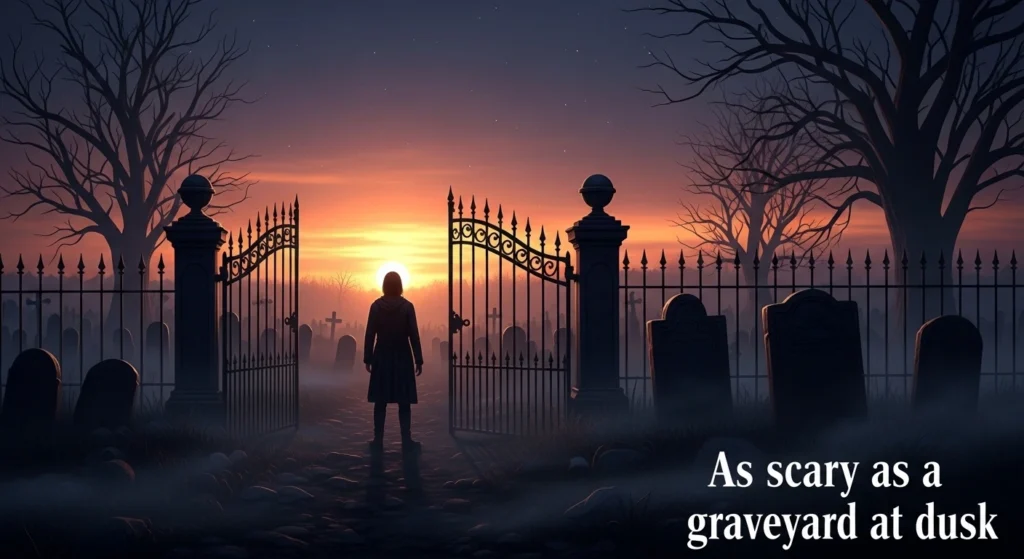
17. As scary as a graveyard at dusk
Meaning: Quiet, lingering fear.
Usage Insight: Classic horror imagery.
Examples:
- The abandoned park looked as scary as a graveyard at dusk.
- The silence felt as scary as a graveyard at dusk.
18. As scary as wind rattling old windows
Meaning: Eerie, unsettling fear.
Usage Insight: Ideal for haunted-house scenes.
Examples:
- The house sounded as scary as wind rattling old windows.
- That noise felt as scary as wind rattling old windows.
19. As scary as a flickering candle in the dark
Meaning: Fear mixed with fragility.
Usage Insight: Good for emotional vulnerability scenes.
Examples:
- Her voice was as scary as a flickering candle in the dark.
- The room felt as scary as a flickering candle in the dark.
20. As scary as silence before a scream
Meaning: Tension before danger.
Usage Insight: Excellent for suspense building.
Examples:
- The pause was as scary as silence before a scream.
- That moment felt as scary as silence before a scream.
21. As scary as a wolf’s shadow in moonlight
Meaning: Threat looming nearby.
Usage Insight: Strong visual comparison.
Examples:
- The figure looked as scary as a wolf’s shadow in moonlight.
- His warning felt as scary as a wolf’s shadow in moonlight.
22. As scary as an empty swing moving alone
Meaning: Subtle, haunting fear.
Usage Insight: Great for symbolic storytelling.
Examples:
- The playground was as scary as an empty swing moving alone.
- The sight felt as scary as an empty swing moving alone.
23. As scary as a cracked voice in the dark
Meaning: Vulnerable yet frightening tone.
Usage Insight: Works in emotional horror scenes.
Examples:
- His whisper was as scary as a cracked voice in the dark.
- That sound felt as scary as a cracked voice in the dark.
24. As scary as a cold hand on your shoulder
Meaning: Sudden shock and terror.
Usage Insight: Classic horror simile.
Examples:
- The touch felt as scary as a cold hand on your shoulder.
- The surprise was as scary as a cold hand on your shoulder.
25. As scary as a face at the window in the rain
Meaning: Creepy visual surprise.
Usage Insight: Strong cinematic imagery.
Examples:
- The reflection was as scary as a face at the window in the rain.
- That sight was as scary as a face at the window in the rain.
26. As scary as a scream carried by the wind
Meaning: Fear spreading across distance.
Usage Insight: Effective in wide outdoor scenes.
Examples:
- The echo was as scary as a scream carried by the wind.
- The valley felt as scary as a scream carried by the wind.
27. As scary as a child laughing in an empty house
Meaning: Disturbing, unexpected sound.
Usage Insight: Common in psychological horror.
Examples:
- The recording sounded as scary as a child laughing in an empty house.
- The silence was as scary as a child laughing in an empty house.
28. As scary as a candle blowing out on its own
Meaning: Sudden supernatural feeling.
Usage Insight: Great for ghost stories.
Examples:
- The darkness was as scary as a candle blowing out on its own.
- That moment felt as scary as a candle blowing out on its own.
29. As scary as a tunnel with no light
Meaning: Hopeless and overwhelming fear.
Usage Insight: Useful in emotional or symbolic writing.
Examples:
- The future looked as scary as a tunnel with no light.
- That situation felt as scary as a tunnel with no light.
30. As scary as a scream frozen in your throat
Meaning: Fear that paralyzes.
Usage Insight: Powerful emotional simile.
Examples:
- The shock was as scary as a scream frozen in your throat.
- That memory felt as scary as a scream frozen in your throat.
31. As scary as a tree split by lightning
Meaning: Violent, sudden terror.
Usage Insight: Strong nature simile for dramatic impact.
Examples:
- The crash was as scary as a tree split by lightning.
- His outburst felt as scary as a tree split by lightning.
32. As scary as darkness swallowing the stars
Meaning: Fear that feels endless.
Usage Insight: Poetic and powerful in dramatic writing.
Examples:
- The silence was as scary as darkness swallowing the stars.
- The thought felt as scary as darkness swallowing the stars.
33. As scary as a scream echoing underground
Meaning: Deep, haunting fear.
Usage Insight: Ideal for cave or tunnel settings.
Examples:
- The noise was as scary as a scream echoing underground.
- The basement felt as scary as a scream echoing underground.
34. As scary as a storm tearing through the forest
Meaning: Chaotic and destructive fear.
Usage Insight: Best for intense scenes.
Examples:
- The argument was as scary as a storm tearing through the forest.
- The night felt as scary as a storm tearing through the forest.
35. As scary as a heartbeat you can’t control
Meaning: Fear rising from within.
Usage Insight: Perfect for internal emotional tension.
Examples:
- The silence was as scary as a heartbeat you can’t control.
- The moment felt as scary as a heartbeat you can’t control.
How to Use Similes Effectively in Writing
To use similes for scary effectively in poems, stories, essays, or songs:
- Match the mood: Choose comparisons that fit the tone—nature similes work well in outdoor scenes, while subtle comparisons suit psychological fear.
- Avoid clichés: Create fresh comparisons instead of overused ones.
- Keep it clear: The reader should immediately understand the connection.
- Use sparingly: Too many similes can overwhelm your writing.
- Blend emotion and imagery: The best figurative language examples make readers feel the fear, not just see it.
In academic writing, similes should support analysis rather than distract from it. In creative writing, they add texture, depth, and originality.
FAQs
1. What are similes for scary?
Similes for scary are comparisons that describe fear or something frightening using “like” or “as,” helping readers visualize and feel the emotion more clearly.
2. What is the difference between a simile and a metaphor?
A simile compares using “like” or “as,” while a metaphor directly states that something is something else without those words.
3. Are similes appropriate in academic writing?
Yes, but they should be used carefully and mainly in descriptive or creative sections.
4. Why are nature similes effective in horror writing?
Nature elements like storms, trees, and darkness naturally evoke strong emotions, making the fear feel realistic and powerful.
5. Can similes improve storytelling?
Absolutely. Similes in literature enhance imagery, create emotional depth, and make scenes more memorable.
Conclusion
Using similes for scary transforms ordinary descriptions into powerful emotional experiences. Through vivid comparisons—especially nature similes—you can make readers feel tension, suspense, and fear in a deeply personal way. Similes are essential tools in figurative language, helping writers communicate complex emotions with clarity and impact. Whether you’re writing poetry, fiction, essays, or songs, the right comparison can bring your ideas to life. When used thoughtfully, scary similes add intensity, imagery, and unforgettable depth to your storytelling.