Think about the last time you casually said a word without realizing it was actually two words fused into one. Maybe you talked about your “brunch” plans, scrolled through “Instagram,” or complained about being in a “motel” that wasn’t quite a hotel. You probably didn’t stop to think about it—but language was quietly shaping itself around you.
Portmanteau words in American English are everywhere. They are the linguistic shortcuts that blend two existing words into a new one, carrying meaning, emotion, and cultural context in a compact form. From everyday conversations to global branding, these blended words reflect how language evolves to keep up with modern life.
Understanding portmanteaus isn’t just about vocabulary—it’s about noticing how society thinks, communicates, and adapts. These words reveal creativity, humor, cultural shifts, and even technological progress. In this article, we’ll explore how portmanteau words are formed, why they matter, and how they shape American English in subtle but powerful ways. You’ll begin to see them not just as words, but as small stories embedded in language itself.
What Are Portmanteau Words in American English?
Portmanteau words are linguistic blends created by combining parts of two separate words to form a new meaning. In American English, they are especially common because the language is flexible, adaptive, and heavily influenced by media, technology, and cultural exchange.
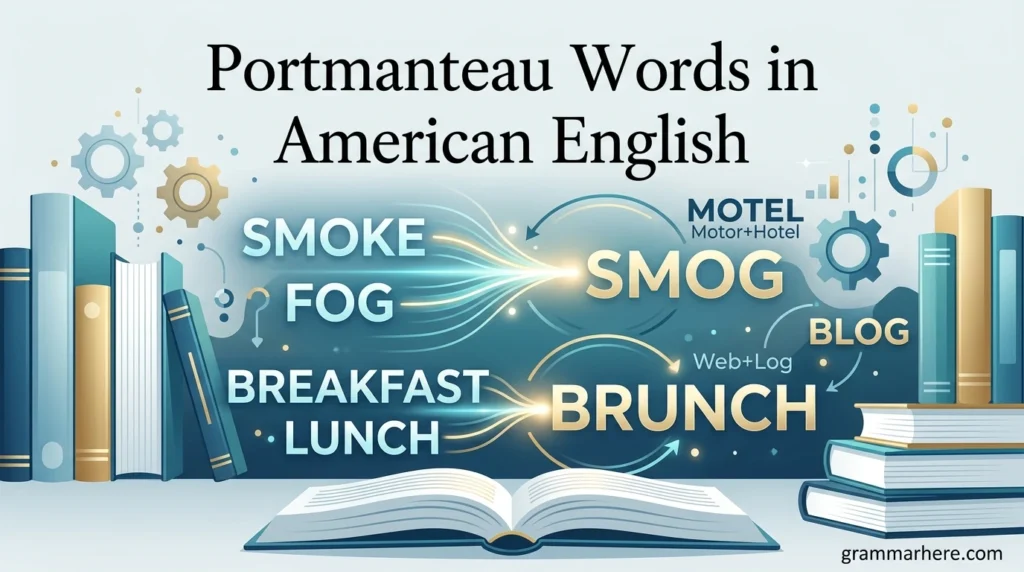
A simple example is “brunch,” formed from “breakfast” and “lunch.” It represents more than food—it represents a lifestyle shift, a relaxed weekend culture where traditional meal boundaries blur. Similarly, “smog” combines “smoke” and “fog,” capturing an environmental reality in one efficient word.
What makes portmanteaus fascinating is their efficiency. Instead of explaining a concept with multiple words, English compresses meaning into a single, catchy term. This not only simplifies communication but also adds personality and creativity to everyday speech.
In American English, portmanteaus often arise organically. People combine words in casual speech, and if the blend becomes useful or popular, it sticks. Over time, these words transition from slang to standard vocabulary, becoming part of dictionaries and formal communication.
Origins and Historical Development of Portmanteaus in English
The concept of portmanteau words dates back to the 19th century, but their roots stretch even further in human language evolution. The term itself was popularized by Lewis Carroll in Through the Looking-Glass, where he described “slithy” (slimy + lithe) and “mimsy” (miserable + flimsy) as “portmanteau words.”
In American English, the rise of portmanteaus accelerated during industrialization and modernization. As society changed rapidly, language adapted to describe new inventions, lifestyles, and cultural experiences. Words needed to be faster, shorter, and more expressive.
The 20th century saw a surge in portmanteau creation through mass media. Radio, television, and advertising encouraged catchy, memorable language. Words like “sitcom” (situational comedy) and “infomercial” (information + commercial) became widely recognized.
Today, the internet has dramatically increased the speed at which new portmanteaus form and spread. Social media platforms act as testing grounds where blended words can go viral overnight. What once took decades to enter mainstream vocabulary can now happen in weeks or even days.
How Portmanteau Words Are Formed
Portmanteau formation is both creative and systematic. It usually involves blending the beginning of one word with the ending of another, though variations exist depending on sound and meaning.
Blending Through Sound
Many portmanteaus prioritize phonetic harmony. For example, “brunch” sounds smooth because the transition from “breakfast” to “lunch” is natural. Similarly, “motel” (motor + hotel) flows easily in speech.
Blending Through Meaning
Some blends prioritize conceptual clarity over sound. “Infotainment” combines “information” and “entertainment,” highlighting content that serves both purposes.
Creative Compression
Sometimes, words are shortened dramatically to create a punchy effect. “Blog” (weblog) is a perfect example of digital-era compression that quickly became standard vocabulary.
The process is rarely formal. Instead, it evolves through usage. If people understand and adopt the new word, it survives. If not, it fades away. This organic development makes portmanteaus a living part of language evolution.
Everyday Life Examples of Portmanteau Words
Portmanteaus are so deeply embedded in American English that we often use them without noticing their structure.
Common examples include:
- Brunch: breakfast + lunch
- Smog: smoke + fog
- Spork: spoon + fork
- Guesstimate: guess + estimate
- Staycation: stay + vacation
Each of these words reflects a cultural need for convenience or expression. “Staycation,” for instance, emerged during times when travel was expensive or restricted, capturing the idea of vacationing at home.
Real-Life Scenarios
Imagine a family deciding to skip travel and enjoy a relaxed weekend at home. Calling it a “staycation” instantly frames the experience positively. Similarly, when weather reports mention “smog,” the word instantly communicates both pollution and visibility issues without extra explanation.
These words become mental shortcuts that help people communicate complex ideas quickly and efficiently in everyday conversation.
Media and Pop Culture Influence on Portmanteaus
American media plays a major role in popularizing portmanteau words. Television shows, movies, and celebrity culture often introduce or reinforce blended terms that eventually enter mainstream language.
For example, “romcom” (romantic comedy) is widely used in entertainment discussions. It simplifies genre classification while also reflecting how audiences consume media in shorthand forms.
Pop culture also encourages playful language creation. Fans often invent portmanteaus to describe celebrity relationships, such as combining names to form “ship names.” These blends spread rapidly on social media platforms, becoming part of online identity and fandom culture.
The entertainment industry itself relies heavily on portmanteaus for branding. Short, catchy names are easier to remember and market. This constant exposure ensures that portmanteaus remain a dynamic and evolving part of American English.
Technology and Internet Language Revolution
The digital age has transformed portmanteau creation into a global phenomenon. Technology demands speed, efficiency, and memorability—all qualities that portmanteaus naturally provide.
Words like “emoji” (from Japanese influence but widely adopted in English usage), “podcast” (iPod + broadcast), and “netizen” (internet + citizen) reflect how technology reshapes language.
Social Media Impact
Platforms like Twitter, Instagram, and TikTok accelerate linguistic creativity. Users constantly experiment with new blends to express trends, emotions, or viral content. A word can be born in a meme and become globally recognized within days.
Digital Communication Needs
Because online communication favors brevity, portmanteaus help reduce long explanations into compact expressions. This efficiency is essential in fast-paced digital environments.
As technology continues to evolve, new portmanteaus will likely emerge to describe experiences we have not yet imagined.
Marketing and Branding Power of Portmanteaus
Companies often use portmanteau words to create memorable brand identities. A well-crafted blend can instantly communicate purpose and attract attention.
Brands favor portmanteaus because they are:
- Easy to pronounce
- Distinctive
- Emotionally engaging
- Easy to trademark
For example, “Pinterest” (pin + interest) suggests a platform where users collect and share ideas visually. Similarly, “FedEx” (Federal + Express) communicates speed and reliability.
Psychological Appeal
Portmanteaus feel modern and innovative. They suggest creativity and forward-thinking, which helps brands connect with younger audiences. A single blended word can carry an entire marketing message.
In competitive markets, the right portmanteau can be the difference between forgettable and iconic branding.
Emotional and Conceptual Power of Blended Words
Portmanteau words are not just functional—they also carry emotional weight. They often reflect shared experiences or cultural shifts in a compact form.
For example, “staycation” evokes relaxation and comfort, while “smog” evokes concern about environmental issues. The emotional tone is embedded directly into the word structure.
These words also shape how people think about concepts. When a new portmanteau becomes popular, it often defines how society understands that idea. Language doesn’t just describe reality—it influences perception.
This emotional efficiency is part of why portmanteaus are so powerful. They compress not only meaning but also feeling.
Common Misunderstandings About Portmanteaus
Many people confuse portmanteaus with other word forms, leading to misunderstanding about their linguistic role.
One common mistake is thinking that all compound words are portmanteaus. However, compounds simply join full words (like “toothbrush”), while portmanteaus blend parts of words.
Another misconception is that portmanteaus are informal or slang-only. In reality, many are fully accepted in academic, scientific, and professional contexts.
Clarifying the Difference
- Portmanteau: Blended parts of words (brunch)
- Compound word: Full words combined (notebook)
- Acronym: Initial letters (NASA)
Understanding these differences helps clarify how English evolves structurally and creatively.
Portmanteaus vs Compound Words and Blends
While portmanteaus and compound words may seem similar, their formation and linguistic behavior differ significantly.
Compound words maintain full word integrity, while portmanteaus merge fragments. For instance, “blackboard” is a compound word, but “brunch” is a portmanteau.
Blends also differ in flexibility. Portmanteaus often feel more playful and modern, while compounds tend to be more traditional and stable in structure.
Why the Difference Matters
Understanding this distinction helps learners better analyze English vocabulary. It reveals how language balances structure with creativity, precision with efficiency, and tradition with innovation.
Learning and Cognitive Impact of Portmanteaus
Portmanteau words also influence how people learn and process language. Because they are compact and often intuitive, they can make vocabulary easier to remember.
Children and language learners often find portmanteaus engaging because they reveal meaning through word structure. Recognizing “smog” as smoke + fog, for example, strengthens memory retention.
These words also encourage creative thinking. Learners begin to see language as flexible rather than fixed, which improves linguistic confidence and experimentation.
In educational settings, teaching portmanteaus can help students understand word formation, semantics, and cultural context simultaneously.
The Future of Portmanteau Words in American English
The future of portmanteau words is closely tied to technological and cultural evolution. As new experiences emerge, language will continue to adapt through blending.
Artificial intelligence, virtual reality, and digital lifestyles are already generating new vocabulary needs. It is likely that future portmanteaus will describe hybrid realities and experiences we cannot yet fully define.
The speed of language evolution will also increase. Social media ensures that new blends can spread globally in hours, not years. This rapid adoption cycle means American English will continue to expand through creative linguistic fusion.
Portmanteaus will remain a symbol of linguistic adaptability and cultural innovation.
Conclusion
Portmanteau words in American English are more than clever linguistic shortcuts—they are reflections of how people think, live, and evolve. From “brunch” and “smog” to modern digital blends like “podcast” and “netizen,” these words capture cultural shifts in compact, meaningful forms.
They demonstrate how language adapts to convenience, creativity, and communication needs. Whether used in everyday conversation, branding, media, or technology, portmanteaus continue to shape how ideas are expressed and understood.
As society changes, so will its vocabulary. New experiences will demand new words, and portmanteaus will continue to emerge as one of the most flexible tools in English. Recognizing them not only improves vocabulary but also deepens our understanding of language as a living, evolving system that grows alongside human experience.
FAQs
1. What is a portmanteau word in simple terms?
A portmanteau word is a blend of two words combined to create a new meaning, such as “brunch” from breakfast and lunch.
2. Are portmanteaus the same as compound words?
No. Compound words join full words together, while portmanteaus mix parts of words to form a new term.
3. Why are portmanteau words popular in American English?
They are concise, creative, and efficient, making communication faster and more expressive in everyday language.
4. Can portmanteau words be formal?
Yes. Many portmanteaus like “infotainment” and “motel” are widely accepted in formal and professional contexts.
5. How are new portmanteau words created?
They usually emerge naturally when speakers blend parts of words to describe new ideas or experiences.
6. What is the difference between slang and portmanteaus?
Slang is informal language, while portmanteaus are structural word blends that can be formal or informal.
7. Do businesses use portmanteau words?
Yes. Many brands use them to create memorable and meaningful names, such as “Pinterest” or “FedEx.”
8. Will portmanteau words continue to grow in the future?
Yes. As language evolves with technology and culture, new portmanteaus will continue to emerge frequently.