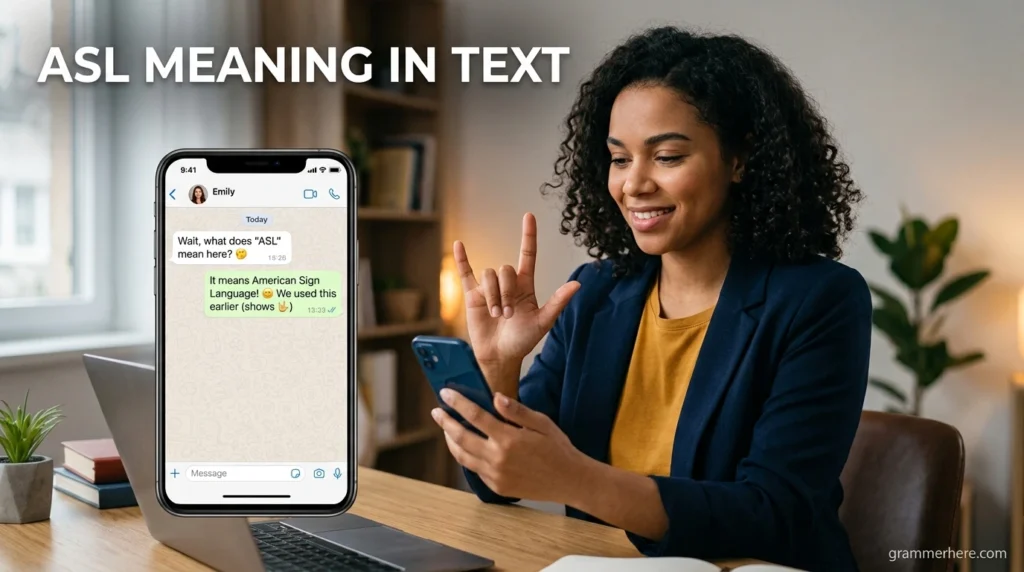
If you have seen “ASL” in a text message, social media comment, or online chat, you may wonder what it means. Internet slang can be confusing because the same abbreviation may have different meanings depending on the conversation. The ASL meaning in text is commonly understood as “age, sex, location,” especially in older online chat culture. However, in modern social media conversations, ASL can sometimes have other meanings, so context is important. Understanding texting abbreviations helps you communicate more confidently on platforms such as WhatsApp, Instagram, TikTok, Snapchat, and other messaging apps. Whether someone sends you “ASL?” or you see the abbreviation in a comment, knowing its meaning can help you understand what the person is asking. In this guide, we will explain the ASL slang meaning, its full form, history, examples, modern usage, possible misunderstandings, and appropriate ways to respond.
What Does ASL Mean in Text?
The most traditional ASL meaning in text is:
ASL = Age, Sex, Location
In online conversations, particularly older chatrooms and messaging communities, someone might type “ASL?” to ask for three basic details:
- A = Age
- S = Sex
- L = Location
For example, if someone sends:
“Hey, ASL?”
They may be asking:
“How old are you, what is your sex, and where are you from?”
This abbreviation became popular because people wanted to ask these questions quickly while chatting online.
However, ASL is not limited to this meaning. Depending on context, it can represent different phrases or organizations. Therefore, you should always consider the surrounding conversation before deciding what the abbreviation means.
ASL Full Form in Texting
The most common traditional full form of ASL in texting is Age, Sex, Location.
ASL Full Form
ASL → Age, Sex, Location
This meaning was especially common during the early days of internet chatrooms, instant messaging, and online communities.
For example:
Person A: ASL? Person B: 21, female, Lahore.
Here, Person A is asking for age, sex, and location.
Another example:
Person A: Hi! ASL? Person B: 19, male, Islamabad.
The abbreviation makes the question much shorter than typing the complete phrase.
ASL Slang Meaning Explained Simply
If you are looking for the ASL slang meaning, the simplest explanation is:
ASL usually means “Age, Sex, Location” in older online chat slang.
It is essentially a quick way of asking someone about their basic personal details.
The term became strongly associated with online strangers meeting and chatting. People in chatrooms often had little information about each other, so asking “ASL?” was an easy conversation starter.
Today, however, the phrase is less common among younger internet users because social media profiles already provide information about a person’s interests, location, age range, or identity.
Where Did ASL Come From?
The use of ASL as “age, sex, location” became popular during the early development of internet chat culture.
Before modern social media platforms became dominant, people often met strangers through:
- Internet Relay Chat (IRC)
- Online chatrooms
- Instant messaging services
- Forums
- Dating and friendship communities
People did not always have profile pictures, biographies, or detailed public profiles. Asking “ASL?” was therefore a quick way to learn basic information about another person.
Why Did ASL Become Popular?
The abbreviation was convenient because typing online was often slower and less sophisticated than it is today.
Instead of writing:
“How old are you, what is your sex, and where are you located?”
Someone could simply type:
“ASL?”
This saved time and became recognizable within online communities.
Is ASL Still Popular Today?
The traditional ASL slang meaning is still understood, but it is not as dominant as it once was.
Modern internet users are more likely to use:
- “How old are you?”
- “Where are you from?”
- “Where do you live?”
- “What’s your age?”
- “What are you into?”
Social media has changed the way people communicate. Profiles often contain information that people previously had to ask for directly.
Still, you may encounter “ASL?” in older online communities, casual chats, dating conversations, or conversations with people familiar with classic internet slang.
How Is ASL Used in Real Conversations?
The meaning becomes much easier to understand when you see natural examples.
Example 1: Basic Chat
Alex: Hey, nice to meet you. Sam: Nice to meet you too. Alex: ASL? Sam: 20, male, Karachi.
Here, ASL clearly means age, sex, location.
Example 2: Meeting Someone Online
Person 1: Where are you from? Person 2: Pakistan. You? Person 1: UK. ASL? Person 2: 22, female, London.
Again, the abbreviation is being used to ask for basic personal information.
Example 3: Casual Conversation
A: ASL? B: 18, male, Lahore. What about you?
This is a short and direct use of the abbreviation.
What Does “ASL?” Mean When Someone Sends It Alone?
If someone sends only:
“ASL?”
the traditional interpretation is:
“What is your age, sex, and location?”
However, you should not automatically assume this meaning in every conversation.
Look at the messages before and after it.
For example:
“Can you do ASL?”
could refer to something completely different, such as American Sign Language.
This is why context matters.
ASL Meaning on WhatsApp
On WhatsApp, ASL can mean different things depending on who is using it.
In an old-fashioned online-chat context, someone saying:
“ASL?”
may mean:
“Age, sex, location?”
However, WhatsApp users may also use ASL to refer to American Sign Language.
For example:
“I am learning ASL.”
Here, ASL almost certainly means American Sign Language, not age, sex, location.
Another example:
“Do you know ASL?”
This could mean:
“Do you know American Sign Language?”
Therefore, WhatsApp context is extremely important.
ASL Meaning on Instagram
On Instagram, the traditional “age, sex, location” meaning is possible, but it is not usually the first meaning modern users encounter.
If someone comments:
“ASL?”
they might be using old internet slang to ask about your personal information.
However, if a post is about communication, deaf culture, or signing, ASL may mean American Sign Language.
For example:
“This ASL tutorial is amazing.”
Here, ASL means American Sign Language.
Should You Give Your Information?
You do not have to answer an ASL question if you do not feel comfortable sharing personal information.
You can simply say:
“I’d rather not share that.”
or:
“Why do you ask?”
Your privacy should come first, especially when communicating with strangers online.
ASL Meaning on TikTok
The ASL meaning on TikTok depends heavily on the video, caption, comment, or conversation.
If someone comments:
“ASL?”
they could be using the classic internet meaning “age, sex, location.”
But TikTok also contains educational content about American Sign Language, so ASL frequently appears with that meaning too.
For example:
“Learning ASL for beginners.”
Here, the meaning is clearly American Sign Language.
How to Identify the Meaning on TikTok
Check the surrounding content.
If the video discusses:
- Sign language
- Deaf communication
- Hand signs
- Signing tutorials
then ASL probably means American Sign Language.
If someone directly asks you:
“ASL?”
during a personal conversation, the traditional slang interpretation may be more likely.
ASL Meaning on Snapchat
On Snapchat, ASL can also be used as an abbreviation for age, sex, location.
For example:
User: Hey You: Hey User: ASL? You: 19, male, Pakistan.
However, Snapchat conversations can involve strangers, so you should be careful about sharing personal information.
You can respond without giving exact details:
“I’m a teenager. I’m from Pakistan.”
You do not need to provide your exact age or location if you do not want to.
ASL vs. American Sign Language
One of the biggest sources of confusion is that ASL also means American Sign Language.
This is completely different from the slang meaning “age, sex, location.”
ASL as Age, Sex, Location
Example:
“ASL?”
Meaning:
“What is your age, sex, and location?”
ASL as American Sign Language
Example:
“I am taking an ASL class.”
Meaning:
“I am taking an American Sign Language class.”
The sentence itself usually makes the intended meaning clear.
ASL Does NOT Always Mean Age, Sex, Location
It is important not to assume that every appearance of ASL is slang.
ASL can refer to:
- Age, Sex, Location
- American Sign Language
- Other specialized meanings in specific fields or communities
Therefore, context is the key.
If someone says:
“ASL interpreter”
they are almost certainly talking about American Sign Language.
If someone says:
“ASL?”
in a personal chat with a stranger, age, sex, location may be intended.
Common Confusions About ASL
Confusion 1: ASL Always Means Age, Sex, Location
Not necessarily.
ASL has a well-known language-related meaning, too.
Confusion 2: ASL Always Means American Sign Language
Also incorrect.
In informal online conversations, especially older chat slang, ASL can mean age, sex, location.
Confusion 3: ASL Is Always Flirty
No.
Someone asking “ASL?” may simply be trying to learn basic information about you.
However, in some conversations, the question may be part of flirting or trying to get personal information.
Confusion 4: You Must Answer ASL Questions
You do not.
You can ignore the question, ask why they want to know, or give a general answer instead.
What ASL Does Not Mean
When someone types “ASL?”, it does not automatically mean:
- “Are you single?”
- “What is your exact address?”
- “Send me your photo.”
- “What is your phone number?”
- “Do you like me?”
- “Tell me everything about yourself.”
The traditional slang meaning is simply age, sex, location.
Anything beyond that depends on the conversation.
How to Reply When Someone Says “ASL?”
There are many ways to respond, depending on your comfort level and the situation.
Polite Response
If you are comfortable answering:
“I’m 20, male, and from Lahore.”
A shorter response could be:
“20, M, Lahore.”
Casual Response
“I’m 19 and from Pakistan. What about you?”
This keeps the conversation friendly.
Privacy-Respecting Response
If you do not want to share personal details:
“I’d rather keep that private.”
Or:
“I don’t usually share personal information with people online.”
This is a perfectly reasonable response.
Ask Them Instead
You can turn the question around:
“Why do you ask?”
Or:
“What do you mean by ASL?”
This is especially useful if you are unsure whether they mean age, sex, location or American Sign Language.
Flirty Responses to “ASL?”
If the conversation is clearly friendly or romantic and you are comfortable, you can use a playful response.
For example:
“Guess my age first 😉”
Or:
“Old enough to know good conversation when I see it 😄”
Another playful answer:
“You first 😏”
These responses avoid giving away too much information immediately.
Keep Flirting Respectful
Flirty replies should still respect personal boundaries. If the person becomes pushy or asks for information you do not want to share, you can say:
“I’m not comfortable sharing that.”
You never have to continue a conversation that makes you uncomfortable.
Boundary-Respecting Responses
If a stranger asks you “ASL?” and you do not want to answer, try:
- “I prefer not to share personal details.”
- “Can we talk about something else?”
- “I’m not comfortable answering that.”
- “Maybe later when we know each other better.”
- “What made you ask?”
These responses are clear without being rude.
Similar Slang Terms and Abbreviations
ASL belongs to a larger group of internet abbreviations designed to make online communication faster.
Here are some related terms:
WYD
WYD = What You Doing?
Example:
“WYD tonight?”
Meaning:
“What are you doing tonight?”
WYA
WYA = Where You At?
Example:
“WYA?”
Meaning:
“Where are you?”
HBU
HBU = How About You?
Example:
“I’m good. HBU?”
Meaning:
“I’m good. How about you?”
BTW
BTW = By The Way
Example:
“BTW, I’ll call you later.”
IDK
IDK = I Don’t Know
Example:
“IDK what happened.”
LOL
LOL = Laughing Out Loud
Example:
“That was so funny lol.”
TBH
TBH = To Be Honest
Example:
“TBH, I really like this song.”
These abbreviations are generally easier to understand because their meanings are more stable in everyday texting.
ASL Compared With WYA
Although ASL and WYA can both involve location, they are not the same.
ASL: Age, Sex, Location
WYA: Where You At?
WYA focuses mainly on someone’s current location.
For example:
“WYA?”
could mean:
“Where are you right now?”
ASL is broader because it traditionally asks for three pieces of information.
ASL Compared With WYD
ASL and WYD are also completely different.
ASL: Age, Sex, Location
WYD: What You Doing?
For example:
“ASL?” = “How old are you, what is your sex, and where are you from?”
while:
“WYD?” = “What are you doing?”
Mixing up these abbreviations can easily change the meaning of a conversation.
Why Internet Slang Keeps Changing
Internet language changes quickly.
New abbreviations appear because users want communication to be:
- Faster
- Shorter
- More casual
- More expressive
- Easier to type on phones
Younger users also create new slang through platforms such as TikTok, Instagram, Snapchat, Discord, and gaming communities.
Some abbreviations remain popular for years, while others disappear quickly.
ASL is an interesting example because its traditional slang meaning belongs strongly to an older era of internet communication, while its other meaning—American Sign Language—remains widely recognized.
ASL and Gen-Z Slang Culture
Is ASL part of modern Gen-Z slang?
Not exactly in the same way as newer Gen-Z expressions.
Many Gen-Z users know abbreviations such as:
- POV
- FR
- NGL
- IMO
- IRL
- RN
- WYD
- WYA
- LOL
The traditional “age, sex, location” use of ASL is more associated with older internet chat culture.
However, younger users may still encounter it through social media, gaming, online communities, or conversations with older internet users.
This makes understanding older slang useful even when the term is not currently trending.
Is ASL Still Popular in 2026?
The answer depends on which meaning you mean.
American Sign Language remains a widely recognized term.
The “age, sex, location” slang meaning, however, is much less common than it was during earlier online-chat culture.
Modern users usually ask these questions directly instead of writing “ASL?”
For example, someone may write:
“How old are you?”
instead of:
“ASL?”
Similarly, they may ask:
“Where are you from?”
instead of using the old abbreviation.
So while you may still see ASL online, its meaning should always be interpreted from context.
Quick ASL Meaning Cheat Sheet
TermMeaningCommon ContextASLAge, Sex, LocationOlder online chat slangASLAmerican Sign LanguageLanguage/educationWYDWhat You Doing?Casual textingWYAWhere You At?Casual textingHBUHow About You?MessagingBTWBy The WayGeneral textingIDKI Don’t KnowCasual chatTBHTo Be HonestSocial media/textingIRLIn Real LifeOnline conversations
FAQs
What does ASL mean in texting?
In traditional internet slang, ASL means “Age, Sex, Location.” Someone using “ASL?” may be asking your age, sex, and where you are from.
What is the ASL full form in chat?
The traditional ASL full form in online chat is Age, Sex, Location. However, ASL can also mean American Sign Language, depending on context.
What does ASL mean on TikTok?
The ASL meaning on TikTok depends on context. It can mean “age, sex, location” in personal chat, while videos about signing and deaf communication usually use ASL to mean American Sign Language.
What does ASL mean on Snapchat?
On Snapchat, ASL may mean Age, Sex, Location, especially when someone asks “ASL?” in a personal conversation. It can also mean American Sign Language.
Is ASL a slang word?
ASL can be considered internet slang when it means Age, Sex, Location. It is an abbreviation rather than a traditional slang word.
Is ASL still used?
Yes, but the “age, sex, location” meaning is less common today than it was in older online chatrooms. ASL meaning American Sign Language remains widely used.
What should I reply to “ASL?”
If you are comfortable, you can provide general information. If you are not comfortable sharing personal details, say “I prefer not to share that” or ask “Why do you ask?”
Does ASL mean American Sign Language?
Yes. American Sign Language is one of the most common meanings of ASL outside texting slang. Context tells you which meaning is intended.
Final Thoughts
The ASL meaning in text is traditionally “Age, Sex, Location.” It became popular during the early days of online chatrooms when people used short abbreviations to communicate quickly with strangers. Today, this slang meaning is less common, but you may still encounter “ASL?” in casual chats, social media, gaming communities, or older internet conversations.
At the same time, remember that ASL also commonly means American Sign Language. The surrounding conversation is the best way to determine which meaning someone intends.