
Imagine walking into your kitchen and noticing a puddle of water on the floor. You see the refrigerator door slightly open and immediately conclude that someone forgot to close it properly. Later that day, after noticing similar puddles several times over the week, you begin to suspect that the refrigerator itself may have a leak.
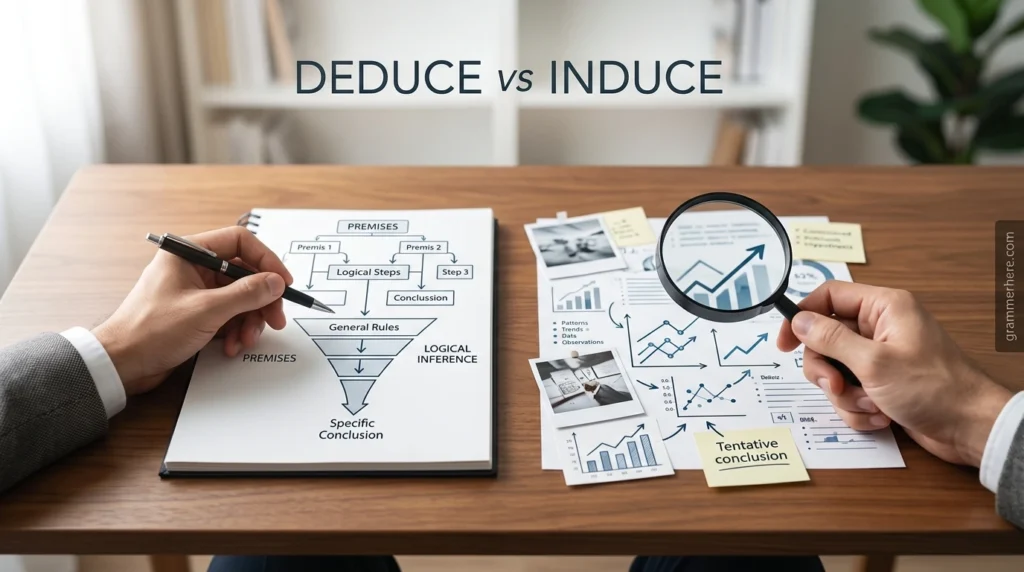
Although both conclusions involve reasoning, they arise from two different mental processes. The first is deduction—drawing a specific conclusion from known facts. The second is induction—forming a broader conclusion based on repeated observations.
Understanding the difference between deduce vs induce is more than a vocabulary exercise. These two forms of reasoning influence how we solve problems, make decisions, learn from experience, conduct research, and interpret everyday events. Whether you’re a student writing an essay, a professional analyzing data, or simply trying to understand the world more clearly, knowing when you’re deducing and when you’re inducing can sharpen your thinking dramatically.
This article explores these concepts in depth, uncovering their meanings, practical applications, common misconceptions, and the valuable lessons they teach about reasoning itself.
What Do Deduce and Induce Mean?
At first glance, the words deduce and induce seem closely related because both involve reaching conclusions. However, they operate in opposite directions.
Deduce means to arrive at a conclusion based on established facts, rules, or evidence. The conclusion logically follows from information already known.
Induce means to form a general principle or conclusion from specific observations or experiences. Instead of starting with a rule, you discover one.
Think of deduction as moving from the general to the specific, while induction moves from the specific to the general.
For example:
- All birds have feathers.
- A sparrow is a bird.
- Therefore, a sparrow has feathers.
This is deduction because the conclusion follows logically from the premises.
Now consider:
- Every sparrow you’ve seen has feathers.
- Every robin you’ve seen has feathers.
- Every eagle you’ve seen has feathers.
- Therefore, birds probably have feathers.
This is induction because you’re creating a general rule from observations.
These distinctions may seem subtle, but they shape how knowledge is built and applied in nearly every field.
Why People Commonly Confuse Deduce and Induce
Many people use these words interchangeably because both involve reaching conclusions. Yet the path taken to reach those conclusions differs significantly.
Part of the confusion comes from everyday language. Someone might say, “I deduced that it would rain today,” when they actually observed dark clouds, rising humidity, and weather patterns over several days. In that case, they induced a prediction from observations.
The confusion also arises because deduction and induction often work together. A detective, for example, may induce patterns from multiple cases and then deduce what happened in a specific crime.
The Language Overlap
In casual conversation, precision often takes a back seat to convenience. As a result:
- Deduce is frequently used to mean “figure out.”
- Induce is sometimes mistaken for “cause.”
While induce can mean “cause” in other contexts, in reasoning it refers to drawing general conclusions from examples.
Recognizing this distinction improves both communication and critical thinking.
Understanding Deductive Reasoning
Deductive reasoning begins with a rule, principle, or established truth and applies it to a particular situation.
When the premises are true and the reasoning is valid, the conclusion must be true.
Imagine a teacher telling students that all assignments submitted after Friday receive a late penalty. A student submits work on Monday. From the rule, you can deduce that the assignment will receive a penalty.
There is little uncertainty because the conclusion directly follows from the given information.
Characteristics of Deduction
Deductive reasoning is:
- Logical and structured
- Based on existing facts or rules
- Highly reliable when premises are correct
- Focused on certainty
This makes deduction valuable in mathematics, law, programming, and formal argumentation.
People often rely on deduction without realizing it. Every time you follow instructions, apply a policy, or interpret a rule, you’re engaging in deductive thinking.
Understanding Inductive Reasoning
Inductive reasoning works differently. Instead of applying existing rules, it seeks to discover them.
Imagine a gardener noticing that plants grow better when placed near a sunny window. After observing this pattern repeatedly across different plants, the gardener concludes that sunlight promotes healthy growth.
This conclusion is reasonable, but unlike deduction, it isn’t guaranteed. Future observations could reveal exceptions.
Characteristics of Induction
Inductive reasoning is:
- Observation-based
- Exploratory and creative
- Useful for identifying patterns
- Probabilistic rather than certain
Scientists, researchers, marketers, and everyday problem-solvers depend heavily on induction.
Whenever you learn from experience, you’re likely using inductive reasoning.
The Direction of Thought: General vs Specific
One of the easiest ways to remember the difference between deduce and induce is to focus on direction.
Deduction travels:
General Rule → Specific Conclusion
Induction travels:
Specific Observations → General Rule
Consider a simple example involving traffic.
Deduction Example
that every road under construction experiences delays.
You learn that Main Street is under construction.
You deduce that Main Street will likely have delays.
Induction Example
notice traffic jams on Main Street every morning.
You observe similar patterns for several weeks.
You induce that rush-hour traffic regularly causes congestion there.
The direction of reasoning is the key distinction.
How Deduction Creates Confidence
There is something comforting about deduction because it provides certainty when the underlying information is trustworthy.
Imagine assembling furniture with a clear instruction manual. Each step logically follows the previous one. If you follow the directions correctly, the result should match expectations.
Life often feels less complicated when deductive reasoning is available because it reduces ambiguity.
Situations Where Deduction Excels
Deduction works especially well when:
- Rules are clearly defined
- Information is complete
- Accuracy is essential
- Consistency matters
This explains why fields such as mathematics and engineering rely heavily on deductive processes.
When certainty is required, deduction is often the preferred tool.
How Induction Fuels Discovery
While deduction offers certainty, induction offers possibility.
Many of humanity’s greatest discoveries began with observation rather than established rules.
A scientist notices recurring patterns. A business owner sees customer trends. A parent observes behaviors in a child. Over time, these observations become insights.
Induction allows people to learn from reality rather than merely apply existing knowledge.
The Power of Patterns
Imagine noticing that every time you exercise regularly, your energy levels improve.
After repeated experiences, you induce that exercise contributes to greater vitality.
You didn’t begin with a formal rule. Instead, the rule emerged from observation.
This pattern-finding ability helps humans adapt, innovate, and grow.
Real-Life Examples of Deduce vs Induce
The distinction becomes clearer when viewed through everyday situations.
At School
A teacher announces that students who score above 90 percent receive honors.
Emma scores 95 percent.
You deduce that Emma receives honors.
Later, after observing that students who attend review sessions consistently score higher, you induce that review sessions improve performance.
At Work
A company policy states that expense reports submitted late require manager approval.
An employee submits one late.
You deduce approval is required.
After reviewing several years of sales data and noticing strong summer growth, you induce that seasonal demand affects revenue.
At Home
You know touching a hot stove causes burns.
The stove is glowing red.
You deduce that touching it would be dangerous.
After repeatedly seeing your dog run to the door before visitors arrive, you induce that the dog notices signs humans often miss.
The Role of Deduction in Problem-Solving
Problem-solving often requires moving from known information toward a solution.
Suppose your computer won’t connect to the internet.
You know:
- If the router is unplugged, internet access fails.
- The internet is not working.
- The router is unplugged.
You deduce the cause of the problem.
This process narrows possibilities and helps identify solutions efficiently.
Why Deduction Matters
Deduction reduces guesswork.
Instead of relying on assumptions, it builds conclusions from established facts.
This makes it especially valuable when mistakes carry significant consequences, such as in medicine, engineering, or legal decisions.
The Role of Induction in Learning and Growth
Most personal growth begins with induction.
Children learn language by hearing repeated examples. Athletes improve by recognizing patterns in performance. Entrepreneurs discover market trends through observation.
Induction allows experience to become knowledge.
Imagine someone keeping a journal for six months. They notice their mood improves after spending time outdoors. Gradually, they induce a connection between nature and emotional well-being.
That insight may influence future choices.
Experience as a Teacher
Induction transforms:
- Experiences into lessons
- Observations into understanding
- Patterns into predictions
Without induction, learning from life would be far more difficult.
Common Mistakes People Make
Understanding the distinction is important because both forms of reasoning can be misused.
Mistakes in Deduction
Deductive reasoning fails when premises are incorrect.
For example:
- All dogs are blue.
- Max is a dog.
- Therefore, Max is blue.
The reasoning structure is valid, but the premise is false.
Mistakes in Induction
Inductive reasoning can lead to overgeneralization.
Imagine meeting two rude tourists from a particular country and concluding that everyone from that country is rude.
The conclusion is based on insufficient evidence.
Strong induction requires numerous observations and careful evaluation.
Recognizing these pitfalls helps people think more critically and avoid flawed conclusions.
How Deduction and Induction Work Together
In reality, deduction and induction rarely operate separately.
They often function as partners.
A scientist may observe a pattern and induce a theory. Then they use deduction to predict outcomes based on that theory. Experiments test whether those predictions are correct.
This cycle repeats continuously.
A Simple Example
Suppose a baker notices bread rises better on humid days.
Through observation, they induce a possible relationship.
Next, they deduce that if humidity affects rising, today’s humid conditions should improve the next batch.
Testing the prediction helps confirm or challenge the original idea.
Many breakthroughs emerge from this combination of reasoning methods.
Deduce vs Induce in Communication and Relationships
Reasoning doesn’t only occur in classrooms and laboratories. It shapes relationships as well.
Imagine a friend seems unusually quiet.
You know they recently experienced a stressful event. From that information, you may deduce why they’re withdrawn.
Over time, you might notice a broader pattern: whenever people feel overwhelmed, they tend to become less communicative. That broader understanding is induced from multiple experiences.
Why This Matters
Strong relationships depend on accurate interpretation.
Understanding whether you’re making a deduction or an induction can help you:
- Avoid assumptions
- Ask better questions
- Show greater empathy
- Communicate more effectively
Awareness of your reasoning process often leads to wiser judgments.
Practical Tips for Using Both Effectively
Developing stronger reasoning skills involves knowing when each approach is most appropriate.
When to Use Deduction
Use deduction when:
- Rules are known
- Facts are reliable
- Precision is important
- Conclusions need certainty
When to Use Induction
Use induction when:
- Exploring new ideas
- Identifying patterns
- Learning from experience
- Building theories or predictions
Ask Yourself Key Questions
When evaluating a conclusion, consider:
- Am I applying a known rule?
- Or am I creating a rule from observations?
- Is my conclusion certain or probable?
- Do I have enough evidence?
These questions help clarify your thinking and improve decision-making.
The Deeper Lesson Behind Deduce vs Induce
Beyond grammar and logic, the distinction between deduce and induce reveals something profound about human understanding.
We live between certainty and possibility.
Deduction represents the knowledge we already possess. It helps us navigate established truths and dependable principles.
Induction represents curiosity and discovery. It allows us to learn from experience and uncover new insights.
Neither is superior to the other. One provides stability; the other enables growth.
Every day, people move between these modes of thinking—applying what they know while remaining open to what they might learn.
Understanding this balance encourages intellectual humility. It reminds us that some conclusions are certain, while others remain informed possibilities.
Conclusion
The comparison of deduce vs induce goes far beyond a simple vocabulary distinction. Deduction involves drawing specific conclusions from established facts or rules, while induction involves forming broader conclusions from observations and experiences. One moves from the general to the specific; the other moves from the specific to the general.
Throughout daily life, both reasoning methods play essential roles. Deduction helps us apply known principles with confidence, while induction enables us to recognize patterns, make predictions, and discover new ideas. From solving problems at work to understanding relationships and learning from experience, these forms of thinking shape how we interpret the world.
The most effective thinkers know when to rely on each approach. By recognizing whether you’re deducing or inducing, you can communicate more clearly, evaluate evidence more carefully, and make better decisions. Ultimately, mastering both methods provides a richer, more balanced way of understanding life and the countless conclusions we draw every day.