
Introduction
Picture this: someone walks into a room, pauses for a moment, then climbs onto a chair to fix a bulb. Two small prepositions—into and onto—quietly guide the entire meaning of that scene. Most native speakers use them without thinking, but for learners and even writers, these tiny words can feel surprisingly confusing. Why? Because they are not just about grammar—they are about movement, direction, space, and sometimes even intention.
The difference between into and onto may look simple at first glance, yet it carries layers of meaning that shape how we describe actions in real life. One shows movement toward the inside of something, while the other shows movement toward a surface. But beyond rules, they help us visualize experiences more clearly. Whether you’re writing a story, giving instructions, or simply speaking English naturally, understanding these prepositions can make your communication sharper, more accurate, and more expressive.
In this article, we’ll explore into and onto in depth—how they work, where they differ, why they matter, and how mastering them can improve both your grammar and your confidence in using English.
Meaning of “Into” and “Onto”
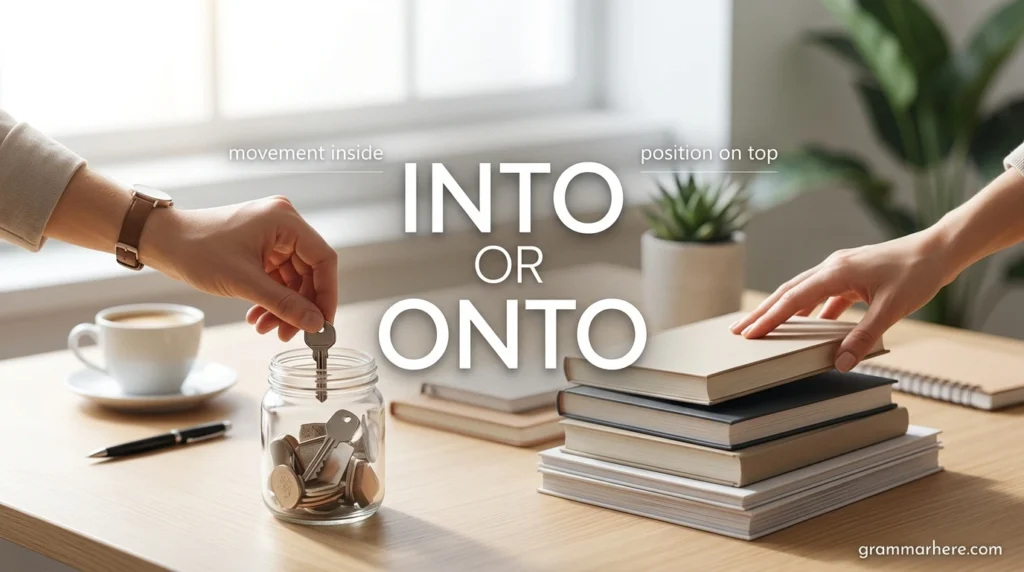
At their core, into and onto are prepositions of movement, but they describe different spatial relationships.
Into expresses movement from outside to the inside of something. It suggests entry, immersion, or transition into a space or condition. For example, “She walked into the house” shows that she moved from outside to inside.
Onto, on the other hand, expresses movement toward a surface or position on top of something. For instance, “He climbed onto the roof” shows movement from ground level to a higher surface.
The difference lies in where the movement ends: into ends inside a boundary, while onto ends on a surface.
Simple Visualization
- Into = entering a box, room, or container
- Onto = stepping on a table, roof, or platform
These distinctions help the listener or reader imagine the action clearly. Without them, sentences lose precision and sometimes even change meaning. Understanding this foundation is essential before moving into more complex uses.
Core Grammatical Difference
The grammatical distinction between into and onto is rooted in direction and result.
Into combines movement + enclosure. It often pairs with nouns that represent enclosed or bounded spaces such as rooms, buildings, water, or abstract states like confusion or trouble.
Onto combines movement + surface contact. It pairs with nouns representing flat or raised surfaces like tables, floors, walls, or objects you can stand or place something on.
Structural Understanding
- Subject + verb + movement + into + enclosed space
- Subject + verb + movement + onto + surface
For example:
- The cat jumped into the box.
- The cat jumped onto the box.
Notice how the meaning changes depending on whether the box is seen as a container or a surface. This is where learners often get confused. English relies heavily on perspective, so understanding context is just as important as memorizing rules.
Spatial Imagery and Physical Movement
Both into and onto help build mental images of movement, almost like a camera capturing action in real time.
When someone says, “The ball rolled into the tunnel,” your mind pictures the ball disappearing inside a dark space. But if they say, “The ball rolled onto the field,” you imagine it landing on a flat grassy area.
Why Spatial Awareness Matters
Language is not just about words—it is about visualization. Prepositions like these guide how we imagine movement.
Real-Life Example Scenarios
- A child jumps into a swimming pool → full immersion
- A child jumps onto a diving board → surface landing
These small distinctions shape storytelling, instructions, and even safety directions. Misusing them can create confusion, especially in technical or instructional contexts.
Understanding spatial imagery makes your language more natural and expressive, helping listeners “see” what you mean instead of just hearing it.
Psychological and Conceptual Uses
Interestingly, into and onto are not limited to physical movement. They also describe emotional or mental transitions.
Into as a Mental State
Into often describes becoming involved in something:
- She got into trouble.
- He is into music.
- They fell into depression.
Here, “into” represents immersion into a situation, interest, or emotional state.
Onto as Awareness or Control
Onto can imply control or discovery:
- The police are onto the suspect.
- She is onto a new idea.
In these cases, onto suggests gaining access to something hidden or moving closer to understanding.
These metaphorical uses show how deeply embedded prepositions are in expressing human thought and emotion. They are not just grammar tools—they reflect how we experience reality.
Into in Everyday Life Examples
Into is one of the most frequently used prepositions in English because it applies to countless daily situations.
Physical Entry Examples
- He walked into the room.
- She poured milk into the glass.
- The car drove into the garage.
Each example shows movement from outside to inside a defined space.
Emotional and Situational Examples
- He got into an argument.
- She went into shock.
- They ran into difficulties.
These expressions show how into extends beyond physical space into experiences and conditions.
Why It Feels Natural
We often think of life changes as “entering” something new—like entering a phase, problem, or emotion. That’s why into is so powerful: it mirrors how humans perceive transitions.
Onto in Everyday Life Examples
Onto is equally important but used in more specific physical and metaphorical contexts.
Physical Surface Movement
- She jumped onto the bed.
- The book fell onto the floor.
- He stepped onto the platform.
Each action involves contact with a surface rather than entry into a space.
Figurative Uses
- The team is onto a winning strategy.
- He is onto something important.
Here, onto suggests discovery or progress toward understanding.
Everyday Relevance
We often use onto when describing actions that involve elevation, positioning, or awareness. It brings precision to descriptions involving surfaces and discovery.
Common Mistakes Learners Make
One of the most frequent errors is confusing into and onto based on translation rather than meaning.
Mistake 1: Misinterpreting Space
- Incorrect: He jumped into the table.
- Correct: He jumped onto the table.
The table is a surface, not a container.
Mistake 2: Ignoring Context
- Incorrect: She poured water onto the glass.
- Correct: She poured water into the glass.
A glass is a container, not a surface.
Mistake 3: Literal Translation Errors
Many learners translate directly from their native language, which often does not distinguish between surface and interior movement.
The key is to visualize the action, not just translate words.
Subtle Cases and Borderline Usage
Some situations are not as clear-cut, and context becomes essential.
Example: Boxes and Containers
- “He put the papers into the box” (inside)
- “He stacked boxes onto each other” (surface contact)
A box can function as both container and surface depending on usage.
Example: Vehicles
- “She got into the car” (entering inside)
- “He climbed onto the bus roof” (surface)
Even familiar objects can shift meaning depending on perspective.
Key Insight
English is flexible. The same object can change grammatical interpretation based on how it is used in the sentence. Understanding intent is more important than memorizing rigid rules.
Role in Phrasal Verbs
Both into and onto appear in many phrasal verbs, shaping their meanings.
Into in Phrasal Verbs
- Break into (enter illegally or suddenly)
- Look into (investigate)
- Run into (meet unexpectedly)
These verbs often imply entry into situations or experiences.
Onto in Phrasal Verbs
- Hold onto (grip tightly)
- Get onto (contact or board something)
- Climb onto (physically move up)
These often emphasize surface contact or action toward position.
Phrasal verbs show how prepositions are deeply integrated into English meaning, not just grammar rules.
Writing Clarity and Style Impact
Using into and onto correctly improves writing clarity and reader experience.
Why It Matters in Writing
- Prevents confusion in instructions
- Enhances storytelling detail
- Improves professional communication
For example:
- “She walked into the meeting” (participation context)
- “She stepped onto the stage” (performance context)
Stylistic Effect
Correct usage adds subtle precision. Readers unconsciously build clearer mental images, making your writing more engaging and natural.
Writers who master these distinctions often produce smoother, more vivid descriptions.
Practical Memory Tricks
Learning grammar is easier with mental shortcuts.
Trick 1: Inside vs Surface Rule
- Into = inside something
- Onto = on top of something
Trick 2: Visualization Method
Imagine:
- A box → into
- A table → onto
Trick 3: Action Test
Ask:
- Am I entering something? → into
- Am I landing on something? → onto
Trick 4: Motion Flow
Think of movement direction:
- Into = inward flow
- Onto = upward or surface flow
These simple tricks help reduce confusion and make usage automatic over time.
FAQs
1. What is the main difference between into and onto?
Into shows movement inside something, while onto shows movement on a surface.
2. Can into and onto be used in the same sentence?
Yes, for example: “He walked into the room and climbed onto the chair.”
3. Is it correct to say “onto the room”?
No, rooms are spaces, so “into the room” is correct.
4. Can onto be used for emotions?
Not usually. Emotional states typically use “into,” such as “into trouble.”
5. Why do learners confuse into and onto?
Because both involve movement, but they differ in spatial perspective.
6. Is into always about physical movement?
No, it can also describe mental or emotional states.
7. Can onto mean discovery?
Yes, as in “The detective is onto the truth.”
8. How can I quickly master into vs onto?
Practice by visualizing whether the action involves entering a space or landing on a surface.
Conclusion
The difference between into and onto may seem small, but it carries significant meaning in English communication. One describes entering spaces and experiences, while the other describes landing on surfaces or discovering something new. Together, they shape how we express movement, emotion, and thought with precision.