Imagine sitting at a busy café on a rainy afternoon. Through the window, people hurry past with umbrellas tilted against the wind. You suddenly notice a child splashing in puddles, laughing while everyone else rushes by. At that moment, you see the child. Then your attention shifts, and you deliberately look toward the street to understand what caught your eye. A few minutes later, you continue watching the scene as the child jumps from puddle to puddle while the rain keeps falling.
These three simple verbs—see, look, and watch—appear almost identical at first. Many English learners use them interchangeably, assuming they all mean the same thing. Yet native speakers naturally understand that each word carries a different feeling, intention, and level of attention.
Learning the distinction is more important than it may seem. These words appear constantly in conversations, movies, classrooms, books, and workplaces. Using the wrong one can make a sentence sound awkward or confusing. More importantly, understanding them deeply helps you communicate thoughts more naturally and precisely. This article explores not only the meanings of see, look, and watch, but also the emotions, situations, habits, and subtle human behaviors connected to each one.
The Core Meaning of See, Look, and Watch
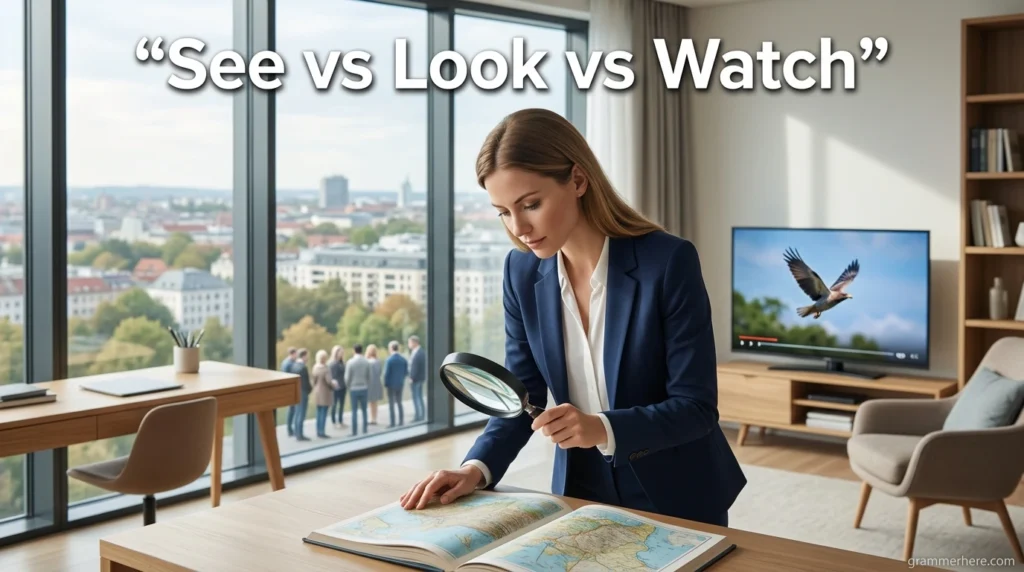
At the heart of these three verbs lies one important difference: attention.
- See happens naturally.
- Look requires intention.
- Watch involves ongoing attention over time.
Think of walking into a room. You may immediately see a bright red chair because it catches your eye automatically. If someone says, “Look at that painting,” you intentionally direct your eyes toward it. If a movie starts playing, you may watch it for two hours because your attention stays focused continuously.
These differences may seem small, but they shape the meaning of countless sentences.
Consider these examples:
- “I saw a bird.”
- “I looked at the bird.”
- “I watched the bird fly away.”
The first sentence simply means the bird entered your vision. The second shows deliberate attention. The third suggests you followed the bird’s movement over time.
This progression mirrors how humans experience the world. First, we notice something. Then we focus on it. Finally, we may stay engaged with it.
Understanding this sequence helps learners avoid one of the most common English mistakes: using these verbs as perfect substitutes. They overlap, but they are not identical. Each word creates a slightly different picture in the listener’s mind.
What Does “See” Really Mean?
The verb see often feels passive and effortless. It describes something that enters your vision without deliberate action.
You wake up in the morning and see sunlight through the curtains. You walk down a street and see cars passing by.
In all these situations, your eyes naturally receive information.
But see goes deeper than physical vision. English speakers also use it to describe understanding, realization, and emotional awareness.
For example:
- “I see what you mean.”
- “Now I see the problem.”
- “She finally saw the truth.”
Here, see means mentally understanding something.
Seeing Without Trying
One reason learners confuse these verbs is because see feels automatic. You usually cannot control it completely. If your eyes are open, you naturally see many things around you.
Imagine entering a crowded market. You instantly see colorful fruits, people talking, and signs hanging above the shops. You did not choose every detail individually; your brain absorbed them automatically.
This passive quality makes see different from look and watch, which involve conscious effort.
Emotional Meaning of “See”
Sometimes see carries emotional weight.
When someone says: “I felt seen.”
They do not mean physically visible. They mean understood, valued, and emotionally recognized.
This reveals something beautiful about language: vision is often connected to human connection and understanding.
The True Purpose of “Look”
Unlike see, the word look involves intention. You choose to direct your eyes somewhere.
If a teacher says, “Look at the board,” students actively focus their vision. If a parent says, “Look both ways before crossing,” the child intentionally checks the road.
The action is deliberate.
Looking as a Decision
Looking often represents curiosity, searching, or concentration.
Imagine losing your keys. You do not simply see for them—you look for them.
That tiny difference changes everything. Looking suggests effort and purpose.
Examples include:
- “Look at this photo.”
- “She looked out the window.”
- “He looked for his wallet.”
Each sentence involves directed attention.
The Emotional Side of Looking
Looking can also reveal feelings.
A nervous student may avoid looking at the teacher. A person in love may look at someone differently than everyone else. Parents often look proudly at their children during school performances.
Where we look often reflects what matters to us emotionally.
Common Phrase Patterns
The verb look appears in many everyday expressions:
- Look at
- Look for
- Look after
- Look forward to
- Look around
Each phrase changes meaning slightly, making look one of the most flexible verbs in English.
Why “Watch” Requires Time and Attention
The verb watch combines focus with duration. You do not merely direct your eyes briefly—you continue paying attention over time.
You watch a football match, watch a movie, or watch children playing in a park.
The key idea is sustained observation.
Watching Movement and Change
Most things we watch involve action or movement.
For example:
- watching birds fly
- watching waves crash
- watching people dance
The scene unfolds gradually, and your attention follows it.
Imagine sitting beside a window during a thunderstorm. You may first see lightning. Then you look toward the sky. Afterward, you might watch the storm for an hour.
That sequence perfectly demonstrates the difference between the three verbs.
Watching and Human Emotion
Watching often creates emotional involvement.
People watch sunsets because they feel peaceful. Families watch old videos because they feel nostalgic. Fans watch sports because they feel excitement and suspense.
Watching is rarely passive. Emotion usually accompanies it.
The Simple Formula That Helps Remember the Difference
Many learners struggle to remember when to use each word. One helpful formula is this:
VerbAttention LevelTime InvolvedIntentional?SeeLowInstantNoLookMediumShortYesWatchHighLongerYes
This table explains the relationship clearly.
A Real-Life Example
Imagine walking through a park:
- You see a dog.
- You look at the dog.
- You watch the dog chase a ball.
The situation evolves naturally from passive noticing to active observation.
Once learners understand this pattern, choosing the correct word becomes much easier.
Common Mistakes English Learners Make
Even advanced learners confuse these verbs because translations in other languages often overlap.
Here are some common mistakes:
Mistake 1: “Watch” for Static Objects
Incorrect:
- “I watched the picture on the wall.”
Correct:
- “I looked at the picture on the wall.”
Pictures do not move, so look works better.
Mistake 2: Using “See” for Deliberate Attention
Incorrect:
- “See this chart carefully.”
Correct:
- “Look at this chart carefully.”
If attention is intentional, use look.
Mistake 3: Confusing Movies and Photos
We usually:
- watch movies
- watch TV
- look at photos
- look at paintings
Why? Because movies involve ongoing movement and action.
Mistake 4: Forgetting Time Duration
If attention continues over time, watch is often the correct choice.
You can:
- watch a baby sleep
- watch traffic move
- watch rain fall
The action unfolds gradually.
How Native Speakers Naturally Use These Words
Native speakers rarely think consciously about grammar when using these verbs. Instead, they rely on instinct developed through experience.
Understanding that instinct can help learners sound more natural.
Everyday Conversations
A friend might say:
- “Did you see that?” after something surprising happens suddenly.
But they would say:
- “Watch this!” before showing a trick or performance.
And they might say:
- “Look at this!” when showing a photo on their phone.
Each verb fits a specific social purpose.
Tone and Energy
These verbs also carry different energy levels.
- See feels relaxed and automatic.
- Look feels direct and intentional.
- Watch feels engaged and immersive.
Understanding these emotional tones improves speaking fluency.
The Hidden Psychological Difference Between Them
Language often reflects human psychology. These verbs reveal how attention works in the mind.
Seeing Is Automatic Awareness
Humans constantly see things without conscious control. Our brains absorb visual information automatically for survival and awareness.
This makes see psychologically passive.
Looking Is Directed Focus
Looking requires decision-making. Your mind chooses a target and focuses attention deliberately.
This mirrors concentration and curiosity.
Watching Is Sustained Engagement
Watching activates deeper mental involvement. Your brain follows movement, predicts outcomes, and stays emotionally connected over time.
This explains why watching movies, sports, or performances can feel emotionally exhausting or exciting.
The verbs are not merely grammar—they reflect how human attention operates.
Real-Life Situations That Clarify the Difference
Sometimes the clearest way to understand language is through everyday situations.
At the Cinema
You:
- see the movie poster
- look at the ticket
- watch the movie
Each action involves a different level of engagement.
In a Classroom
Students:
- see words on the board
- look at diagrams carefully
- watch the teacher demonstrate an experiment
Again, attention gradually deepens.
During Travel
Travelers:
- see mountains in the distance
- look at maps
- watch sunsets over the ocean
These examples feel natural because they mirror real human experiences.
Idioms and Expressions Using See, Look, and Watch
English uses these verbs in many expressions that extend beyond physical vision.
Expressions with “See”
- “See you later”
- “I see your point”
- “Let me see”
- “Seeing is believing”
These expressions often involve understanding or future meetings.
Expressions with “Look”
- “Look out!”
- “Look here”
- “Look on the bright side”
- “Don’t look back”
These usually involve direction, warning, or perspective.
Expressions with “Watch”
- “Watch your step”
- “Watch your language”
- “Watch out”
- “Time will watch over us” (poetic use)
These often suggest caution or attention.
Learning idioms helps students move beyond textbook English into natural communication.
Why Context Changes Everything
One fascinating aspect of English is that context can slightly shift meaning.
For example:
- “I saw him dancing.”
- “I watched him dancing.”
The first sentence may describe a brief moment. The second suggests longer observation and deeper attention.
Similarly:
- “Look at him.” sounds direct and intentional.
But:
- “See him.” may refer to meeting him rather than visually observing him.
Context shapes interpretation.
Emotional Context Matters Too
A mother watching her child perform in a school play feels emotionally engaged.
A tourist looking at a monument may simply feel curious.
Someone seeing smoke suddenly may feel alarmed.
The verbs interact with emotion, setting, and purpose.
Practical Tips to Use These Words Correctly
Understanding theory helps, but practical habits make learning permanent.
Tip 1: Ask Yourself About Attention
Before choosing a verb, ask: “How much attention is involved?”
- little attention → see
- intentional attention → look
- continuous attention → watch
Tip 2: Think About Time
Does the action continue over time?
If yes, watch may be best.
Tip 3: Notice Movement
Moving things are often watched:
- sports
- animals
- films
- performances
Still objects are usually looked at:
- photos
- paintings
- signs
Tip 4: Listen to Native Usage
Movies, podcasts, and conversations reveal natural patterns. Repeated exposure builds instinct.
How Children Learn These Verbs Naturally
Children provide an interesting example of language learning.
A parent might say:
- “Look at the bird!” The child intentionally focuses attention.
Later:
- “Did you see the bird?” The parent checks whether the child noticed it.
And then:
- “Watch the bird fly!” The child follows the movement.
Children learn these distinctions gradually through experience, not grammar rules alone.
This reminds adult learners that language becomes easier through repeated real-world exposure.
Why These Small Differences Matter in Communication
Some learners wonder whether these distinctions truly matter. After all, people may still understand the general meaning.
But subtle language differences shape clarity, tone, and naturalness.
Compare these:
- “I watched your photo.”
- “I looked at your photo.”
The first sounds strange because photos are static.
Or compare:
- “I saw TV last night.”
- “I watched TV last night.”
The second sounds natural because television involves continuous viewing.
Correct word choice makes speech smoother, clearer, and more native-like.
It also helps listeners understand exactly what kind of attention or experience you mean.
FAQs
1. What is the main difference between see, look, and watch?
See is automatic, look is intentional, and watch involves continuous attention over time.
2. Do we say “watch TV” or “see TV”?
We usually say “watch TV” because television programs involve ongoing viewing.
3. Can I say “look a movie”?
No. The correct phrase is “watch a movie” because movies involve movement and duration.
4. Why do we say “look at a picture”?
Pictures are static objects, so we intentionally direct our eyes toward them rather than watching them.
5. Is “see” always passive?
Mostly yes, but it can also mean understanding, such as “I see your point.”
6. What kinds of things do people usually watch?
People commonly watch movies, sports, performances, animals, and moving events.
7. Can “watch” mean being careful?
Yes. Expressions like “Watch your step” mean “be careful” or “pay attention.”
8. Which verb is best for beginners to practice first?
Start by understanding the attention difference:
- see = notice
- look = focus
- watch = follow over time
This simple rule solves most confusion.
Conclusion
The difference between see, look, and watch may appear small, yet these three verbs reveal how humans interact with the world through attention and awareness. We see things naturally, often without effort. We watch when something holds our attention over time and draws us into an experience.
Understanding these distinctions improves far more than grammar. It sharpens communication, helps learners sound natural, and deepens awareness of how language reflects human behavior. Every conversation, movie, classroom lesson, and everyday moment offers chances to notice these patterns in action.