
Introduction
Imagine reading a sentence that says, “Her confidence began to sore after the speech.” Something feels off, yet your brain understands the idea behind it. Now picture another line: “His confidence began to soar after the speech.” Suddenly, everything clicks. One tiny spelling difference completely transforms pain into flight, struggle into success, heaviness into elevation.
This is the fascinating confusion between “sore” and “soar.” These two words sound almost identical when spoken, but they carry entirely different meanings. One relates to pain, discomfort, or emotional sensitivity, while the other represents rising, flying, and reaching higher levels. Because they are homophones (words that sound alike but differ in meaning and spelling), they often confuse learners, writers, and even native speakers.
Understanding the difference is more than just grammar—it helps you communicate clearly, avoid embarrassing mistakes, and express ideas with precision. In writing, a single swapped letter can change your entire message. This article explores both words in depth, their meanings, uses, examples, and simple tricks to never confuse them again.
1. Core Meaning of Sore vs Soar
At the heart of the confusion lies a simple truth: “sore” and “soar” belong to completely different worlds.
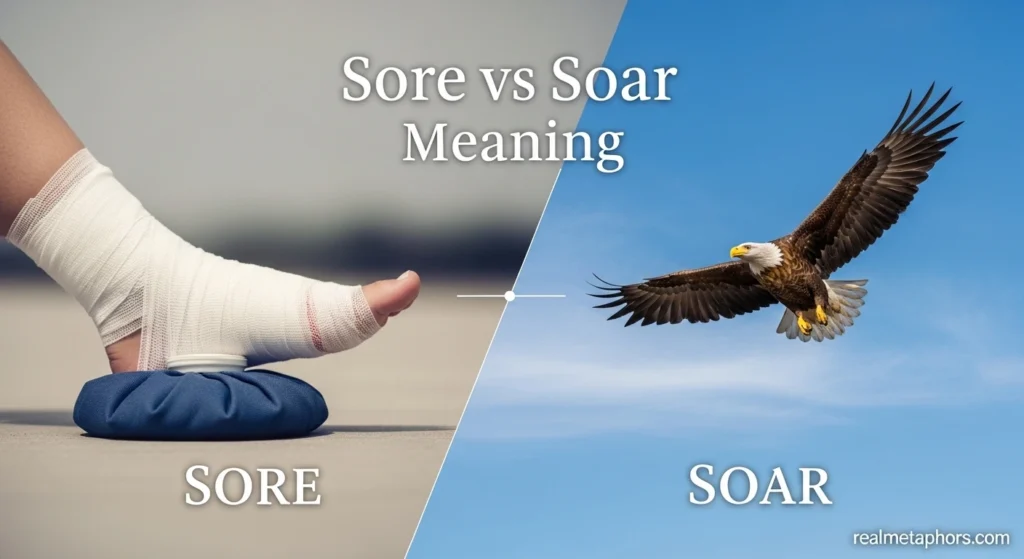
Sore is related to pain, discomfort, or irritation. It is commonly used when describing physical pain in the body or emotional hurt. For example, after a long workout, your muscles feel sore. After an argument, your feelings might feel sore.
Soar, on the other hand, means to rise high, fly upward, or increase dramatically. Birds soar in the sky. Prices can soar in the market. Confidence can soar after success.
Simple Breakdown:
- Sore = Pain / discomfort / sensitivity
- Soar = Rise / fly / increase / grow
What makes this confusing is pronunciation. Both sound identical when spoken quickly. However, their meanings sit at opposite ends of human experience—one grounded in pain, the other in elevation and freedom.
Understanding this basic distinction helps build clarity before diving into deeper examples and real-life usage.
2. Pronunciation Confusion: Why They Sound the Same
One of the biggest reasons people confuse these words is pronunciation. Both sore and soar are pronounced exactly the same: /sɔːr/.
This creates a challenge in spoken English. When someone hears the word, they must rely entirely on context to understand the meaning. For example:
- “My legs are sore” → pain
- “Eagles soar above mountains” → flying
Because there is no difference in sound, learners often mix up spelling when writing. This is especially common in fast typing, texting, or exams.
Why It Happens:
- English has many homophones
- Spelling doesn’t always match sound
- Context is not always clear for beginners
Real-Life Situation:
Imagine a student writing, “My dreams will sore high.” The sentence sounds correct when spoken, but written English demands precision. The correct version is “soar high.”
This is why mastering spelling is essential. Even though pronunciation is identical, meaning depends entirely on correct word choice.
3. Etymology and Language Roots
The origins of these words show how differently they evolved.
Sore comes from Old English “sāre,” meaning painful or wounded. It has always been associated with physical or emotional distress. Over centuries, it kept its connection to discomfort and sensitivity.
Soar, however, has a more uplifting origin. It comes from Old French “essorer,” meaning to fly up or take flight, especially used for birds. It carries a sense of freedom, movement, and elevation.
Key Insight:
- Sore = grounded in pain and human vulnerability
- Soar = connected to movement, air, and upward motion
Even historically, these words represent opposite experiences of life: suffering versus rising.
Understanding their roots helps learners remember that these words are not just spelling variations—they are conceptually opposite ideas shaped by different linguistic histories.
4. Understanding “Sore” in Physical Pain
The most common use of sore is physical discomfort. It describes parts of the body that feel painful, tender, or irritated.
After exercise, your muscles may feel sore. If you have a throat infection, your throat becomes sore. Even a small injury can make a body part sore.
Examples:
- My arms are sore after lifting weights.
- She has a sore throat and cannot speak properly.
- His feet felt sore after walking all day.
Types of Physical Soreness:
Muscle Soreness
Occurs after exercise or physical effort.
Throat or Body Soreness
Often caused by infection or strain.
General Body Soreness
A tired, achy feeling across the body.
Soreness is usually temporary but uncomfortable. It signals that the body needs rest or care. This is why “sore” often appears in health-related conversations.
5. Sore in Emotional Language
“Sore” is not limited to physical pain—it also describes emotional hurt.
When someone says, “She is sore about the breakup,” it means she is emotionally upset or hurt. The feeling is not visible, but it is deeply experienced.
Emotional Uses:
- Sore feelings after criticism
- Sore about losing a competition
- Sore over misunderstandings
Example Scenario:
A student who studies hard but receives a low grade may feel sore about the result. The disappointment is emotional, not physical, but still real.
This usage shows how language connects body and mind. Emotional soreness behaves like physical pain—it lingers, affects mood, and needs time to heal.
Understanding this meaning helps in communication, especially in relationships and storytelling.
6. Understanding “Soar” in Its Literal Meaning
Unlike “sore,” soar represents movement, height, and freedom.
Literally, it is used for birds or objects rising high in the sky. Eagles, hawks, and planes soar above the earth.
Examples:
- The eagle soared above the mountains.
- The kite soared in the windy sky.
- The plane soared through the clouds.
Literal vs Figurative Soar:
Literal Soar:
Physical movement upward in the air.
Visual Image:
A bird spreading its wings and gliding without effort.
Soar gives a sense of freedom, lightness, and control over gravity. It is often associated with nature, skies, and open space.
This literal meaning forms the foundation for its metaphorical uses in language.
7. Soar in Motivation and Success
Beyond physical flight, soar is widely used in emotional and motivational contexts.
It describes rapid growth, success, or improvement.
Examples:
- Her confidence soared after the presentation.
- Sales soared during the festival season.
- His happiness soared when he heard the news.
Why “Soar” Feels Powerful:
It suggests upward movement without limits. Unlike slow growth, soaring feels fast, dramatic, and inspiring.
Real-Life Reflection:
When someone overcomes fear or achieves success, we often say they “soar” because their progress feels like breaking free from limitations.
This metaphor is powerful in speeches, writing, and storytelling because it creates a vivid image of rising beyond obstacles.
8. Common Mistakes and Confusion
Many learners mix up sore vs soar because of spelling and sound similarity.
Frequent Errors:
- My confidence will sore → ❌
- My muscles will soar → ❌
- Birds sore in the sky → ❌
Why Mistakes Happen:
- Same pronunciation
- Fast typing errors
- Lack of context awareness
Simple Truth:
If it involves pain → use sore If it involves rising → use soar
Even experienced writers sometimes make mistakes when typing quickly, but proofreading solves this easily.
9. Memory Tricks to Never Confuse Them
A few simple tricks can help you remember the difference forever.
Trick 1: “Pain has OR in Sore”
Think of sore = pain OR discomfort
Trick 2: “Soar has wings”
Soar looks like “air” or “flight”—imagine a bird flying.
Trick 3: Emotional Association
- Sore = slow, heavy feeling
- Soar = light, upward movement
Trick 4: Visualization
Picture:
- Sore = bandage, injury, tired body
- Soar = sky, wings, freedom
These mental images help lock the meanings in your memory naturally.
10. Real-Life Conversation Examples
Understanding usage becomes easier through dialogue.
Example 1:
A: Why are you walking slowly? B: My legs are sore after yesterday’s match.
Example 2:
A: How did the presentation go? B: Great! My confidence soared after the first slide.
Example 3:
A: Is the bird injured? B: No, it’s soaring above the trees.
These conversations show how context instantly clarifies meaning even when pronunciation is identical.
11. Writing Tips for Students and Learners
For students, mastering sore vs soar is essential for writing accuracy.
Tips:
- Always check context before choosing the word
- Proofread essays carefully
- Use memory tricks during exams
- Practice sentences daily
Writing Awareness:
In academic writing, a wrong word can change meaning completely. For example:
- “Emotions soared” vs “Emotions were sore”
One expresses positivity; the other suggests pain.
Building awareness of such differences improves both writing quality and communication clarity.
12. Cultural and Idiomatic Understanding
Both words appear in different cultural expressions and idioms.
Sore Expressions:
- Sore loser (someone upset about losing)
- Sore spot (a sensitive topic)
Soar Expressions:
- Soar to new heights
- Let your dreams soar
These phrases are commonly used in speeches, motivational content, and storytelling. They reflect emotional states and aspirations in symbolic ways.
Understanding idioms helps you interpret deeper meanings in conversations, movies, and literature.
Conclusion
The difference between sore and soar may look small on paper, but it represents two completely different experiences of life—one rooted in pain and discomfort, the other in freedom and elevation. While “sore” describes physical aches and emotional hurt, “soar” symbolizes growth, success, and rising beyond limits. Their identical pronunciation often confuses learners, but context and meaning always reveal the correct choice.
By understanding their origins, uses, and real-life examples, you can confidently use both words without hesitation. Simple memory tricks, awareness of context, and regular practice make the distinction easy to master. Whether you’re writing an essay, speaking in conversation, or improving your vocabulary, recognizing the difference between sore and soar helps you communicate with clarity and precision. Ultimately, one word keeps you grounded in pain, while the other lifts you into possibility and progress.
FAQs
1. What is the main difference between sore and soar?
Sore means pain or discomfort, while soar means to rise or fly high.
2. Are sore and soar pronounced the same?
Yes, both are pronounced the same: /sɔːr/.
3. Can soar be used for emotions?
Yes, it can describe emotions rising, like confidence or happiness soaring.
4. What does sore mean in daily life?
It refers to physical pain or emotional hurt.
5. Is soar always related to flying?
Not always. It can also mean rapid increase or growth.
6. Why do people confuse sore and soar?
Because they sound identical but have different spellings and meanings.
7. What is a simple trick to remember sore?
Think of “sore = pain OR discomfort.”
8. What is an example of soar in a sentence?
“The company’s profits soared after the new product launch.”