
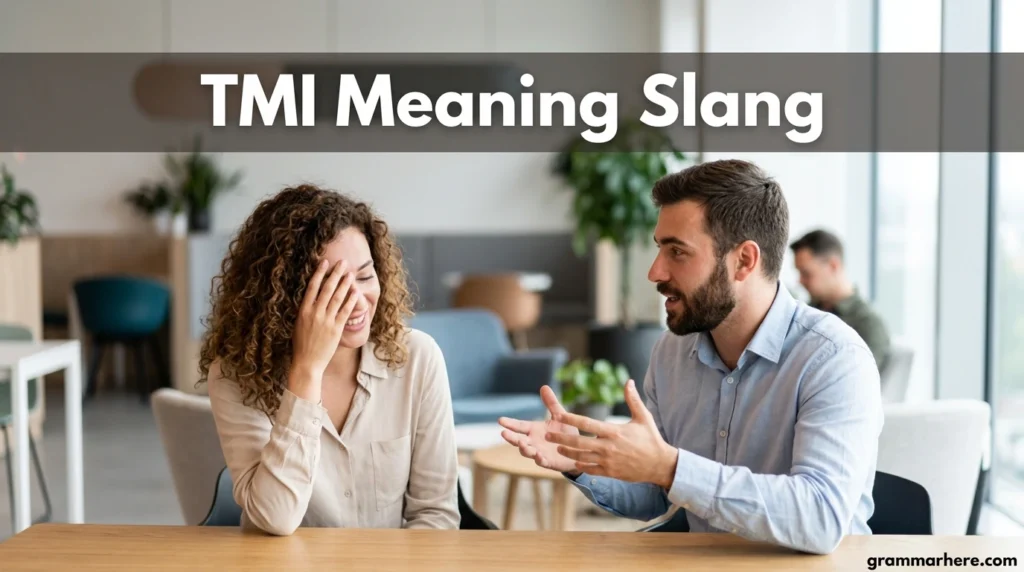
If you’ve ever received a message saying “TMI!”, you may have wondered what it actually means. The phrase appears everywhere—from text messages and WhatsApp chats to TikTok comments, Instagram captions, Snapchat conversations, and online forums. Because internet slang changes so quickly, many people search for TMI meaning slang to avoid confusion and communicate more naturally online.
Understanding online abbreviations is an important part of modern digital communication. Whether you’re chatting with friends, scrolling through social media, or joining an online community, knowing what common slang terms mean helps you understand jokes, avoid misunderstandings, and respond confidently. In this guide, you’ll learn the complete meaning of TMI, its full form, where it came from, how people use it in everyday conversations, and the best ways to reply when someone says it. By the end, you’ll feel comfortable recognizing and using this popular internet expression.
What Does TMI Mean in Slang?
TMI stands for “Too Much Information.”
In internet slang, it is used when someone shares personal, embarrassing, or unnecessary details that other people did not really want or need to know.
Most of the time, TMI is said as a light-hearted reaction rather than a serious insult. It can also be playful between close friends.
Short Meaning
- TMI = Too Much Information
- Used when someone overshares personal details.
- Usually humorous or friendly.
- Common in texting, social media, and casual conversations.
For example:
Friend: “I accidentally brushed my teeth with hand soap this morning.”
You: “😂 TMI!”
TMI Full Form
The full form of TMI is:
Too Much Information
The phrase became popular because it provides a quick way to tell someone they have shared more personal information than necessary.
Unlike many internet abbreviations, TMI has remained popular for many years because it is easy to understand and fits many situations.
What Does TMI Mean in Texting?
In texting, TMI usually means:
“You shared more information than I wanted to know.”
It often appears after someone describes:
- Personal hygiene
- Bathroom stories
- Medical details
- Dating experiences
- Awkward situations
- Embarrassing moments
However, it is often meant jokingly rather than offensively.
Example Text Conversations
Person A: “I’ve been sneezing so much that I used an entire box of tissues.”
Person B: “TMI 😂”
Friend: “I forgot to wear matching socks today.”
You: “Haha that’s not really TMI.”
Person A: “I told my crush I liked them and then tripped.”
Friend: “LOL that’s embarrassing but not TMI.”
TMI Meaning in Online Chat
In online chat rooms, gaming communities, Discord servers, and messaging apps, TMI works exactly the same way.
People use it when someone shares details that feel:
- Too personal
- Uncomfortable
- Embarrassing
- Unexpected
- Unnecessary
It helps keep conversations light while letting someone know they may be oversharing.
Origin of TMI and How It Became Popular
The phrase “Too Much Information” existed long before the internet.
People used it in everyday English conversations to politely say that someone had shared something overly personal.
As texting became popular during the late 1990s and early 2000s, people shortened many common phrases into abbreviations. TMI quickly became one of the most recognized.
Later, social media platforms helped spread it even further.
Today it is commonly seen on:
- TikTok
- Snapchat
- X (formerly Twitter)
- Discord
Despite being an older internet abbreviation, TMI is still widely understood by people of different age groups.
Why Do People Say TMI?
People use TMI for several reasons.
To React Humorously
Many people say TMI simply because a story becomes unexpectedly personal.
Example:
“I accidentally walked into the bathroom while my brother was showering.”
Friend:
“TMI 😂”
To Set Boundaries
Sometimes people genuinely don’t want to hear certain details.
Instead of sounding rude, they simply reply:
“TMI.”
This politely changes the subject.
To Joke With Friends
Close friends often tease each other by saying TMI even when the story isn’t actually inappropriate.
It has become part of casual online humor.
How Is TMI Used in Real Conversations?
Here are realistic chat examples.
Example 1
Sarah: “I’ve had hiccups for three hours.”
Emma: “That’s annoying.”
Example 2
Jake: “I forgot deodorant today.”
Chris: “TMI 😂”
Example 3
Alex: “My dentist pulled four teeth yesterday.”
Friend: “Whoa…TMI 😅”
Example 4
Person A: “I accidentally sent my mom a screenshot meant for my best friend.”
Person B: “LOL that’s funny.”
Example 5
Friend: “I had food poisoning all night.”
You: “TMI 😂 Hope you’re okay though.”
TMI Meaning on WhatsApp
WhatsApp conversations are usually personal, so TMI appears quite often.
People use it when friends begin describing:
- Medical issues
- Embarrassing stories
- Personal habits
- Dating details
Example:
Friend:
“I’ve been talking to my crush for five hours.”
You:
“Not TMI—but that’s impressive 😂”
Another example:
Friend:
“My stomach has been making weird noises all morning.”
You:
“TMI 😂”
TMI Meaning on Instagram
On Instagram, TMI usually appears:
- In comments
- Story replies
- Reels
- Direct Messages
Example comment:
“Nobody needed to know that 😂 TMI.”
It often reacts to creators sharing funny but overly personal stories.
TMI Meaning on TikTok
TikTok users frequently say TMI in comment sections.
Creators often tell embarrassing stories, dating experiences, or awkward moments.
Comments may include:
- “TMI but hilarious 😂”
- “Girl…TMI.”
- “This is definitely TMI.”
Sometimes creators even label their own videos:
“Warning: TMI Storytime.”
This tells viewers that personal details are coming.
TMI Meaning on Snapchat
Snapchat is casual and private, making TMI very common.
Friends use it after receiving:
- Voice notes
- Snaps
- Long chats
- Personal confessions
Example:
Friend:
“I haven’t washed my hair for six days.”
Reply:
“TMI 😂”
What TMI Does NOT Mean
Many people confuse TMI with unrelated abbreviations.
Here are some incorrect interpretations.
TMI Does Not Mean
- Tell Me Immediately
- Trust Me Instead
- Text Me Instantly
- Too Many Ideas
- Talk More Inside
In internet slang, TMI almost always means “Too Much Information.”
Common Confusions About TMI
Some people think TMI is always rude.
Actually, the meaning depends on tone.
Friendly
“TMI 😂”
Usually playful.
Serious
“TMI.”
Can politely tell someone to stop sharing personal details.
Sarcastic
“Oh wow…TMI.”
May express discomfort.
Always consider the relationship and conversation.
Similar Slang Terms and Related Abbreviations
If you understand TMI, you’ll probably see these abbreviations too.
SlangMeaningLOLLaugh Out LoudOMGOh My GodBRBBe Right BackTBHTo Be HonestFYIFor Your InformationIDCI Don’t CareSMHShaking My HeadIMOIn My OpinionICYMIIn Case You Missed ItNGLNot Gonna Lie
These abbreviations are commonly used alongside TMI in online conversations.
Alternatives to Saying TMI
Instead of saying TMI, people sometimes use:
- That’s a bit personal.
- I didn’t need to know that.
- You’re oversharing.
- That’s quite detailed.
- Okay…that’s enough information.
- I’ll pretend I didn’t hear that.
- You really shared everything!
These alternatives can sound softer or more humorous depending on the situation.
How to Reply When Someone Says TMI
There are many ways to respond depending on the mood of the conversation.
Polite Responses
- Sorry, I got carried away.
- My bad!
- You’re right.
- I’ll stop there.
- Fair enough.
Funny Responses
- You asked for honesty!
- Too late now 😂
- No refunds on information.
- That’s only half the story.
- Welcome to my life.
Flirty Responses
- You haven’t heard the best part yet 😉
- I only share secrets with you.
- Guess you’re getting the VIP version.
- I’ll save the rest for later.
Use these only if the conversation is clearly playful and both people are comfortable.
Boundary-Respecting Responses
If someone genuinely feels uncomfortable, it’s best to reply respectfully.
Examples:
- Sorry about that.
- Thanks for letting me know.
- I’ll change the subject.
- I understand.
- No worries—we can talk about something else.
Respecting boundaries helps maintain healthy online conversations.
When Should You Avoid Using TMI?
Although TMI is common, it isn’t appropriate everywhere.
Avoid using it:
- In professional emails
- During formal meetings
- In business communication
- With teachers unless casual
- In serious medical discussions
Instead, choose polite language when necessary.
Is TMI Still Popular?
Yes.
Although newer slang appears every year, TMI remains one of the most recognized internet abbreviations.
People of different generations still understand it.
Reasons it remains popular include:
- Easy to remember
- Short
- Funny
- Works on every platform
- Fits many conversations
It continues to appear regularly across social media.
TMI in Gen-Z Slang Culture
Gen-Z uses TMI slightly differently from older generations.
Sometimes they say TMI even when the information isn’t actually too personal.
Instead, it simply means:
- That’s unexpected.
- You’re saying a lot.
- That’s wild.
- I wasn’t ready for that.
It has become part of online humor, especially in memes and reaction videos.
Tips for Using TMI Correctly
Keep these simple rules in mind.
- Use it casually.
- Know your audience.
- Don’t use it to embarrass people.
- Remember that tone matters.
- Add emojis if you’re joking.
- Respect someone’s feelings if they stop sharing.
Using TMI kindly helps conversations stay comfortable and fun.
FAQs
What does TMI mean in slang?
TMI means “Too Much Information.” It is used when someone shares overly personal or unnecessary details in a conversation.
What is the full form of TMI?
The full form of TMI is Too Much Information.
What does TMI mean on TikTok?
On TikTok, TMI usually reacts to videos or comments that include embarrassing, personal, or unexpectedly detailed stories.
Is TMI rude?
Not usually. Most people use TMI as a friendly joke. However, depending on the tone, it can politely tell someone they are oversharing.
What does TMI mean in texting?
In texting, TMI means someone has shared more personal information than the listener expected or wanted.
Is TMI still used today?
Yes. TMI remains popular on WhatsApp, Instagram, TikTok, Snapchat, and other social media platforms.
Can I use TMI with friends?
Absolutely. It is most commonly used between friends in casual conversations, especially when reacting to funny or awkward stories.
Conclusion
Understanding TMI meaning slang makes it much easier to follow today’s online conversations. Standing for “Too Much Information,” TMI is a friendly internet abbreviation used when someone shares personal, embarrassing, or unnecessary details. Whether you see it in text messages, WhatsApp chats, Instagram comments, TikTok videos, or Snapchat conversations, the meaning is generally the same. While it is often used humorously among friends, it can also serve as a polite way to set conversational boundaries. By recognizing when and how to use TMI—and knowing how to respond appropriately—you can communicate more naturally, avoid misunderstandings, and feel confident participating in modern digital conversations.