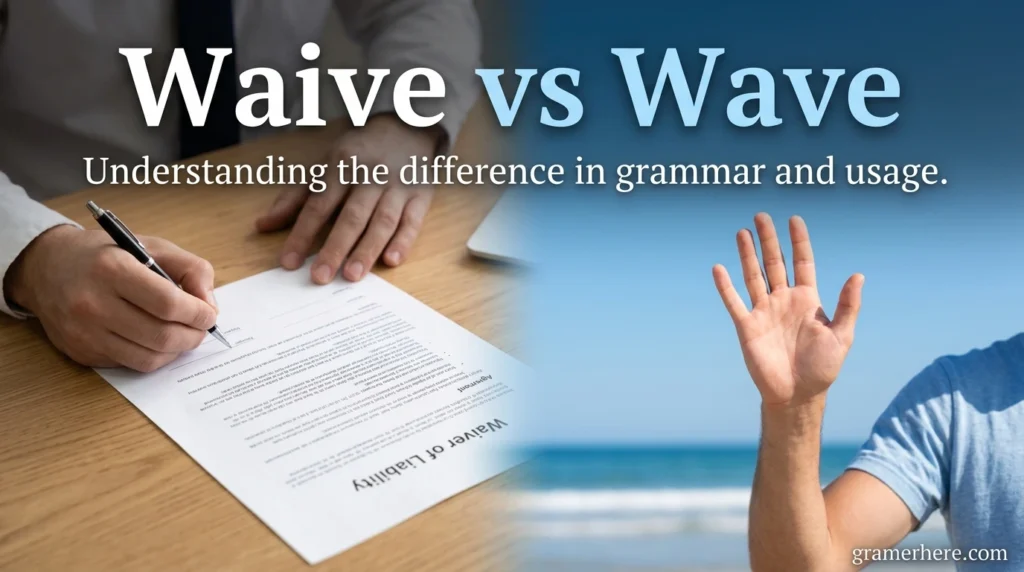
Imagine standing at an airport terminal. A loved one is walking toward the gate, and you lift your hand in a gentle goodbye. At the same time, over the loudspeaker, an announcement declares that certain baggage fees have been waived for passengers. In that single moment, two nearly identical-sounding words—wave and waive—quietly do very different jobs.
This confusion is more common than you might think. Whether you’re writing an email, signing a contract, or simply telling a story, mixing up waive and wave can subtly change your meaning—or even create misunderstandings. These words sound alike, but their meanings belong to completely different worlds: one is about movement and expression, while the other is about permission and letting go.
In this article, we’ll explore the meanings, differences, and real-life applications of waive vs wave through engaging examples, thoughtful insights, and practical guidance. By the end, you’ll not only understand the distinction—you’ll feel confident using both words naturally in everyday life.
What Does “Wave” Mean?
At its core, wave is about movement—often something visible, flowing, or rhythmic. You’ve probably used it countless times without even thinking about it.
A wave can be a physical motion, like raising your hand to greet someone or signal goodbye. It can also describe natural patterns, such as ocean waves rolling onto the shore or even abstract ideas like sound waves traveling through the air.
Common Uses of “Wave”
1. Physical Gestures
When you wave, you move your hand back and forth, often to communicate silently. It’s one of the simplest forms of human connection.
Example: She waved from across the street, her smile unmistakable.
2. Natural Movements
The word also describes flowing patterns in nature.
Example: The waves crashed gently against the rocks.
3. Symbolic or Emotional Waves
Sometimes, wave describes feelings or events that come in surges.
Example: A wave of relief washed over him after hearing the news.
In every case, wave involves motion, energy, or a visible shift. It’s dynamic and expressive—something you can often see or feel.
What Does “Waive” Mean?
In contrast, waive lives in a more abstract world. It’s about giving something up—usually a right, rule, or requirement.
When you waive something, you intentionally choose not to enforce it. This word often appears in formal, legal, or administrative contexts, but its meaning is surprisingly relatable.
Common Uses of “Waive”
1. Giving Up a Right
You might waive your right to something, often voluntarily.
Example: He waived his right to a refund.
2. Removing a Requirement
Organizations frequently waive fees or rules.
Example: The bank waived the service charge for the month.
3. Letting Something Go
On a personal level, it can also reflect flexibility.
Example: She waived her usual rules to help a friend in need.
Unlike wave, waive is invisible. It’s not something you see—it’s something you decide. It represents choice, permission, and sometimes generosity.
Why “Waive” and “Wave” Are Often Confused
The confusion between waive and wave comes down to one simple reason: they sound identical. In spoken language, there’s no difference at all.
But in writing, the distinction matters.
The Root of the Confusion
- Both words are pronounced the same (/weɪv/)
- They differ by just one letter
- Their meanings are unrelated
This creates a perfect storm for mix-ups, especially in fast writing or casual communication.
A Simple Way to Remember
Think of it this way:
- Wave = movement you can see
- Waive = permission you can’t see
That one mental shortcut can prevent most mistakes.
The Emotional Side of “Wave”
While wave may seem straightforward, it carries surprising emotional depth.
A wave isn’t just a motion—it’s often a message.
Human Connection Through Gesture
When someone waves at you, it can mean:
- Hello
- Goodbye
- I see you
- I care
It’s a silent language that crosses cultures.
Waves of Feeling
Emotionally, wave often describes how feelings come and go.
Example: A wave of nostalgia hit her as she walked through her old school.
This usage highlights how emotions aren’t static—they rise, peak, and fade, much like the ocean.
The Power Behind “Waive”
If wave is about expression, waive is about decision-making.
To waive something is to exercise control—sometimes quietly, but meaningfully.
A Choice That Matters
When you waive a fee or rule, you’re making a deliberate decision:
- To be flexible
- To show understanding
- To prioritize people over policy
Real-Life Impact
Consider this situation:
A student misses a deadline due to a family emergency. The teacher decides to waive the penalty.
That small decision can have a huge emotional impact. It turns a rigid system into a human one.
Real-Life Scenarios: Wave vs Waive
Let’s explore how these words play out in everyday life.
Scenario 1: At the Airport
She waved goodbye as her parents walked away. The airline waived the extra baggage fee.
Scenario 2: At School
He waved to his friend across the classroom. The principal waived the late submission rule.
Scenario 3: At Work
She waved during the video call. The manager waived the dress code for the event.
Each pair shows how one word describes an action, while the other reflects a decision.
Common Mistakes and How to Avoid Them
Even experienced writers mix these up occasionally. Here are some typical errors:
Mistake 1: Using “Wave” Instead of “Waive”
Incorrect: The company decided to wave the fee.
Correct: The company decided to waive the fee.
Mistake 2: Using “Waive” Instead of “Wave”
Incorrect: He waived at the crowd.
Correct: He waved at the crowd.
Quick Tip
If you can physically see it happening, it’s probably wave. If it’s about rules or permissions, it’s waive.
The Role of Context in Understanding Meaning
Context is your best guide when choosing between these words.
Visual Context
If the sentence describes something visible or physical, wave is the right choice.
Abstract Context
If the sentence involves rules, rights, or decisions, waive fits better.
Example Comparison
- She waved her hand → visible action
- She waived the requirement → abstract decision
The surrounding words often make the answer obvious once you pause to think.
How These Words Reflect Human Behavior
Interestingly, wave and waive mirror two sides of human nature.
Expression vs Decision
- Wave represents how we express ourselves outwardly
- Waive represents how we make internal choices
Connection vs Flexibility
- Waving builds connection
- Waiving shows understanding
Together, they highlight how communication isn’t just about words—it’s about actions and intentions.
Practical Tips for Everyday Use
Mastering waive vs wave doesn’t require memorization—just awareness.
Tip 1: Pause Before Writing
Take a second to consider the meaning you intend.
Tip 2: Visualize the Action
Can you picture it happening? If yes, use wave.
Tip 3: Think About Rules
If it involves giving something up, use waive.
Tip 4: Practice with Examples
The more you use both words correctly, the more natural it becomes.
Teaching the Difference to Others
If you’re helping someone else learn this distinction, simplicity works best.
Use Everyday Examples
- Wave: greeting someone
- Waive: canceling a fee
Encourage Visualization
Ask: “Can you see it happening?”
Reinforce with Practice
Short sentences and real-life scenarios help build confidence quickly.
Subtle Nuances and Advanced Understanding
For those who want to go deeper, there are subtle layers to these words.
“Wave” as a Metaphor
It’s often used metaphorically to describe patterns:
- Wave of change
- Wave of innovation
“Waive” in Legal Contexts
In legal language, waiving a right can have serious consequences. It’s not just casual—it’s binding.
Understanding these nuances adds depth to your communication, especially in professional settings.
Why This Distinction Matters in Writing
Clarity is everything in writing. Using the wrong word—even one letter off—can:
- Confuse readers
- Change meaning
- Reduce credibility
Imagine writing:
“The company waved your rights.”
That creates a completely different (and confusing) image.
Precision shows attention to detail—and that builds trust with your audience.
FAQs
1. What is the main difference between waive and wave?
Wave refers to movement or gesture, while waive means to give up a right or requirement.
2. Are waive and wave pronounced the same?
Yes, they are homophones and sound exactly alike.
3. Can “wave” ever mean the same as “waive”?
No, their meanings are completely different despite similar pronunciation.
4. How can I remember the difference easily?
Think: wave = motion, waive = permission.
5. Is “waive” used mostly in formal contexts?
Yes, it often appears in legal, business, or official situations.
6. Can “wave” be used metaphorically?
Yes, it’s commonly used to describe emotional or social patterns.
7. What’s a common mistake people make?
Using “wave” when they mean “waive,” especially in writing about fees or rules.
8. Why is it important to use the correct word?
Using the wrong word can change meaning and confuse readers.
Conclusion
At first glance, waive and wave seem like a minor spelling challenge. But as you’ve seen, they represent entirely different ideas—one rooted in visible action, the other in thoughtful decision-making.