
Imagine sitting in a classroom while a teacher asks, “Why wasn’t the homework completed?” A student quietly replies, “Because the instructions weren’t clear.” At first glance, those two words may seem almost identical. Both are negative forms of the verb “to be,” both appear constantly in daily conversation, and both can easily confuse English learners and native speakers alike.
Yet choosing between wasn’t and weren’t can completely change whether a sentence sounds natural, grammatical, or awkward. Many people hesitate before speaking or writing because they are unsure which word fits. Is it “He wasn’t ready” or “He weren’t ready”? Why do we sometimes hear “If I weren’t you” instead of “If I wasn’t you”? And why do songs, movies, and casual speech sometimes seem to break the rules?
Understanding the difference between wasn’t and weren’t is more than a grammar lesson. It helps people communicate clearly, sound confident, and avoid misunderstandings in school, work, and everyday life. This article explores their meanings, proper usage, emotional nuance, common mistakes, real-life examples, and practical lessons so you can finally use both words with confidence.
The Basic Difference Between Wasn’t and Weren’t
At their core, wasn’t and weren’t are contractions.
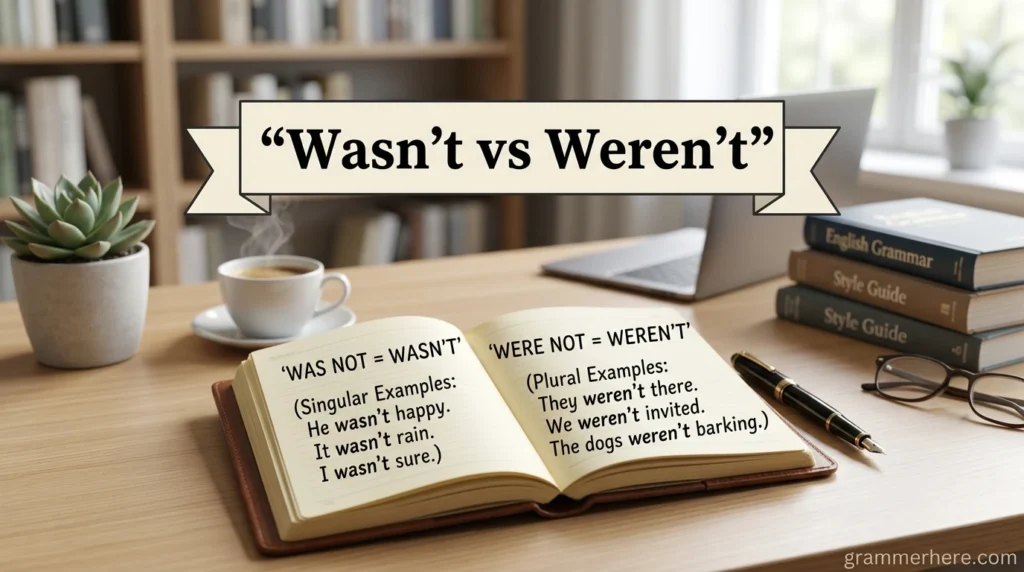
- Wasn’t = was not
- Weren’t = were not
The difference depends mainly on the subject of the sentence.
Using “Wasn’t”
“Wasn’t” is used with singular subjects in the past tense.
Examples:
- He wasn’t home.
- She wasn’t feeling well.
- The movie wasn’t interesting.
- I wasn’t ready.
Using “Weren’t”
“Weren’t” is used with plural subjects and with “you.”
Examples:
- They weren’t late.
- We weren’t invited.
- You weren’t listening.
- The books weren’t expensive.
Think of it this way:
- Singular = wasn’t
- Plural = weren’t
This simple rule solves most situations. However, English becomes more interesting when exceptions, emotional tone, and hypothetical situations appear. That is where many learners begin to struggle.
Why People Commonly Confuse Wasn’t and Weren’t
Grammar confusion often happens because spoken English moves quickly. In casual conversation, people focus more on meaning than perfect grammar.
Imagine hearing these sentences in a noisy room:
- “You wasn’t there!”
- “They wasn’t ready.”
- “If I wasn’t busy…”
Even though some of these are grammatically incorrect in standard English, they appear in regional dialects, songs, and informal speech. Over time, repeated exposure makes people unsure about the proper rule.
Another reason for confusion is that English does not always follow strict logical patterns. For example:
- “I was”
- “You were”
Why should “I” use was while “you” uses were? The structure feels inconsistent to many learners.
Children learning English often experiment with patterns naturally. A child might say:
- “We was playing outside.”
The child understands the past tense but has not yet mastered subject agreement.
Adults learning English face similar challenges. The brain tries to simplify the language, but English grammar frequently resists simplification.
Understanding that confusion is normal helps learners feel less intimidated. Mastery comes through noticing patterns repeatedly in real-life situations.
Understanding Subject Agreement in Everyday English
Subject agreement means the verb must match the subject correctly.
Singular Subjects Use Wasn’t
Singular nouns and pronouns require wasn’t.
Examples:
- The dog wasn’t barking.
- My brother wasn’t angry.
- The phone wasn’t working.
Even “I” uses wasn’t:
- I wasn’t tired yesterday.
Plural Subjects Use Weren’t
Plural nouns and pronouns require weren’t.
Examples:
- The students weren’t prepared.
- My parents weren’t home.
- The lights weren’t on.
“You” always takes weren’t, whether singular or plural:
- You weren’t serious.
- You weren’t ready.
This rule surprises many people because “you” can refer to one person or many people, yet English still uses were and weren’t.
A helpful trick is to mentally expand the contraction:
- wasn’t → was not
- weren’t → were not
If “was not” sounds correct, use wasn’t. If “were not” sounds correct, use weren’t.
How Wasn’t and Weren’t Shape Tone and Emotion
Grammar is not only about correctness. It also affects emotional tone.
Consider these two sentences:
- “He wasn’t kind.”
- “They weren’t supportive.”
Both describe negative experiences, but the emotional impact differs because of the subject involved.
Personal Responsibility
“Wasn’t” often feels more personal because it usually refers to one person or thing.
Example:
- “My friend wasn’t honest with me.”
The sentence focuses attention on a single individual.
Group Dynamics
“Weren’t” can create a sense of collective responsibility.
Example:
- “My coworkers weren’t helpful.”
Now the issue feels broader and more socially connected.
In storytelling, these subtle differences matter. Writers often use singular or plural structures strategically to shape emotional focus.
Imagine someone saying:
- “I wasn’t enough.”
The sentence feels intimate and deeply personal.
Now compare:
- “We weren’t ready.”
This suggests shared struggle or collective failure.
Grammar quietly influences emotional meaning more than many people realize.
The Special Case of “If I Were” and “If I Weren’t”
One of the most confusing grammar situations involves hypothetical statements.
People often ask:
- Should it be “If I wasn’t” or “If I weren’t”?
In formal grammar, hypothetical or imaginary situations usually use were.
Examples
- If I were rich, I would travel the world.
- If she were here, things would feel different.
- If I weren’t so tired, I’d help you.
This structure is called the subjunctive mood. It describes situations that are unreal, imagined, or contrary to fact.
Why It Sounds Strange
Many people naturally say:
- “If I was rich…”
In informal speech, this is common and widely accepted in conversation. However, formal writing and careful English generally prefer:
- “If I were rich…”
The same applies to negatives:
- Formal: “If I weren’t busy…”
- Informal: “If I wasn’t busy…”
Both may appear in real life, but understanding the distinction helps you adapt to different situations such as academic writing, business communication, or casual conversation.
Common Mistakes People Make
Mistakes with wasn’t and weren’t usually fall into recognizable patterns.
Mistake 1: Using Wasn’t With Plural Subjects
Incorrect:
- The children wasn’t quiet.
Correct:
- The children weren’t quiet.
Mistake 2: Using Weren’t With Singular Subjects
Incorrect:
- She weren’t ready.
Correct:
- She wasn’t ready.
Mistake 3: Confusing Hypothetical Situations
Incorrect in formal English:
- If I wasn’t nervous, I’d speak first.
Preferred formal version:
- If I weren’t nervous, I’d speak first.
Mistake 4: Following Informal Speech Too Closely
People often imitate phrases heard in music or regional dialects without realizing those forms may not follow standard grammar rules.
Learning grammar does not mean rejecting informal speech entirely. Instead, it means understanding when certain forms are appropriate and when they are not.
Real-Life Situations Where Correct Usage Matters
Grammar becomes truly important when communication affects relationships, opportunities, or credibility.
In School
Teachers and examiners notice subject agreement errors quickly.
A sentence like:
- “The results wasn’t accurate.”
may reduce confidence in the writer’s abilities.
At Work
Professional communication often depends on clarity.
Compare:
- “The files wasn’t uploaded.”
- “The files weren’t uploaded.”
The second sounds polished and professional.
In Social Situations
Grammar mistakes rarely destroy conversations, but they can sometimes create awkward impressions.
Imagine giving a presentation and repeatedly saying:
- “The customers wasn’t satisfied.”
Listeners may focus on the mistake instead of your message.
Clear grammar helps ideas sound stronger.
How Native Speakers Actually Use These Words
Interestingly, native speakers do not always follow textbook grammar rules.
In many dialects, people say things like:
- “You wasn’t there.”
- “We wasn’t ready.”
These forms may reflect regional speech patterns, cultural identity, or informal communication styles.
Informal Speech vs Standard English
Standard English is generally expected in:
- Academic writing
- Professional emails
- Formal presentations
- Exams
Informal speech is more flexible in:
- Casual conversations
- Song lyrics
- Movies
- Social media
Understanding this difference prevents confusion. A phrase may be common in conversation yet still be grammatically nonstandard.
Language is shaped by both rules and real human behavior. Skilled communicators learn how to move between formal and informal styles depending on the situation.
Mini Stories That Show the Difference Clearly
Stories help grammar feel natural instead of mechanical.
The Missed Train
David arrived at the station breathing heavily. The train doors had already closed.
“He wasn’t early enough,” his friend said.
Here, wasn’t refers to one person.
The Forgotten Invitations
At a wedding dinner, several guests looked confused.
“We weren’t told about the schedule,” they explained.
Now weren’t refers to multiple people.
The Imaginary Dream
A tired office worker stared out the window.
“If I weren’t afraid of change,” she thought, “I’d start over somewhere new.”
This sentence expresses an unreal possibility, so weren’t fits the hypothetical mood.
Small stories make grammar memorable because emotions attach meaning to structure.
Why Grammar Confidence Improves Communication
Many people fear grammar because they associate it with criticism or embarrassment. Yet grammar is really a tool for clarity.
When you confidently choose between wasn’t and weren’t, you:
- express ideas more clearly,
- reduce misunderstandings,
- sound more polished,
- and communicate with greater authority.
Imagine writing:
- “The instructions weren’t clear.”
The sentence feels direct and trustworthy.
Now imagine uncertainty:
- “The instructions wasn’t… weren’t…?”
That hesitation can interrupt confidence.
Grammar mastery does not require perfection. Even fluent speakers make mistakes. What matters is developing awareness and improving gradually through use and practice.
Confidence grows when patterns become familiar.
Easy Tricks to Remember the Difference
Simple memory techniques can make grammar easier.
Trick 1: Singular vs Plural
Ask yourself:
- One person or thing? → wasn’t
- More than one? → weren’t
Examples:
- The cat wasn’t hungry.
- The cats weren’t hungry.
Trick 2: Replace the Contraction
Expand the sentence:
- was not
- were not
Which sounds natural?
Trick 3: Watch for “You”
“You” almost always pairs with weren’t in the past tense.
Examples:
- You weren’t wrong.
- You weren’t late.
Trick 4: Imaginary Situations Use “Were”
Hypothetical statements often use:
- if I were
- if he were
- if she weren’t
The more you notice these patterns in books, movies, and conversations, the easier they become.
How These Words Appear in Writing and Literature
Writers carefully choose grammar to shape voice and realism.
Formal Writing
Academic and professional writing usually follows standard grammar rules strictly.
Example:
- “The witnesses weren’t available.”
Fiction and Dialogue
Novelists sometimes intentionally break grammar rules to create authentic characters.
Example:
- “He wasn’t gonna listen anyway.”
- “We wasn’t expecting trouble.”
These choices reflect personality, region, education level, or emotional state.
Song Lyrics and Pop Culture
Music frequently bends grammar rules for rhythm or emotional effect.
Listeners may hear:
- “You wasn’t there for me.”
Even if grammatically incorrect, the phrase may sound emotionally powerful or fit the rhythm better.
Understanding this distinction helps readers and learners avoid confusion between artistic expression and formal correctness.
The Psychological Side of Grammar Mistakes
Grammar mistakes often affect confidence more than intelligence.
Many intelligent people hesitate while speaking because they fear being judged for small errors. Someone may know exactly what they want to say but pause nervously before choosing between wasn’t and weren’t.
This anxiety can become especially strong for:
- English learners,
- students,
- job seekers,
- and public speakers.
The truth is that communication is about connection first. Grammar supports that connection, but small mistakes do not erase intelligence or value.
Still, improving grammar creates freedom. When people stop second-guessing basic structures, they focus more fully on ideas, creativity, and conversation.
Learning the difference between wasn’t and weren’t may seem small, but small improvements build long-term confidence.
Language growth happens one pattern at a time.
Practical Exercises to Strengthen Your Understanding
Practice transforms knowledge into habit.
Exercise 1: Fill in the Blank
Choose wasn’t or weren’t:
- The movie ______ very exciting.
- My friends ______ ready to leave.
- I ______ expecting that surprise.
- The shoes ______ expensive.
Answers:
- wasn’t
- weren’t
- wasn’t
- weren’t
Exercise 2: Hypothetical Sentences
Complete these formally:
- If I ______ taller, I’d play basketball.
- If she ______ so busy, she would join us.
Answers:
- were
- weren’t
Exercise 3: Real-Life Observation
Listen to conversations, movies, or songs and notice:
- when grammar follows formal rules,
- when informal speech changes them,
- and how tone influences structure.
Observation builds natural understanding over time.
FAQs
1. What is the main difference between wasn’t and weren’t?
“Wasn’t” is used with singular subjects, while “weren’t” is used with plural subjects and “you.”
2. Is “I weren’t” grammatically correct?
Usually no. Standard English uses “I wasn’t.” However, hypothetical expressions may use “If I weren’t.”
3. Why do people say “If I were” instead of “If I was”?
“If I were” is part of the subjunctive mood used for imaginary or unreal situations.
4. Can “you” use wasn’t?
Standard English uses “you weren’t,” not “you wasn’t.”
5. Are grammar mistakes with wasn’t and weren’t common?
Yes. Even native speakers sometimes confuse them in casual speech.
6. Is it okay to use informal grammar in conversation?
In casual settings, informal grammar is common. Formal situations usually require standard grammar.
7. Why do songs sometimes use incorrect grammar?
Artists may change grammar for rhythm, rhyme, emotion, or style.
8. How can I remember the correct usage easily?
Think:
- one person/thing = wasn’t
- multiple people/things = weren’t
Conclusion
The difference between wasn’t and weren’t may appear small, but it plays an important role in clear and confident communication. At the simplest level, wasn’t belongs with singular subjects, while weren’t matches plural subjects and “you.” Yet as we explored, English becomes more layered when hypothetical situations, informal speech, emotional tone, and regional dialects enter the picture.
Understanding these words is not merely about memorizing grammar rules. It is about recognizing how language reflects thought, emotion, identity, and context. A single word choice can make speech sound polished, casual, formal, emotional, or even poetic.