
Picture yourself writing a quick message to a friend: “I saw __ unusual bird today.” You pause. Should it be a unusual bird or an unusual bird?
It seems like a tiny choice—just one letter separating a from an. Yet this small decision quietly shapes how natural, polished, and fluent your English sounds. Whether you are speaking in a classroom, writing a professional email, posting online, or learning English as a second language, understanding a and an can make communication smoother and more confident.
Many people think the rule is simple: use a before consonants and an before vowels. But real English is more interesting than that. Pronunciation, rhythm, accents, silent letters, abbreviations, and even emotion influence how these articles work. Sometimes the correct choice surprises learners and native speakers alike.
This article explores a and an in depth—from basic meaning to tricky exceptions, real-life examples, common misunderstandings, and practical lessons. By the end, these tiny words will feel far less confusing and far more meaningful in everyday communication.
Understanding What “A” and “An” Really Mean
At first glance, a and an appear almost invisible in sentences. They are small words people often skip over while reading. Yet they play an important role in English grammar because they introduce singular, non-specific nouns.
When someone says, “I bought a book,” they are not referring to one particular famous book. They simply mean one book among many possible books. The article creates openness and flexibility.
Think about walking into a café. A customer might say:
- “Can I have a sandwich?”
- “I saw an interesting painting.”
- “There’s a musician outside.”
Each sentence introduces something for the first time. The speaker assumes the listener does not yet know exactly which object or person is being discussed.
These articles are called indefinite articles because they point to something non-specific. This is different from the, which refers to something already known or clearly identified.
For example:
- “I saw a dog.” → any dog
- “The dog was barking loudly.” → now both people know which dog
This small grammatical shift changes the listener’s understanding instantly.
Many learners focus only on memorizing rules, but understanding the purpose behind a and an makes them easier to use naturally. They are not random grammar decorations. They help organize information, guide conversations, and introduce ideas gently into speech.
Why English Uses Two Forms Instead of One
A common question among learners is simple: if a and an mean the same thing, why does English need both?
The answer lies in sound and rhythm.
English naturally prefers smooth pronunciation. Saying “a apple” creates an awkward sound break because two vowel sounds crash together. Over time, speakers found it easier to insert an n sound between them, creating “an apple.”
This adjustment makes speech flow more comfortably.
Imagine someone speaking quickly:
- “a orange”
- “an orange”
The second option feels softer and easier to pronounce. Language often evolves in ways that reduce effort and improve rhythm.
This is why the rule depends on pronunciation rather than spelling. English cares more about how words sound than how they look in this situation.
For example:
- “an hour” is correct because hour begins with a vowel sound.
- “a university” is correct because university begins with a “yoo” sound, which acts like a consonant.
These examples reveal something deeper about language: communication is not only visual but musical. Articles help speech move naturally from one word to another.
Children usually learn this instinctively by hearing English repeatedly. Adult learners, however, often rely on spelling, which can create confusion. Once pronunciation becomes the focus, many difficult cases suddenly make sense.
The Core Rule: Sounds Matter More Than Letters
The biggest breakthrough in mastering a and an comes from understanding one powerful principle:
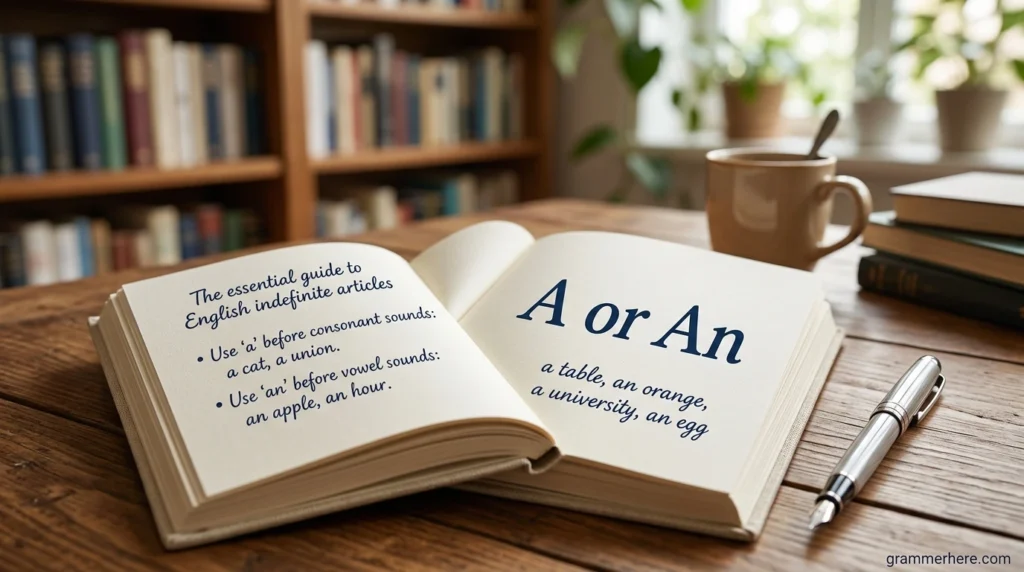
Use a before consonant sounds and an before vowel sounds.
Notice the word sounds. Not letters.
H3: Examples Using “A”
Use a before words that begin with consonant sounds:
- a car
- a teacher
- a house
- a university
- a European country
Even though university and European begin with vowel letters, they sound like “yoo,” which is a consonant sound.
H3: Examples Using “An”
Use an before vowel sounds:
- an apple
- an idea
- an umbrella
- an hour
- an honest person
Here, hour and honest begin with silent “h,” so the first sound is actually a vowel sound.
This distinction can feel strange at first. A learner may look at the spelling and assume the opposite article should be used. But spoken English reveals the real rule.
Imagine a student reading aloud in class. They say, “a honest mistake,” and the sentence sounds slightly rough. Once corrected to “an honest mistake,” the rhythm improves immediately.
The more you listen to natural English conversations, the more this pattern becomes intuitive.
The Hidden Power of Pronunciation
Pronunciation influences grammar more than many people realize. Articles are one of the clearest examples of this connection.
A person may know vocabulary perfectly but still sound unnatural if article pronunciation is incorrect. Native speakers often notice rhythm before grammar rules.
Consider these two sentences:
- “She is a MBA student.”
- “She is an MBA student.”
The second is correct because MBA begins with the sound “em.”
This surprises many learners because the first letter is M, a consonant. Yet the spoken sound starts with a vowel.
The same pattern appears with abbreviations and acronyms:
- an FBI agent
- an HTML file
- a NASA scientist
Why? Because:
- FBI → “ef-bee-eye”
- HTML → “aitch-tee-em-el”
- NASA → “nah-sah”
Pronunciation decides everything.
This is why listening practice matters. Reading alone cannot fully teach article usage. Hearing real speech trains the brain to recognize sound patterns automatically.
Many fluent English speakers do not consciously think about grammar rules at all. They simply feel which option sounds smoother.
That feeling develops through repeated exposure and attentive listening.
Common Mistakes People Make With “A” and “An”
Even advanced learners sometimes struggle with articles because English contains many unusual pronunciations.
One common mistake is focusing only on spelling.
For example:
- “an university” ❌
- “a university” ✅
Because university sounds like “yoo-ni-ver-si-tee,” it begins with a consonant sound.
Another frequent mistake involves silent letters:
- “a hour” ❌
- “an hour” ✅
The “h” is silent, so the word starts with the vowel sound “ow.”
H3: Mistakes With Acronyms
People often hesitate with abbreviations:
- a FBI agent ❌
- an FBI agent ✅
Again, pronunciation matters.
H3: Mistakes in Fast Writing
In texting or casual writing, people sometimes ignore articles entirely:
- “I bought car yesterday.”
While understandable, the sentence sounds incomplete in standard English. Articles help speech and writing feel polished.
Mistakes with a and an rarely destroy meaning, but they can affect clarity and fluency. In professional settings—job interviews, academic writing, presentations, or business emails—small grammar details influence impressions more than many people expect.
How Children Naturally Learn These Articles
One fascinating aspect of language learning is how naturally children absorb article patterns.
A child rarely studies grammar charts. Instead, they hear thousands of examples:
- a dog
- an apple
- a balloon
- an elephant
Gradually, the brain recognizes sound patterns.
If a toddler says “a elephant,” adults instinctively repeat the corrected version: “An elephant.”
Over time, rhythm becomes memory.
Adults often learn differently. They study rules intellectually, which can sometimes slow natural fluency. They may stop mid-sentence to analyze grammar instead of speaking naturally.
This difference explains why immersion is powerful. Hearing English repeatedly helps learners internalize article usage emotionally rather than mechanically.
Imagine learning music. Reading notes matters, but listening and practicing create real fluency. Articles work similarly.
The good news is that adults can still build this instinct through exposure:
- listening to podcasts
- watching films
- reading aloud
- repeating sentences
Eventually, correct usage begins to “sound right” automatically.
The Emotional Side of Speaking Correct English
Grammar is not only about correctness. It also affects confidence.
Many learners hesitate during conversations because they fear making small mistakes. Articles often become one of those anxiety points.
Someone may think: “Was it a or an? Did I say it wrong?”
This hesitation can interrupt natural communication.
Yet the truth is comforting: most people understand meaning even when articles are imperfect. Communication usually survives small grammar errors.
Still, mastering these details builds self-assurance.
Imagine a student giving a presentation:
- “an important opportunity”
- “a unique experience”
The speech flows smoothly. The speaker feels prepared and polished.
Small grammatical accuracy creates psychological confidence. It allows people to focus on ideas instead of worrying about tiny corrections.
Language is deeply connected to identity and self-expression. When learners feel fluent, they participate more freely in conversations, classrooms, interviews, and social situations.
In this way, a and an become more than grammar tools. They become part of clear and confident communication.
Situations Where the Rules Feel Confusing
English loves exceptions, and articles sometimes create surprising situations.
Consider these examples:
- a one-time event
- an honor
- a unicorn
- an heir
At first glance, these seem inconsistent. But pronunciation explains everything.
H3: Words Beginning With “U”
Some u words sound like “yoo”:
- a university
- a user
- a unicorn
Others begin with true vowel sounds:
- an umbrella
- an uncle
- an unusual idea
H3: Silent “H” Words
Certain words have silent “h” sounds:
- an hour
- an honest answer
- an honor
But many “h” words keep the consonant sound:
- a house
- a history book
- a hospital
These examples reveal why memorizing only spelling-based rules often fails.
The best strategy is simple: listen to the first sound you pronounce.
This approach solves most confusing cases quickly and naturally.
The Role of “A” and “An” in Everyday Conversations
Articles appear constantly in daily life, often without people noticing.
In restaurants:
- “I’d like a coffee.”
- “Can I get an omelet?”
At work:
- “We need a meeting.”
- “She sent an email.”
At school:
- “I saw a teacher.”
- “He wrote an essay.”
These tiny words create natural sentence flow. Without them, English can sound abrupt or incomplete.
Imagine hearing: “I bought phone.”
The meaning exists, but something feels missing. Articles help sentences breathe properly.
They also guide listeners through information step by step. Introducing something with a or an signals that it is new information.
Later, speakers often switch to the:
- “I adopted a cat.”
- “The cat sleeps all day.”
This pattern helps conversations stay organized and understandable.
Articles may seem small, but they quietly support the structure of nearly every English interaction.
Why Some Languages Do Not Use Articles
Many English learners come from languages that do not use articles at all. This can make a and an feel strange or unnecessary.
For example, some languages rely heavily on context rather than separate article words. Speakers may communicate perfectly without needing equivalents to a or the.
As a result, learners sometimes omit articles naturally:
- “I bought book.”
- “She is teacher.”
These sentences reflect the speaker’s native language patterns rather than lack of intelligence or effort.
Understanding this can reduce frustration. Articles are not universally natural—they are language-specific habits.
Learning them requires adjusting thought patterns.
Imagine moving furniture in a familiar room. At first, you bump into things because your brain expects the old arrangement. Over time, the new structure becomes automatic.
English articles work similarly for many learners. Consistent practice gradually rewires instinct.
Patience matters more than perfection.
Practical Tips to Master “A” and “An”
Learning articles becomes easier when practice feels practical rather than overwhelming.
H3: Listen Before You Analyze
Train your ears to notice sounds:
- an apple
- a banana
- an engineer
- a user
Focus on pronunciation patterns.
H3: Read Aloud Daily
Reading aloud strengthens rhythm awareness. Sentences that sound awkward usually reveal incorrect article usage.
H3: Learn Common Exceptions
Memorize frequently confusing words:
- an hour
- a university
- an honest person
- a European city
H3: Practice With Real-Life Objects
Look around your room and describe items:
- a chair
- an orange
- a laptop
- an idea
This creates active learning instead of passive memorization.
H3: Avoid Overthinking
Fluency grows through repetition. Constantly stopping to analyze grammar can slow natural speech.
Over time, correct usage becomes instinctive.
How Articles Influence Writing Style
Articles affect not only grammar but also tone and readability.
Compare these sentences:
- “She shared story.”
- “She shared a story.”
The second feels smoother and more complete.
Good writers use articles naturally to create rhythm. Missing articles can make writing feel robotic or abrupt.
Articles also shape precision:
- “He wants a car.” → any car
- “He wants the car.” → one specific car
This difference becomes important in storytelling, journalism, business writing, and academic work.
Imagine reading a novel without proper articles. The language would feel strangely mechanical, even if the vocabulary were correct.
Professional writers rarely think consciously about a and an, but these small choices contribute heavily to clarity and flow.
For learners hoping to improve writing quality, mastering articles can dramatically elevate sentence naturalness.
The Connection Between Articles and Confidence in Learning
Every language learner experiences moments of self-doubt.
Sometimes a tiny mistake feels larger than it really is. A person may replay a sentence in their mind for hours because they said “a apple” instead of “an apple.”
But fluency is not built through fear. It grows through communication.
Articles are part of progress, not proof of perfection.
Think about learning to ride a bicycle. Early mistakes are unavoidable, yet balance develops through movement, not hesitation.
Language works the same way.
Each conversation teaches rhythm. Each correction sharpens instinct. Every sentence builds familiarity.
Instead of viewing a and an as traps, learners can see them as helpful sound guides that make speech more natural.
Confidence comes when grammar shifts from conscious calculation to effortless habit.
That transformation happens gradually—but it absolutely happens.
FAQs
1. What is the difference between “a” and “an”?
Both are indefinite articles used before singular nouns. A comes before consonant sounds, while an comes before vowel sounds.
2. Do I use “an” before every word starting with a vowel?
No. The decision depends on pronunciation, not spelling. For example, “a university” is correct because it starts with a “yoo” sound.
3. Why do we say “an hour”?
Because the “h” in hour is silent, the word begins with a vowel sound.
4. Is it “a MBA” or “an MBA”?
It is “an MBA” because the pronunciation starts with the vowel sound “em.”
5. Can native English speakers make article mistakes?
Yes. Fast speech, regional accents, or unusual words can sometimes create confusion even for native speakers.
6. Are articles necessary in every sentence?
No. Plural nouns and uncountable nouns often do not use a or an:
- “I like music.”
- “Dogs are friendly.”
7. Why do some learners struggle with articles?
Many languages do not use articles, so learners must develop entirely new grammar habits.
8. What is the fastest way to improve article usage?
Listening to natural English and reading aloud regularly are among the most effective methods.
Conclusion
The difference between a and an may appear small, but these tiny words carry remarkable importance in English. They guide pronunciation, improve rhythm, introduce ideas clearly, and help conversations flow naturally. More importantly, they reveal how deeply sound and meaning are connected in language.
Understanding articles is not just about memorizing grammar rules. It is about learning to hear English differently. Once learners focus on pronunciation instead of spelling alone, many confusing situations suddenly become easier to understand.