
Introduction
Imagine walking into a room that feels like a celebration exploded inside it. Gold-framed mirrors reflect neon lights, velvet curtains hang beside glittering chandeliers, and every surface seems to compete for attention. You pause, unsure whether to admire the boldness or quietly step back. Someone beside you whispers, “That’s a bit gaudy.”
But then you notice another detail—the spelling confusion that often follows this word: gaudy vs gawdy. Are they the same? Is one even correct? Or is this just another case of English language chaos confusing writers, students, and everyday speakers?
In reality, this small spelling debate hides a much larger story about language evolution, aesthetics, perception, and cultural judgment. The word “gaudy” is more than just an adjective—it carries emotional weight, social meaning, and artistic interpretation. Meanwhile, “gawdy” is often a misspelling that continues to circulate, adding to confusion in writing and communication.
Understanding this distinction matters more than it seems. It affects clarity in writing, professionalism in communication, and even how we interpret beauty and excess in everyday life.
What “Gaudy vs Gawdy” Actually Means
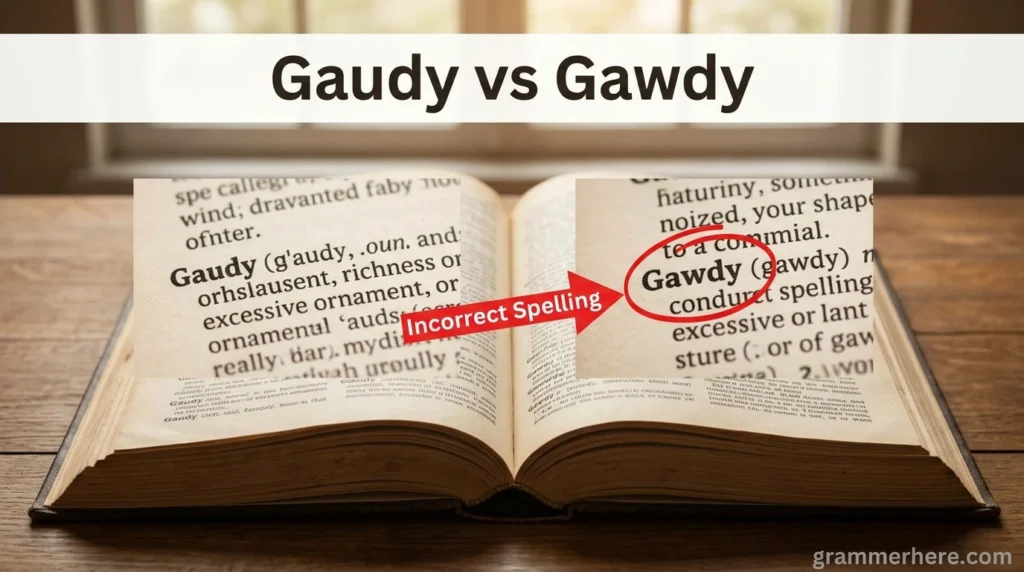
At the core of the confusion lies a simple truth: “gaudy” is the correct spelling, while “gawdy” is widely considered incorrect. Despite this, both versions appear online, in social media posts, and even in informal writing.
“Gaudy” describes something overly bright, flashy, or decorated in a way that feels excessive or tasteless. Think of outfits overloaded with sequins or rooms filled with clashing colors and bold patterns. It is not just about brightness—it is about too muchness.
“Gawdy,” on the other hand, is a phonetic mistake. Because “gaudy” is pronounced with a soft “aw” sound in some accents, people mistakenly assume it is spelled with a “w.” Over time, this error spread through informal writing and digital communication.
Understanding this difference is important because language precision affects credibility. Whether you’re writing essays, captions, or professional content, using the correct form shows attention to detail. But beyond spelling, the concept of “gaudy” also opens the door to exploring taste, aesthetics, and cultural judgment in fascinating ways.
The Origins of the Word “Gaudy”
The word “gaudy” has deep linguistic roots. It originates from older forms of English where “gaud” referred to ornamental trinkets or showy decorations. Over time, the word evolved to describe anything overly decorated or flashy.
Interestingly, the original sense wasn’t entirely negative. In earlier usage, “gaudy” could also imply festive or celebratory decoration. Think of colorful festivals, decorated streets, or celebratory attire. The word carried a sense of joy and abundance.
However, as language evolved, so did perception. What once felt festive began to be seen as excessive or tasteless in certain contexts. By the modern era, “gaudy” had mostly taken on a critical tone, often implying a lack of subtlety or refinement.
This evolution shows how language reflects cultural shifts. What one generation celebrates, another may critique. And in the case of “gaudy,” the word became a linguistic mirror for changing ideas of beauty, restraint, and elegance.
Why “Gawdy” Is Considered Incorrect
The spelling “gawdy” is not recognized in standard English dictionaries. It is simply a misspelling of “gaudy,” born from pronunciation assumptions and informal usage.
Why the mistake happens
Many English words do not sound exactly as they are spelled. When people hear “gaudy,” the “au” sound often resembles “aw,” leading writers to insert a “w” mistakenly. This is especially common in texting, social media captions, and non-academic writing.
The impact of incorrect spelling
While it may seem minor, incorrect spelling can affect clarity and professionalism. In academic writing or professional communication, such errors can distract readers or reduce credibility. Even in casual writing, consistent mistakes can spread confusion.
However, it is also important to recognize that language is flexible. While “gawdy” is incorrect in formal contexts, its existence reflects how spoken language influences writing habits. It is a reminder that English is constantly evolving—and sometimes imperfectly so.
Gaudy in Fashion and Personal Style
Fashion is one of the most visible spaces where “gaudy” is used. A gaudy outfit might include loud colors, excessive accessories, or patterns that clash rather than complement each other.
When bold becomes overwhelming
A dress covered in sequins, neon colors, and heavy embellishments might turn heads—but not always in admiration. Some may see it as expressive, while others see it as overwhelming.
Personal expression vs taste
Fashion is deeply personal. What one person calls gaudy, another may call expressive or artistic. A performer on stage might intentionally wear a gaudy costume to stand out, while the same outfit in a formal office setting might feel inappropriate.
This shows that gaudiness is not absolute—it depends on context, intention, and perception. Fashion becomes a language, and gaudy style is simply one of its loudest dialects.
Gaudy in Interior Design and Spaces
In interior design, gaudy aesthetics often appear in overly decorated rooms filled with mismatched furniture, bold wallpapers, and excessive ornamentation.
The visual overload effect
A space becomes gaudy when there is no visual rest. Every wall, corner, and surface competes for attention. Instead of harmony, the room feels chaotic.
When decoration crosses the line
Decorating a home is about balance. While personal expression is important, too many contrasting elements can make a space feel cluttered rather than cozy.
However, some cultures embrace rich decoration as a sign of warmth, tradition, and hospitality. In such cases, what one viewer calls gaudy might actually be considered beautiful and meaningful.
Psychological Perception of Gaudiness
Why do some people find things gaudy while others admire them? The answer lies in psychology.
Human perception of beauty is influenced by familiarity, cultural background, and personal experience. Minimalist individuals may prefer clean, simple designs, while others enjoy rich, detailed environments.
Cognitive overload
Too many visual elements can overwhelm the brain, leading to discomfort or rejection. This is often why gaudy designs feel “too much” for some people.
Emotional association
People also associate gaudy visuals with certain emotions—excitement, chaos, celebration, or even artificiality. These associations shape whether we see something as attractive or excessive.
Ultimately, gaudiness is not just about design—it is about how the brain processes complexity and stimulation.
Cultural Differences in What Looks Gaudy
What is considered gaudy in one culture may be seen as elegant or traditional in another.
Color and symbolism
In some cultures, bright colors symbolize joy, wealth, or celebration. In others, minimalism is associated with sophistication and calmness.
Cultural expression through design
Festivals, weddings, and ceremonies often feature highly decorative styles. These may appear gaudy to outsiders but carry deep cultural meaning for those within the tradition.
This highlights an important truth: gaudiness is not universal—it is contextual. Understanding this helps us avoid judging aesthetics too quickly.
The Positive Side of Gaudy Expression
While “gaudy” is often used negatively, it can also represent boldness and confidence.
Standing out in a muted world
In environments dominated by neutral tones and minimalism, gaudy expression can be refreshing. It breaks monotony and demands attention.
Artistic freedom
Artists, designers, and performers often use exaggerated styles to communicate emotion. In this sense, gaudiness becomes a tool for creativity rather than a flaw.
Sometimes, what is labeled gaudy is simply unapologetic self-expression.
Negative Connotations and Social Judgment
Despite its creative potential, “gaudy” often carries criticism.
People may use the term to imply poor taste, lack of refinement, or excessive showiness. This judgment is deeply tied to social expectations about what is considered “classy” or “acceptable.”
However, these judgments are subjective. What one group sees as excessive, another may see as vibrant and meaningful. This tension between perception and judgment makes “gaudy” a powerful social word—it reflects not just style, but values.
Gaudy Aesthetics in Media and Celebrities
Pop culture is full of gaudy aesthetics—from flashy stage costumes to extravagant music videos.
Entertainment industry influence
Celebrities often embrace bold fashion choices to capture attention. Bright colors, dramatic outfits, and extravagant sets are common in entertainment.
Intentional exaggeration
In media, gaudiness is often intentional. It is used to create visual impact, build identity, and enhance storytelling.
What might look gaudy in everyday life becomes powerful visual branding in entertainment.
How to Use “Gaudy” Correctly in Writing and Speech
Using “gaudy” correctly requires understanding both meaning and context.
In sentences
- “The hotel lobby was decorated in a gaudy mix of gold and red.”
- “His outfit looked a bit too gaudy for the formal event.”
Tone awareness
The word often carries a slightly negative tone, so it should be used carefully. If neutrality is intended, alternatives like “colorful,” “bold,” or “ornate” may be better choices.
Correct usage ensures clarity and avoids unintended judgment in communication.
Common Mistakes and Memory Tricks
Many people confuse “gaudy” and “gawdy,” but a few simple tricks can help.
Memory tip 1: Think “gaud = ornament”
Remember that “gaud” refers to decoration, so “gaudy” is the correct extension.
Memory tip 2: No “w” in dictionaries
A quick reminder: standard dictionaries do not include “gawdy.”
Common mistakes
- Using “gawdy” in captions or essays
- Confusing pronunciation with spelling
- Assuming both versions are acceptable
Being aware of these errors improves writing accuracy and confidence.
FAQs
1. Is “gawdy” a correct word?
No, “gawdy” is a common misspelling of “gaudy.”
2. What does “gaudy” mean?
It means overly bright, flashy, or excessively decorated in a way that may appear tasteless.
3. Why do people write “gawdy”?
It comes from pronunciation confusion, as “au” sounds like “aw.”
4. Is “gaudy” always negative?
Not always. It can also describe bold, expressive, or festive designs.
5. Can “gaudy” be used in fashion writing?
Yes, it is commonly used to describe bold or excessive fashion styles.
6. What is the origin of “gaudy”?
It comes from older English referring to decorative ornaments or festive items.
7. Is gaudy the same as fancy?
No. Fancy suggests elegance, while gaudy often implies excess or over-decoration.
8. How can I avoid spelling mistakes with gaudy?
Remember that only “gaudy” is correct and associate it with “gaud” (ornament).
Conclusion
The debate between “gaudy vs gawdy” is more than just a spelling correction—it is a journey into how language, perception, and culture shape meaning. While “gaudy” stands as the correct term, its interpretation depends heavily on context, taste, and cultural background. What feels excessive to one person may feel expressive or beautiful to another.