
Introduction
Imagine someone looking you in the eye during a tense moment and calmly saying, “I’m your huckleberry.” It sounds simple, even playful at first—but the weight behind it can feel surprisingly strong. Or picture reading The Adventures of Huckleberry Finn on a quiet afternoon, where a young boy drifts through rivers, freedom, and moral confusion. In both cases, the word “huckleberry” is doing more than naming a fruit or a fictional character—it is carrying meaning, emotion, identity, and history all at once.
The term “huckleberry meaning” is more layered than most people expect. It stretches across nature, literature, slang, and symbolic language. It appears in everyday speech, classic novels, and even modern movies. Understanding it is not just about vocabulary—it’s about understanding how language evolves and how a single word can reflect loyalty, suitability, innocence, and even courage.
This article explores the full depth of “huckleberry meaning,” breaking it down from its literal roots to its emotional and cultural significance in everyday life.
The Literal Meaning of Huckleberry
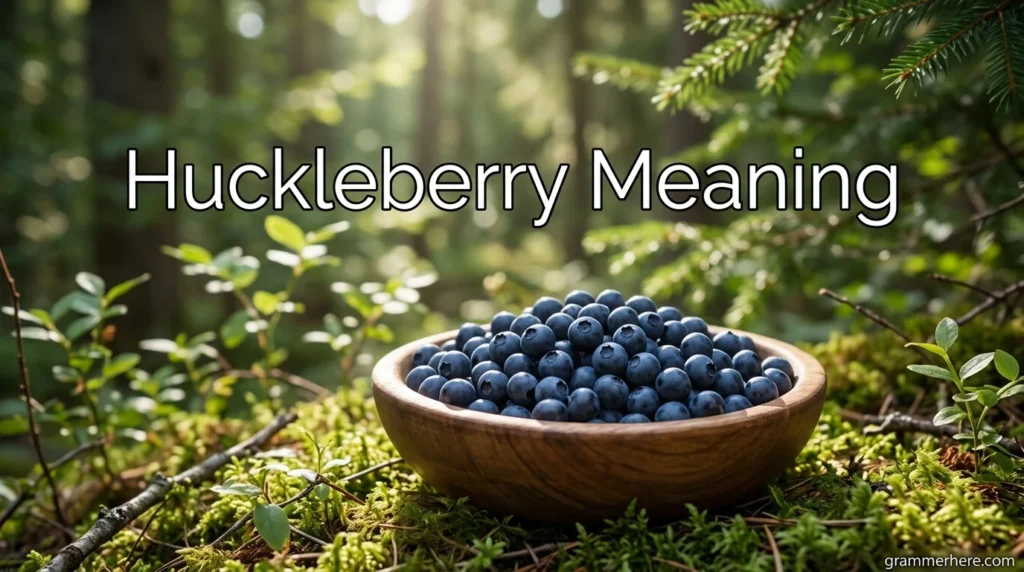
At its most basic level, a huckleberry is a small, round, edible berry that grows wild in North America and parts of Asia. It resembles a blueberry but tends to be more tart and deeply colored. These berries grow on shrubs in forests, mountains, and cool climates, often hidden among leaves.
People have traditionally picked huckleberries for food, pies, jams, and natural remedies. Because they grow in the wild rather than farms, they are often associated with nature’s untouched beauty. This simple fruit carries a sense of wilderness and purity.
However, the literal meaning is just the starting point. Like many natural words in English, “huckleberry” grew beyond its botanical identity. It began to represent personality traits, cultural ideas, and even emotional symbolism over time.
Historical Roots and Evolution of the Word
The word “huckleberry” is believed to have originated in North America during early English colonization. Some linguists suggest it may have been influenced by older English words like “hurtleberry,” which referred to similar wild berries in Europe.
As settlers moved across North America, they encountered unfamiliar plants and named them in descriptive or familiar ways. Over time, “huckleberry” became the standard term for certain wild berry species.
But language rarely stays still. By the 19th century, the word had already begun appearing in literature and folk speech. It was not just a fruit anymore—it was part of storytelling, identity, and rural life.
This evolution shows how language grows from the ground up. A simple word used to describe food eventually becomes part of cultural imagination and expression.
Huckleberry in Literature and Storytelling
One of the most famous appearances of the word is in Mark Twain’s novel The Adventures of Huckleberry Finn. The character Huck is a young boy who rejects societal rules and seeks freedom along the Mississippi River.
H3: Huck as a Symbol of Freedom
Huck represents independence, moral questioning, and natural human instinct. His name becomes symbolic of someone who doesn’t fit neatly into society’s expectations.
H3: The Name as Identity
The choice of “Huckleberry” for the character is intentional. It reflects simplicity, rural life, and innocence. Huck is not polished or refined—he is raw, honest, and shaped by experience rather than structure.
Through this character, the word gains emotional depth. It becomes associated with authenticity and unfiltered human nature.
“I’m Your Huckleberry”: A Famous Phrase Explained
Many people recognize the phrase “I’m your huckleberry” from Western films, especially when used in moments of confrontation or challenge.
At first glance, it sounds confusing. But historically, the phrase likely meant “I’m the right person for the job” or “I’m the one you’re looking for.”
H3: Meaning in Context
When someone says, “I’m your huckleberry,” they are expressing readiness, confidence, and suitability. It’s a way of saying, “If you need someone, I’m the one.”
H3: Cultural Popularity
The phrase gained popularity in Western culture and films, where it is often delivered with calm confidence before a showdown or challenge.
Today, it carries a mix of confidence, humor, and old-fashioned charm.
Emotional Symbolism of Huckleberry
Beyond literal and historical meanings, “huckleberry” has developed emotional symbolism. It often represents qualities like loyalty, simplicity, and reliability.
In relationships, calling someone a “huckleberry” (or being one) can imply that they are dependable or perfectly suited to a role.
It can also suggest emotional honesty. Just as wild berries grow naturally without cultivation, the term can symbolize natural human behavior—unforced and genuine.
This emotional layer is why the word continues to survive in modern language. It speaks to human values that remain timeless.
Huckleberry as a Symbol of Suitability and Compatibility
One of the most interesting interpretations of “huckleberry meaning” is its connection to suitability—being the right match for something or someone.
When people use it in this sense, they are talking about alignment between skill and need, or personality and situation.
H3: Everyday Examples
- A friend who always helps in tough situations might be called “a real huckleberry.”
- A person perfectly suited for a job might be described metaphorically in the same way.
H3: Life Lessons from the Idea
This interpretation teaches that not everyone fits every role—and that’s okay. The idea of being a “huckleberry” encourages people to understand where they naturally belong.
It’s about finding the right place, not forcing the wrong one.
Modern Usage and Slang Interpretations
In modern language, “huckleberry” is not widely used in everyday conversation, but it still appears in films, literature discussions, and cultural references.
Some people use it playfully to mean:
- A trusted companion
- A capable person
- A confident challenger
However, many people misunderstand it or confuse it with other slang terms. Because of its rarity, context becomes extremely important.
Despite not being common slang, it remains memorable due to its unique sound and layered meaning.
Common Misunderstandings About Huckleberry Meaning
Many people assume “huckleberry” only refers to a fruit, which is only partially correct. Others think it has a negative or insulting meaning, which is also incorrect.
Another misunderstanding comes from the phrase “I’m your huckleberry,” which some interpret as playful or random without realizing its deeper historical meaning.
H3: Clarifying the Confusion
The truth is that “huckleberry” is neutral to positive in most contexts. Its meaning depends entirely on usage:
- Literal: a wild berry
- Literary: a symbol of freedom and innocence
- Slang: suitability or confidence
Understanding context is key to avoiding misinterpretation.
Real-Life Situations Where the Meaning Applies
The concept of “huckleberry” can be applied to everyday life in subtle ways.
H3: Workplace Example
A team member who naturally steps up during crises can be seen as the “huckleberry” of the group—someone who fits the challenge perfectly.
H3: Friendship Example
In friendships, the person who always knows how to support others emotionally may embody the symbolic meaning of reliability and natural compatibility.
H3: Personal Growth Example
Sometimes, realizing you are not suited for a situation is just as important as finding where you belong. The idea of huckleberry meaning encourages self-awareness and alignment.
Personality Traits Associated with Huckleberry
Over time, the word has become associated with certain personality traits.
People described in this symbolic sense are often:
- Loyal and dependable
- Naturally confident
- Unpretentious and simple
- Adaptable to situations
- Emotionally grounded
These traits reflect the natural and unforced essence of the word itself. Like a wild berry growing freely, a “huckleberry personality” is authentic rather than artificial.
This interpretation gives the word a human dimension that goes beyond language.
Psychological and Metaphorical Interpretations
From a psychological perspective, “huckleberry meaning” can represent authenticity and self-alignment.
It reflects the idea of being in the right psychological “space”—where a person’s abilities, emotions, and environment are in harmony.
H3: Inner Alignment
When someone feels like a “huckleberry” in life, they are often:
- Comfortable in their role
- Confident in decisions
- At peace with their identity
H3: Metaphor for Life Purpose
It can also symbolize discovering purpose—finding where you naturally fit without forcing yourself into mismatched roles.
This makes the word surprisingly philosophical despite its simple origin.
Lessons We Can Learn from the Meaning of Huckleberry
The deeper meaning of huckleberry teaches several life lessons.
First, authenticity matters. Just like wild berries grow naturally, people thrive when they act in alignment with their true selves.
Second, suitability is more important than comparison. Not everyone is meant for every role, and that is not a weakness.
Finally, language carries hidden depth. Even simple words can reflect complex human experiences.
By understanding “huckleberry meaning,” we learn to appreciate both language and life in a more thoughtful way.
Conclusion
At first glance, “huckleberry” may seem like nothing more than a berry or an old-fashioned word from literature. But as we explore its meanings, it becomes clear that it carries far more depth. It represents nature, identity, emotional suitability, confidence, and even life purpose. From the wild forests where berries grow to the pages of classic novels and modern phrases, the word has traveled far and evolved continuously.
Understanding “huckleberry meaning” is ultimately about understanding how language reflects human life. It reminds us that even the simplest words can hold stories, emotions, and lessons. And sometimes, being someone’s “huckleberry” means being exactly who you are meant to be.
FAQs
1. What is the basic meaning of huckleberry?
A huckleberry is a small wild berry similar to a blueberry, often found in forests and natural landscapes.
2. What does “I’m your huckleberry” mean?
It means “I’m the right person for the job” or “I’m the one you’re looking for,” often used confidently.
3. Is huckleberry a positive word?
Yes, in most contexts it is neutral to positive, symbolizing suitability, reliability, or natural authenticity.
4. Why is Huck Finn called Huckleberry?
The name reflects simplicity, rural life, and individuality, fitting the character’s free-spirited personality.
5. Is huckleberry used in modern slang?
It is rare but still used in cultural references, often meaning a capable or suitable person.
6. What does huckleberry symbolize?
It can symbolize authenticity, freedom, natural identity, and emotional alignment.
7. Where does the word huckleberry come from?
It originated in North America and is believed to be influenced by older English berry names like “hurtleberry.”
8. Can huckleberry describe a person?
Yes, metaphorically it can describe someone dependable, well-suited, or naturally fitting for a role or situation.